Static Electricity
Electricity
Useful applications
-
Photocopiers: rely on static charge on a rotating drum to pick up powdered ink (toner) only where it is needed:
- The drum (or copying plate) is given a uniform positive charge across its whole surface
- An optical image of the page is projected onto the drum. Where the original page is white, light hits the drum and the positive charge on those areas leaks away. Where the original page is dark (text or graphics), the drum stays positively charged
- Negatively charged toner powder is dusted onto the drum; it sticks only to the areas that are still positive, copying the dark pattern of the original page
- A blank sheet of paper is rolled over the drum and the toner transfers to the paper
- The paper is briefly heated so the toner melts and bonds to the fibres, which is why photocopies come out warm
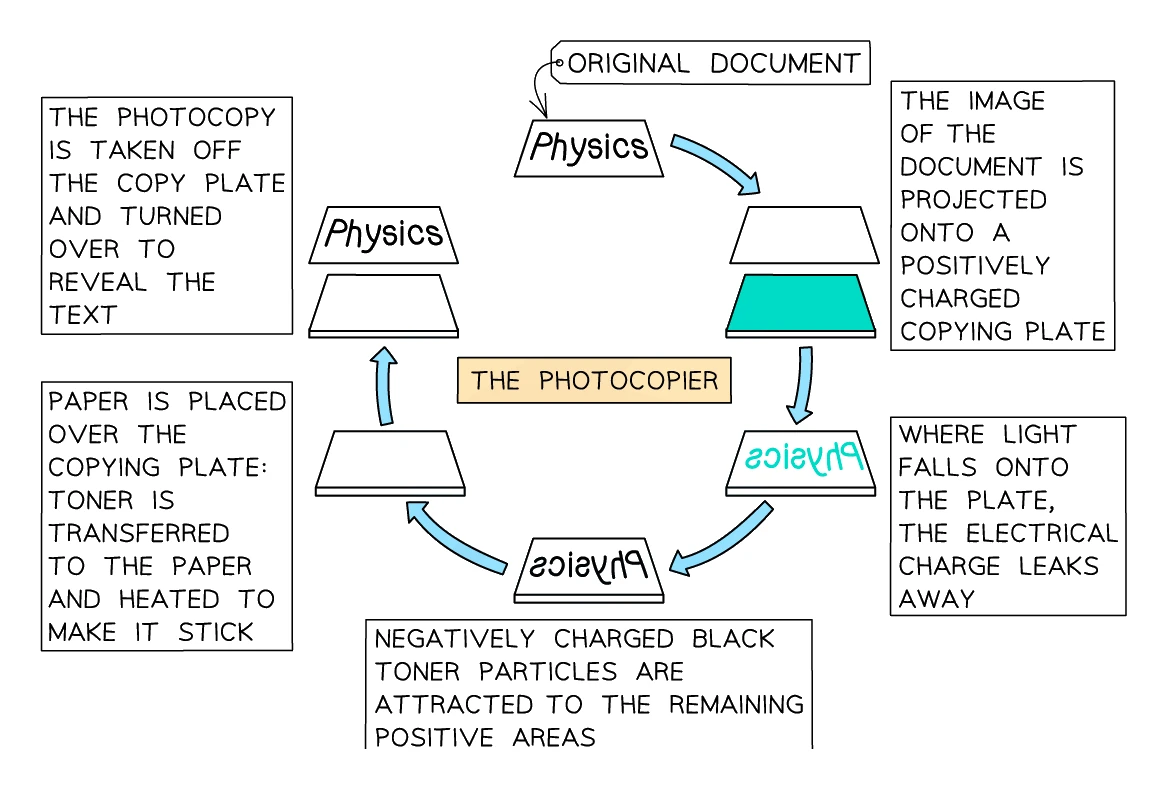
Source: Static electricity by Save My Exams -
Inkjet printers: the same idea, but each droplet of coloured ink is given a charge as it leaves the nozzle, and electrostatic deflection plates steer the droplet to the right spot on the page
-
Electrostatic insecticide sprayers: each fine droplet of insecticide is charged as it leaves the nozzle:
- all droplets carry the same sign of charge, so they repel each other and spread out into a fine even mist instead of clumping into big drops
- the droplets are also attracted to the opposite charge induced on the leaves of the crop, so they coat the underside of leaves as well as the top, wasting less of the chemical
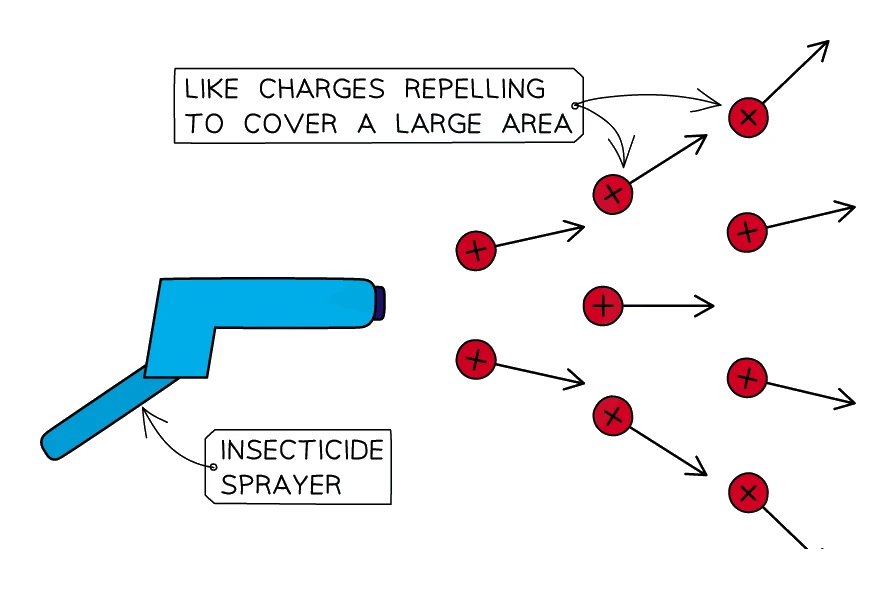
Source: Static electricity by Save My Exams -
Electrostatic spray painting of cars: the same trick applies, where paint droplets carry one sign of charge, the car body is grounded so it carries the opposite, and the paint coats every recess evenly
Sparking, a dangerous consequence
- A spark is what you see when so much charge has built up on one object that the potential difference between it and a nearby object becomes large enough to ionise the air between them. The ionised air becomes briefly conducting, the charge rushes across, and you see (and hear) a small lightning bolt
- Sparking can:
- Give an electric shock to anyone touching the charged surface (uncomfortable from a clothes-dryer; lethal in extreme cases such as a lightning strike)
- Ignite flammable vapour, since a single spark in petrol vapour, hydrogen, or fine dust can start a fire or explosion
Refuelling vehicles and the bonding wire
- Fuel running quickly through the metal pipe of a tanker rubs against the inside of the pipe; the friction transfers electrons between the fuel and the pipe and so charges the fuel
- A petrol-station fuel pump nozzle, an aeroplane refuelling tanker, or a chemical-works pipe is therefore at risk of a spark just as the fuel hits the tank, and that spark is sitting next to flammable vapour
- Two safety practices prevent this:
- The aircraft/lorry chassis is bonded to the tanker (and both to ground) with a thick copper wire called a bonding line before the fuel valves are opened. Any charge that builds up on either body now flows down this low-resistance wire to earth rather than jumping the air gap as a spark
- The fuel nozzle and pipe are made from a slightly conducting plastic or coated metal so that charge does not accumulate at the spout
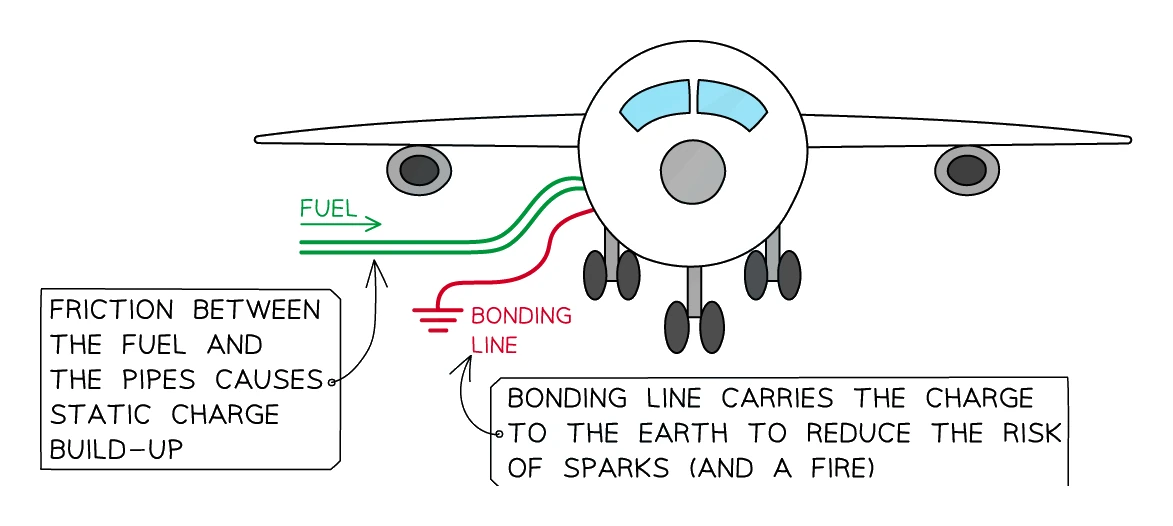
Earthing as a general safety principle
- The general rule for managing dangerous static: connect any conductor that might pick up charge to a thick, low-resistance wire that leads to earth (the ground, treated as an effectively infinite reservoir of charge)
- Examples of earthing in action:
- The earth pin in a three-pin mains plug (topic 07) discharges a faulty appliance's metal casing
- Anti-static wrist straps worn by computer technicians have a thin earth wire that lets any charge build-up on the wearer leak harmlessly to ground before it can damage delicate chips
- Lightning on tall buildings are thick copper or aluminium strips bolted from the top of the building down to a buried earth plate; if lightning strikes the building, the charge flows through the strip rather than through the building's walls
Explaining why a charged conductor discharges when earthed
What comes up: a question describes a negatively charged conductor touching or connecting to an earthed metal object, and asks why a (brief) current flows through the ammeter and then stops.
Write (two marks): (1) electrons flow through the metal towards earth; (2) the current stops once the rod is fully discharged / neutralised (no more excess electrons to move).
Watch out: the mark scheme accepts "charges" in place of "electrons" for the flow mark, but the idea of flow towards earth must be present. Simply saying "current flows" without explaining why it stops will only score one mark.