Static Electricity
Electricity
Aim
- Show that rubbing two together transfers electrons between them, leaving one with a net negative charge and the other with an equal net positive charge
- Identify which rods, when rubbed with a cloth, end up with the same sign of charge and which end up oppositely charged
Variables
- Independent variable: the material of the rod being tested (polythene, acetate, perspex, glass, ebonite, etc.)
- Dependent variable: whether the test rod attracts or repels a known, similarly charged reference rod, when both have been rubbed with the same kind of cloth
- Control variables:
- the type of cloth used (e.g. duster, silk, or woollen pad; pick one and keep it)
- the length of time spent rubbing each rod
- the length of each rod
- the room kept still and free from draughts
Apparatus
| Equipment | Purpose |
|---|---|
| Polythene rod (the reference rod) | Charged once, suspended from a cradle, used to test every other rod against |
| Test rods (acetate, perspex, glass, ebonite, dry wood) | Each one rubbed and brought near the suspended reference rod |
| Cloth (one per rod) | Used to rub the rod and so charge it |
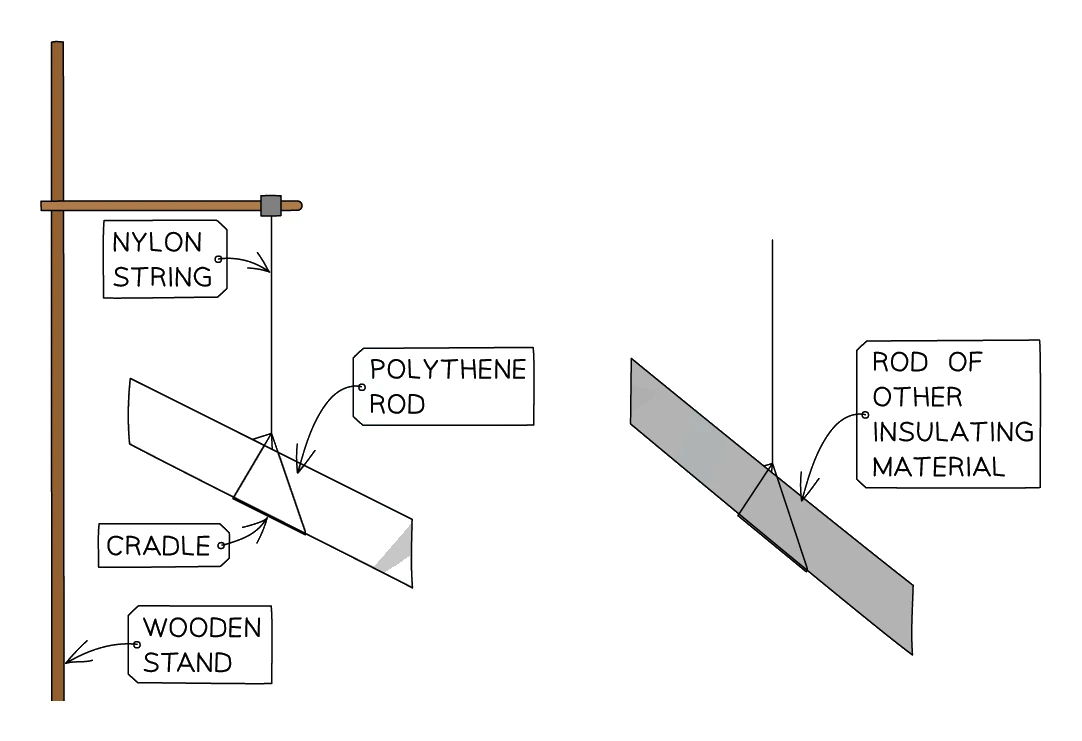
| Insulating cradle of nylon string | Hangs the polythene rod horizontally and lets it rotate freely without leaking charge away |
| Wooden retort stand | Holds the cradle clear of the bench |
Method
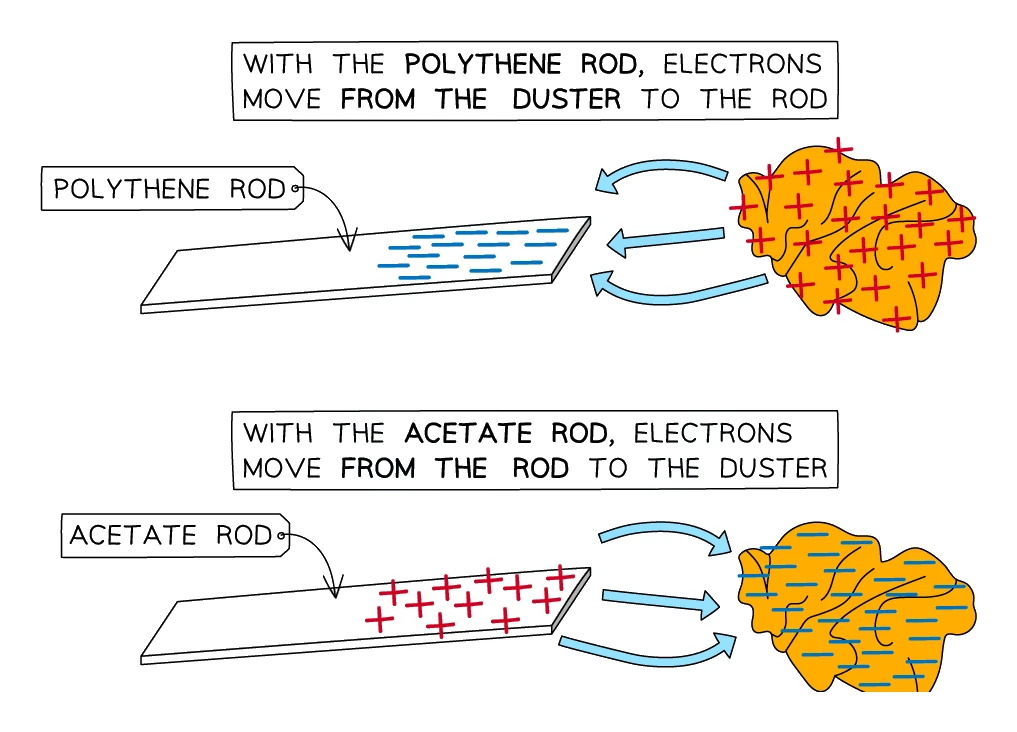
- Grip a polythene rod in the middle so your fingers cannot leak charge from the ends, and stroke both ends firmly with the chosen cloth. Polythene gains electrons from the cloth, so it ends up
- Hang the rod horizontally inside the nylon cradle from the wooden stand. Do not touch the charged ends, because your skin would let charge leak away
- Take one of the test rods and rub it with a fresh cloth in the same way
- Without making physical contact, bring one charged end of the test rod close to one end of the suspended polythene rod
- Observe whether the polythene rod rotates towards the test rod (attraction) or rotates away from it (repulsion)
- Record the observation, then repeat steps 3–5 with the other test rods
Analysis
- Charging is by . Atoms cannot lose their protons by rubbing, so when an insulator becomes charged it must be because electrons have moved from one surface to the other:
- The material that gains electrons becomes negatively charged
- The material that loses electrons becomes positively charged
- The total charge before and after rubbing is the same (charge is conserved), and the two surfaces simply end up with equal and opposite amounts of it
- Reading the results:
- If the suspended rod repels the test rod, the two rods carry the same sign of charge
- If the suspended rod attracts the test rod, the two rods carry opposite signs of charge
- Typical school-lab outcomes:
- Polythene rubbed with a duster → gains electrons, charges negative
- Acetate (or perspex) rubbed with a duster → loses electrons, charges positive
- Two polythene rods rubbed the same way repel each other; a polythene rod and a freshly rubbed acetate rod attract each other
Exam tip
Why charge builds up on plastic but not on earthed metal
A pad rubbed over a car becomes charged on the plastic panels but not on the earthed metal ones, and the explanation is three marks from four ideas: plastic is an insulator (or metal is a conductor); rubbing transfers electrons between the surfaces; the electrons stay on the plastic, which has no free electrons to carry them away; on the metal they flow through it to earth. Tie each of the last two points to its material by name. A sentence about charge staying put or flowing away that names no surface does not earn that mark.
Sources of error and improvements
- Random errors:
- Draughts in the room can swing the suspended rod by themselves; close doors and windows and let the rod settle before each test
- If the rotation is hard to see, rub the rod for longer to deposit more charge and produce a clearer deflection
- Improvement, making the experiment quantitative. Instead of just reading attract/repel, count the number of small paper discs each freshly rubbed rod can pick up from a tray; a graph or bar chart of the results then shows which rod has gained the most charge
Common exam question
Variables, anomalies and charts in a charging investigation
Question: In an investigation of how materials charge, state the independent, dependent and control variables, deal with an anomalous reading, or choose the type of graph for the results (1–2 marks each).
Set in 2 of the 24 papers. The independent variable is the material; the dependent variable is what is measured, such as the force needed to pull charged squares apart (newtonmeter or spring balance; "forcemeter" earns nothing). Control variables are everything else kept the same: rubbing or rotation time and speed, the number, size and thickness of the pieces, the temperature.
An anomalous reading sits far from the other repeats: circle it, say it should be repeated or checked, and leave it out of the mean. A mean that includes it is capped at one mark; dropping the minus sign from a negative charge costs another. Results listed by material are categoric, so name a bar chart, with that reason as the second mark; "histogram" is ignored.