Static Electricity
Electricity
Three states of charge
- A particle (or an object) can be:
- positively charged: has fewer electrons than protons
- negatively charged: has more electrons than protons
- neutral (uncharged): has the same number of electrons and protons, so the charges exactly cancel
- An ordinary atom is neutral because the number of orbiting electrons matches the number of protons in its nucleus; the equal-but-opposite charges add to zero overall
How an object becomes charged
- The only charges that can move at room temperature are electrons, since protons are locked inside the nucleus
- Two consequences follow:
- Gaining electrons leaves an object with a net negative charge
- Losing electrons leaves an object with a net positive charge
- The shortcut to remember this is the maths: subtracting a negative from zero leaves a positive
0 − (−1) = +1
Common exam question
Explaining how an object has become charged
Question: Explain how a cloth, rod or metal grid has become positively or negatively charged, or describe the difference between a neutral particle and a positively charged one (1–2 marks).
Asked in 5 of the 24 papers; the answer is always about electrons. Say that electrons are transferred and that the object which is now positive has lost electrons, while one that is negative has gained them. Saying simply that the cloth has lost electrons, or that the rod took electrons from it, earns both marks, but the electrons must have left the object that is now positive, not another part of the apparatus. A neutral particle has equal numbers of protons and electrons; a positive one has more protons than electrons because it lost some, and "it has no charge" on its own earns nothing.
Protons never move. "Gains protons" and "positive electrons" are both rejected, and the force doing the transferring is friction.
Forces between charges
- Two charged objects placed near one another exert an electric force on one another without touching, which is a non-contact force
- The direction of the force depends on the signs:
- Like charges repel (both positive, or both negative → they push apart)
- Opposite charges attract (one positive, one negative → they pull together)
- The size of the force grows as the charges are brought closer together and shrinks as they are moved apart
| Charge of object 1 | Charge of object 2 | Force is… |
|---|---|---|
| positive | positive | repulsive |
| negative | negative | repulsive |
| positive | negative | attractive |
| negative | positive | attractive |

Common exam question
Explaining why charged objects attract or repel
Question: Explain why a stream of electrons spreads out, why a charged particle accelerates between charged plates, or how two rubbed materials end up stuck together (2–3 marks).
Asked in 4 of the 24 papers. Name each object's charge, then apply the rule. Electrons are all negative, so like charges repel and the stream spreads, one mark each ("similar charge" is tolerated, "positive electrons" is not). A positive particle is attracted to the negative plate and repelled by the positive one, so a resultant force acts on it; quoting "unlike charges attract" or "like charges repel" correctly earns the first mark.
Rubbed materials that stick together take three marks from five ideas: friction; electrons transferred between them (moving protons are ignored); so they are oppositely charged; the one that gained electrons is negative; and opposite charges attract. A negatively charged film sticks to a neutral plate because it repels electrons in the plate, leaving the touching surface oppositely charged.
Why a charged object attracts a neutral one
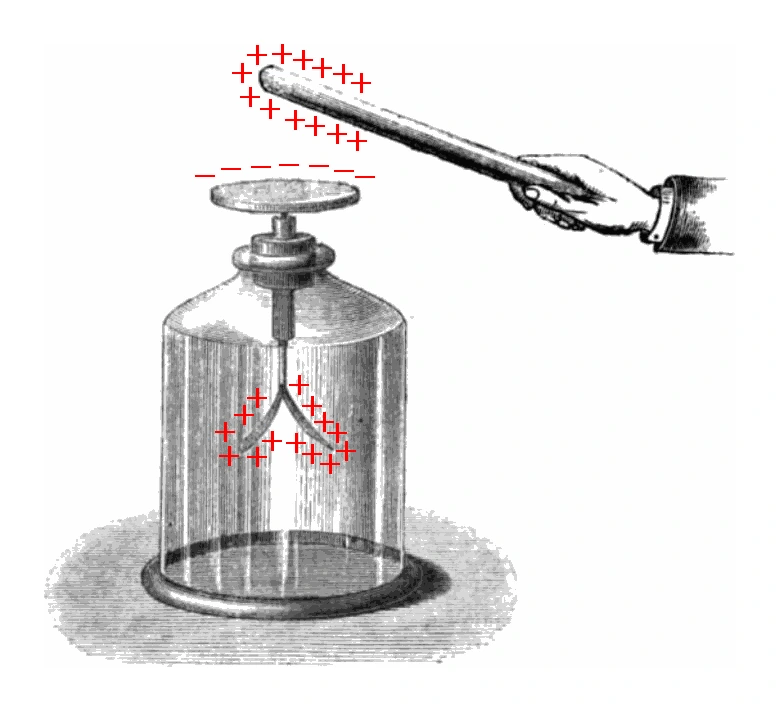
- A charged object also exerts a force on an apparently uncharged object; for example, a rubbed comb picks up small pieces of paper
- The mechanism is induced charge separation:
- Inside the neutral object, the electrons are free to shift a little, even if the object as a whole has no net charge
- When a positively charged comb is brought near, the loose electrons in the paper drift towards the comb, leaving the far side of the paper slightly positive
- The negative near-side is now closer to the comb than the positive far-side, so the attractive force on the near-side wins out and the paper is pulled in
- The same trick explains how charged balloons stick to walls, why dust clings to a television screen, and why a rubbed plastic ruler bends a thin stream of water from a tap
Common exam question
Demonstrating that an object is charged
Question: Describe an experiment that shows an object is charged, or how rubbed rods could show that there are two different types of charge (2–3 marks).
Asked in 2 of the 24 papers. For two marks, bring the object near a light, uncharged insulator (small pieces of paper, hair, a thin water stream, a balloon, a suspended rod) and say that it attracts it: attraction is the evidence. Repulsion on its own is rejected unless you use a gold-leaf electroscope, where the leaf deflecting is accepted.
Showing two types of charge takes three marks: suitable apparatus (the same objects, an electroscope or a coulombmeter); a charged rod exerting a force on it; and evidence of both behaviours, such as two charged rods moving apart while a different pair move together, or an electroscope leaf that swings one way for a positive object and the other way for a negative one. An answer that mentions magnets is rejected.