Components in Series & Parallel Circuits
Electricity
Current in Series and Parallel
Series circuits
- A series circuit is a circuit in which every component sits on the single loop that the current must travel around
- The same current flows through every component because there is only one path for the charge to take; what enters one end of the loop must come out of the other
- A break anywhere in a series circuit (a blown bulb, a loose wire, an open switch) stops the current everywhere, because there is no alternative route
Current in a series circuit is the same at every point
- An ammeter placed anywhere in a series circuit reads the same value
- The current is set by:
- the total voltage of the supply (cell or battery)
- the total resistance of all the components added together
- Increasing the supply voltage pushes more current around the loop; adding more components in series raises the total resistance and so reduces the current
Parallel circuits
- A contains two or more loops that the current can take, joined at points called
- The wires connecting two junctions are called branches; each branch carries its own share of the current
- Because each branch is independent, a break in one branch leaves the other branches still working, since only the branch with the fault loses its current
Current splits at junctions: conservation of charge
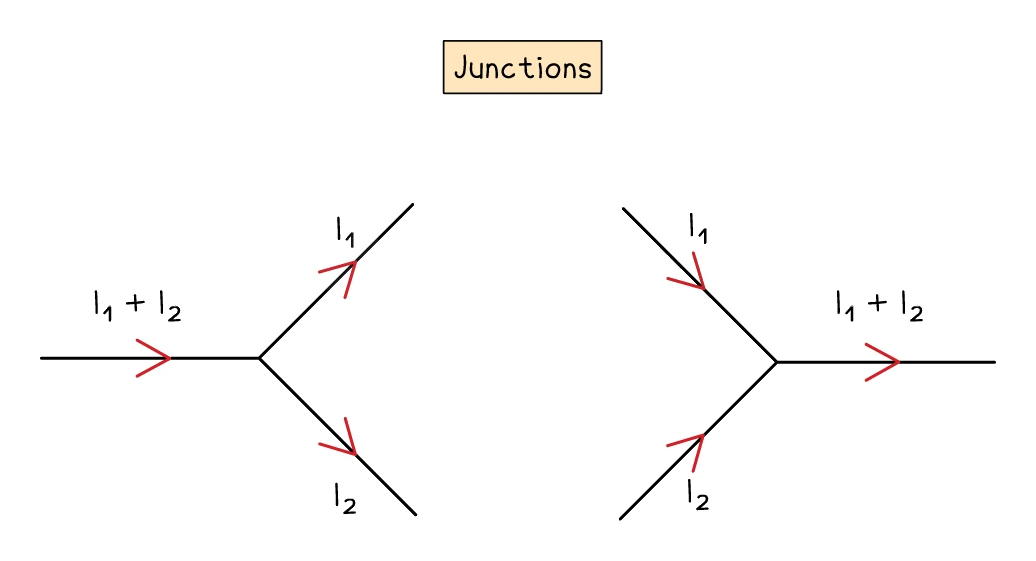
- At any junction, whatever current arrives must also depart, so the sum of branch currents in equals the sum of branch currents out
- This is a direct consequence of conservation of charge: charge can be neither created nor destroyed, so whatever flows in must flow out
- The split between branches is not necessarily equal, because branches with lower resistance carry more current and branches with higher resistance carry less. The two are only equal when the branches have identical resistance
Common exam question
Finding currents at a junction in a parallel circuit
Question: Calculate the current in the battery (or the supply) of a parallel circuit from the branch currents shown, or find a missing branch current (1–2 marks).
The supply current is the sum of the currents in the branches that are switched on, and a missing branch current is the supply current minus the other branches. Set in 4 of the 24 papers. Where there are two marks, one is for showing the addition and one for the value; one scheme accepts the answer in amps as well as in milliamps, so convert only when the question names a unit.
Read the switches before you add: in one paper a branch whose switch was open had to be left out, and adding all three currents earned one mark of the two. The current in the wire returning to the battery equals the current leaving it, so a label on the return wire is just the supply current.