Components in Series & Parallel Circuits
Electricity
Voltage in series
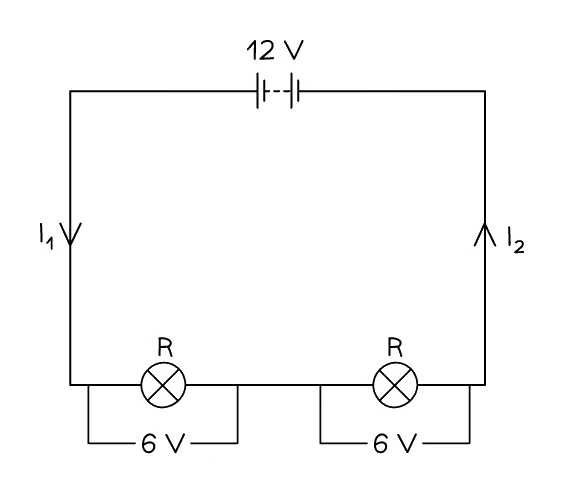
- The total voltage of the supply is shared between the components in a series loop:
V_supply = V₁ + V₂ + V₃ + …
- The share that each component takes is set by its resistance:
- Two identical components in series each take half the supply voltage
- A component with higher resistance takes the larger share of the supply voltage
- A component with lower resistance takes the smaller share
- This is why a high-resistance bulb in series with a low-resistance wire glows brightly while the wire stays cool: the bulb is dissipating most of the supply's energy because most of the voltage is dropped across it
Common exam question
Voltage across one component in a series circuit
Question: Calculate the voltage across one component in a series circuit from the supply voltage and the voltage across the other component, or explain how it changes when a resistance changes (2–4 marks).
The supply voltage is shared, so the voltage across the component is the supply voltage minus the voltage across the other component: in the two-mark version that idea is the first mark and the subtraction the second. Set in 4 of the 24 papers. When the question goes on to V = IR, use the component's own voltage: a current from the full cell voltage scored at most two marks of four. Run backwards, the supply voltage is the sum of the two component voltages.
For the explain version, write the chain: the component's resistance rises, so the total resistance rises and the current falls; the voltage across the fixed resistor falls, so the voltage across the changed component rises, because the total voltage is constant.
Voltage on parallel branches
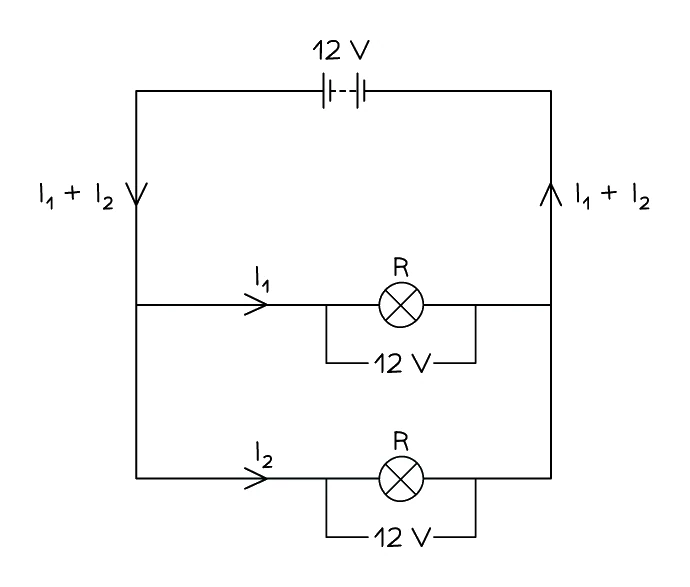
- Every parallel branch sits between the same two junction points; the voltage across one branch therefore matches the voltage across any other branch, and both equal the supply voltage:
V_supply = V_branch1 = V_branch2 = …
- This is because the two ends of every branch are joined to the same two points (the two junctions), and the potential difference between two fixed points is one number whatever route you take between them
- A consequence: any single branch in a parallel circuit will run at its normal "rated" voltage if it is rated to match the supply; this is why household appliances are wired in parallel
Common exam question
Voltage across a parallel branch
Question: State the voltage across one component in a parallel circuit, or explain how it compares with the voltage across the cell (1–2 marks).
Every branch sits across the full supply voltage, so the voltage across the component equals the cell voltage: give the number. In the two-mark version the second mark is for the reason, that the components are in parallel. Set in 2 of the 24 papers. Once you have calculated the voltage across one of two parallel resistors, the voltage across the other is the same value, and a slip in the first part is carried forward.
Never write that the cell's voltage is shared between the branches: sharing is the series rule, and one scheme rejects it outright. The same fact is credited elsewhere: every lamp gets the full voltage when you explain parallel lighting, and every lamp has the same voltage when you explain which lamp is brightest.
Advantages and disadvantages of each wiring
| Feature | Series circuit | Parallel circuit |
|---|---|---|
| Controlling all components together | Yes, one switch acts on every component | Possible, but each branch usually has its own switch as well |
| Controlling components separately | No, they share one current path | Yes, each branch has its own switch |
| Effect of one broken component | All others stop working | Only that branch stops; the others carry on |
| Wiring complexity | Simple, fewer wires needed | More complex, more wires and junctions |
| Voltage across each component | Shares the supply voltage; depends on resistance | Each branch gets the full supply voltage |
Common exam question
Advantages of parallel or series wiring
Question: Explain an advantage of using a parallel circuit for domestic lighting, or give an advantage and a disadvantage of connecting bulbs in series (1–2 marks).
For parallel lighting, one mark is for the advantage and one for linking it to the circuit. Advantages credited: the lamps can be switched on and off independently, if one lamp fails the rest stay lit, and every lamp gets the full mains voltage. The link is that it is a parallel circuit, with the lamps on separate branches; a bare advantage with no mention of parallel branches loses the second mark. Set in 2 of the 24 papers.
For bulbs in series, the disadvantage is that if one bulb fails they all go off, or that they cannot be controlled individually. Accepted advantages: a simpler circuit with fewer wires, one switch controls them all, each bulb needs only a lower voltage, and the circuit is less likely to overheat.