Components in Series & Parallel Circuits
Electricity
Thermistors
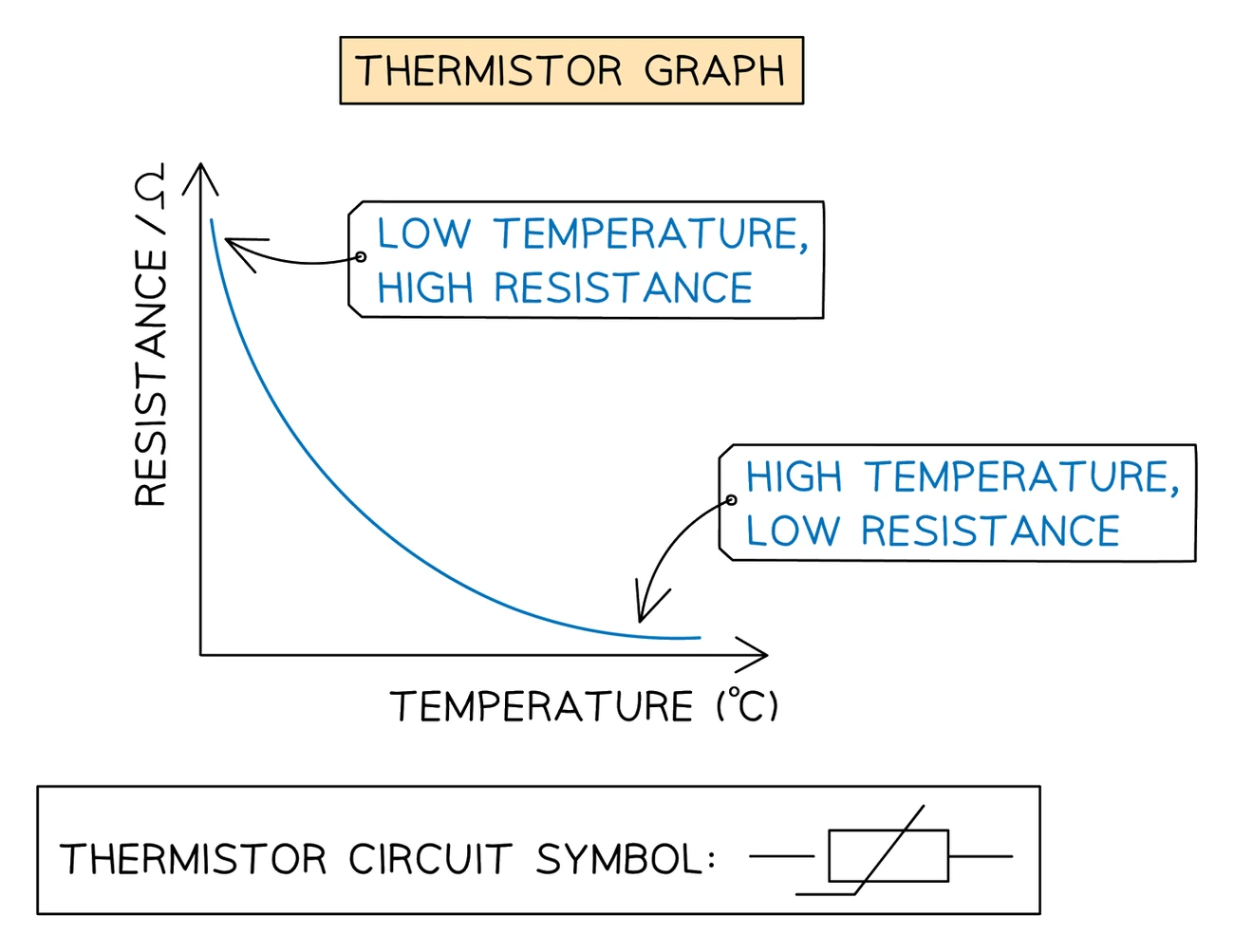
- A thermistor is a resistor whose resistance changes with temperature
- The standard schoolroom thermistor is a negative-temperature-coefficient (NTC) thermistor:
- resistance is high in cold conditions
- resistance is low in hot conditions
- The relationship is non-linear; a graph of resistance against temperature falls steeply at low temperatures and then levels off at high ones
- Uses include thermostats for ovens, fridges and central-heating systems; fire alarms; and temperature sensors in electronics
Light-dependent resistors (LDRs)
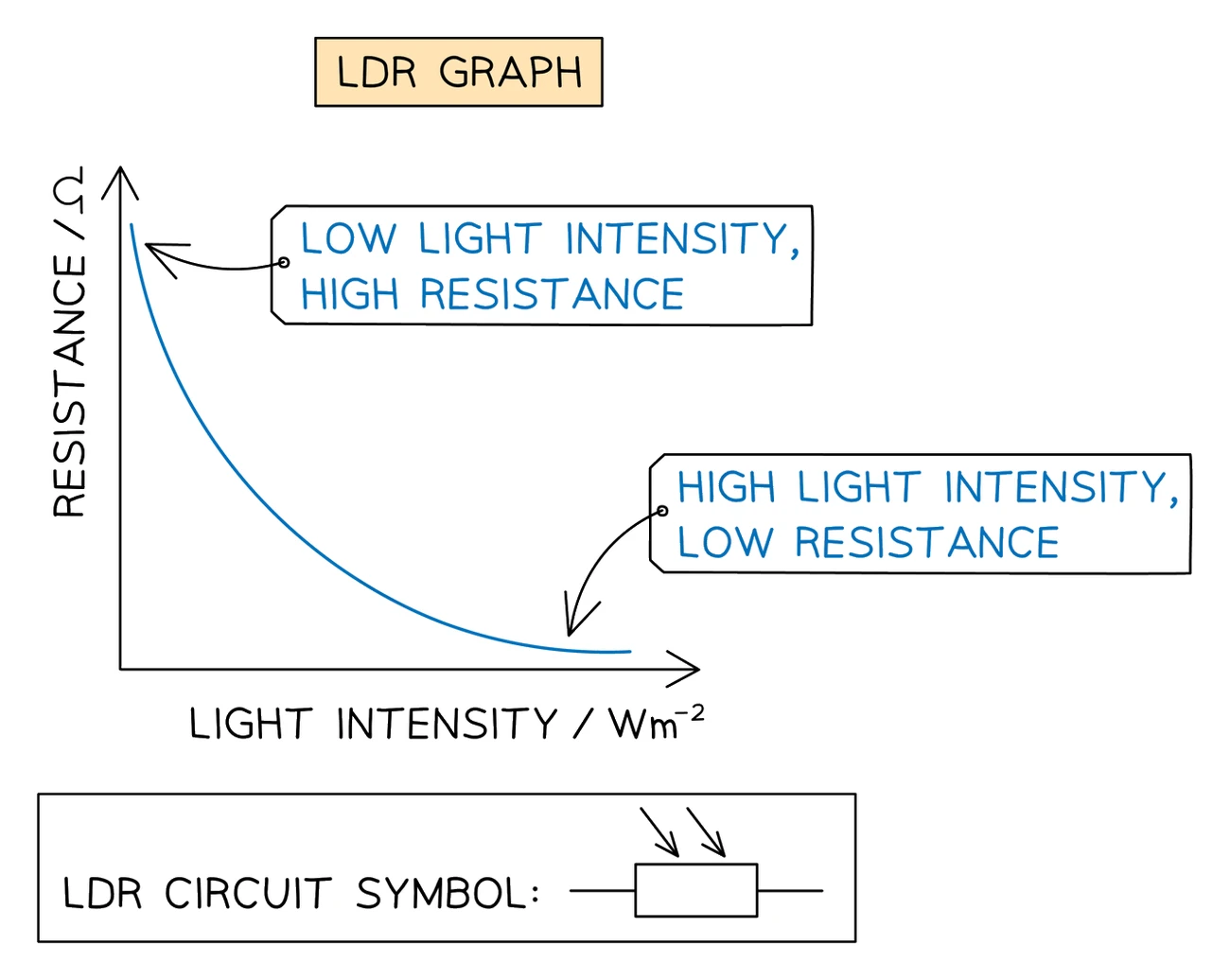
- A light-dependent resistor (LDR) is a resistor whose resistance changes with the light intensity falling on it:
- resistance is high in dark conditions
- resistance is low in bright conditions
- The relationship is again non-linear; a graph of resistance against light intensity falls steeply as the light first grows brighter and then levels off
- Uses include automatic street lamps that switch on at dusk, dawn-detection circuits in alarm clocks, and the light meters in cameras
Common exam question
Explaining the effect of a change in light or temperature
Question: Explain what happens to the brightness of a lamp, or to a voltmeter reading, when an LDR in the circuit is covered or the room containing a thermistor cools (2–3 marks).
Start with the component: covering an LDR, or cooling a thermistor, increases its resistance; the resistance of the circuit therefore rises, so the current falls; so the lamp is dimmer, or a voltmeter across the fixed resistor reads less (one across the thermistor or LDR would read more). State the change and give the chain, because each step is a mark. Set in 2 of the 24 papers. Explaining a dimmer lamp by the paper covering the lamp itself is rejected.
Asked to describe the thermistor's graph, say its resistance decreases as temperature increases and that the relationship is non-linear; "inversely proportional" earns both marks. An unnamed component whose resistance falls as the light gets brighter is a light-dependent resistor.
Lamps and light-emitting diodes (LEDs)
- A filament lamp lights up when current flows through it, because the filament heats up enough to glow white-hot. Lamps are non-ohmic (their resistance climbs as they get hot) but they conduct current in either direction
- A light-emitting diode (LED) is a special kind of diode that emits light when current flows through it in forward bias
- Like any diode, an LED conducts in one direction only; mounted backwards in a circuit, it simply does not light up
- LEDs are widely used as indicator lights because they need very little current to be visibly on, last for years and produce very little heat
- An LED's standard symbol is a diode triangle with two small arrows pointing outwards, meaning light leaves the device. The LDR's symbol carries two small arrows pointing inwards, meaning light is arriving at the resistor
Common exam question
Using an LED to show that a current is flowing
Question: Give a reason why an LED is included in a circuit, draw an LED that will indicate when there is a current in one particular component, or explain why an LED on an a.c. supply flashes (1–2 marks).
The reason is that the LED shows a current is present (for example that a fuse is still intact): one mark. To indicate the current in one component, draw the LED in the branch that contains only that component (one mark) and the right way round, arrowhead pointing the way the conventional current flows (second mark); an LED in the main part of the circuit would light whenever any branch carried a current. Asked in 3 of the 24 papers.
On an a.c. supply the current keeps changing direction, and an LED conducts in one direction only, so it is unlit during each reverse half-cycle: that is why it flashes.