4PH1
Components in Series & Parallel Circuits
Electricity
Adding resistors in series
- Place several resistors one after the other on the same loop and their total resistance is found by adding the individual resistances together:
R_total = R₁ + R₂ + R₃ + …
- Adding another resistor in series makes the loop harder for charge to flow through, so the total current falls (for a fixed supply voltage)
- The total voltage from the supply is shared across the resistors in the same ratio as their resistances: a bigger resistor takes a bigger fraction of the voltage
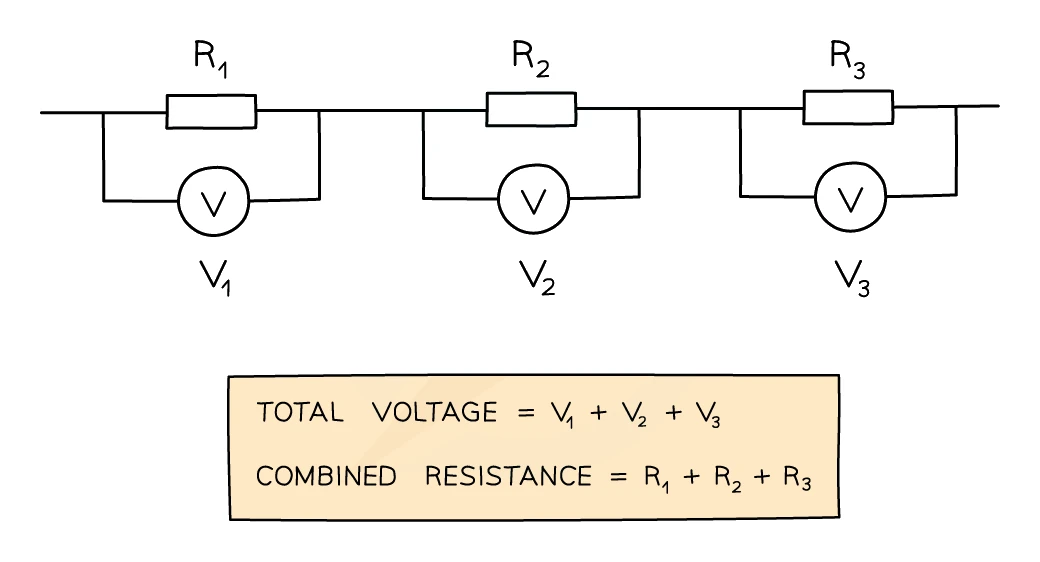
Quick rules to recall
- For components in series:
- current is the same at every point in the loop
- the supply voltage is shared between components, in proportion to their resistances
- the total resistance is the sum of the individual resistances
- For components in parallel:
- the supply current splits between the branches and recombines at junctions
- every branch carries the full supply voltage
- the total resistance is less than the smallest individual branch resistance (a second branch always offers an extra path for charge, lowering overall resistance)
Worked example
Calculating total resistance and current in a series circuit
A 9 V battery is connected in series with two resistors: one of 20 Ω and one of 25 Ω. Calculate the total resistance of the circuit and the current flowing through it.
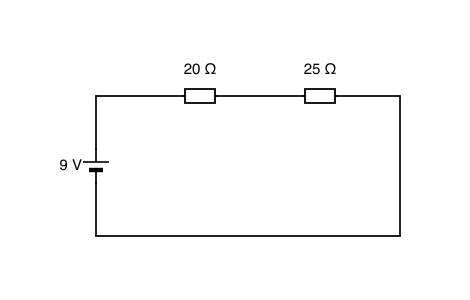
Solution:
- Total resistance: R_total = R₁ + R₂ = 20 + 25 = 45 Ω
- Rearrange V = IR to give I = V / R
- I = 9 / 45 = 0.20 A