Components in Series & Parallel Circuits
Electricity
What an I-V graph shows
- An I-V graph plots the current through a component (y-axis) against the voltage across it (x-axis), with the voltage varied from negative through zero to positive
- The shape of the line tells you how the component's resistance changes with the voltage applied:
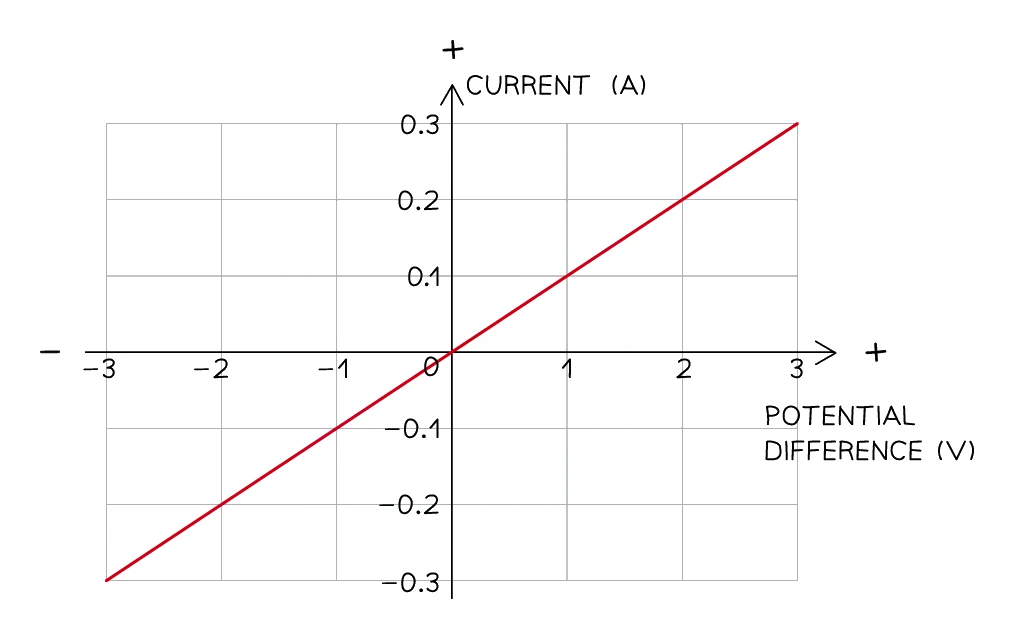
- A straight line through the origin means the current is directly proportional to the voltage. The resistance is constant (this is ohmic behaviour)
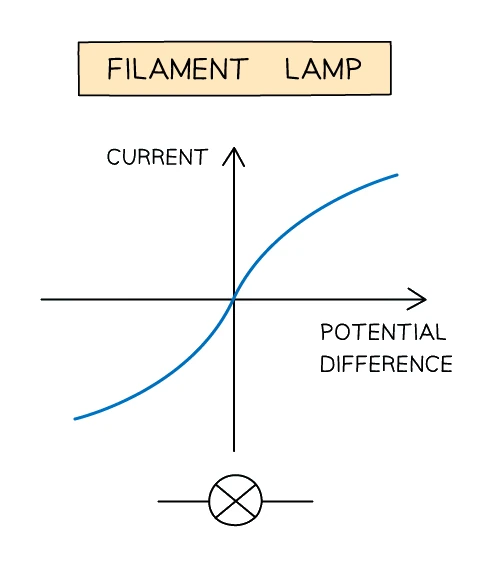
- A curved line through the origin means the current is not directly proportional to the voltage. The resistance is variable (this is non-ohmic behaviour)
- The resistance at any point on an I-V graph is given by R = V / I, not by the gradient. (For an ohmic conductor R = 1/gradient because the line is straight, but in general the V/I ratio at each point is what matters.)
Common exam question
Using an I-V graph to find a resistance
Question: Use the current-voltage graph to determine the resistance of the component when the voltage across it is a given value (3–5 marks).
Read the current at that voltage off the curve (a reading within a small tolerance is accepted), then put it with the voltage into V = IR and rearrange. The three-mark version credits the substitution, the rearrangement (R = V/I seen anywhere earns it) and the evaluation; the five-mark version credits the equation, the reading, the substitution or rearrangement, the evaluation and a matching unit. Set in 2 of the 24 papers. The resistance is the ratio V/I at that point, not the gradient of the curve.
When the current axis is in milliamps, convert to amps (or give the answer in kilohms): a power-of-ten slip costs a mark, and the unit you write must match the number. For comparison, a fixed resistor's line is straight through the origin, and doubling the resistance halves the gradient.
I-V graph for a fixed resistor (or a metal wire at constant temperature)
- A straight line through the origin, because current and voltage are directly proportional, in both polarities
- The slope is the same everywhere, so the resistance is the same everywhere; fixed resistors and wires at a steady temperature are ohmic conductors
I-V graph for a filament lamp
- The curve passes through the origin, but it flattens off as the voltage and current grow; the same shape appears in reverse on the negative side
- A flatter slope corresponds to a higher resistance (because R = V / I and V grows faster than I)
- The physics: a larger current heats the filament; the metal ions then vibrate more vigorously, scattering the drifting electrons more often, so the resistance climbs
- A filament lamp is therefore a non-ohmic component, because its resistance is not constant across its working range
Common exam question
Why a filament lamp's I-V graph is a curve
Question: Describe the relationship shown by a filament lamp's current-voltage graph, or explain why the current is not proportional to the voltage (2 marks).
For describe: the current increases as the voltage increases (one mark), and the relationship is non-linear, the gradient decreasing so that the current rises ever more slowly (second mark). Calling it proportional forfeits that second mark. Asked in 3 of the 24 papers.
For explain, any two of three ideas score: the current heats the filament; its resistance increases with temperature; so for the same voltage the current is lower, which is what bends the graph. "Lamp" is condoned for "filament", but "it heats up" alone is one idea, not two. A straight line through the origin means the component is a resistor (an ohmic conductor), not a lamp, unless the lamp has not yet warmed enough for its graph to curve. "It does not obey Ohm's law" is not one of the three ideas, although the phrase does score when a question asks whether a straight-line graph could belong to a lamp.
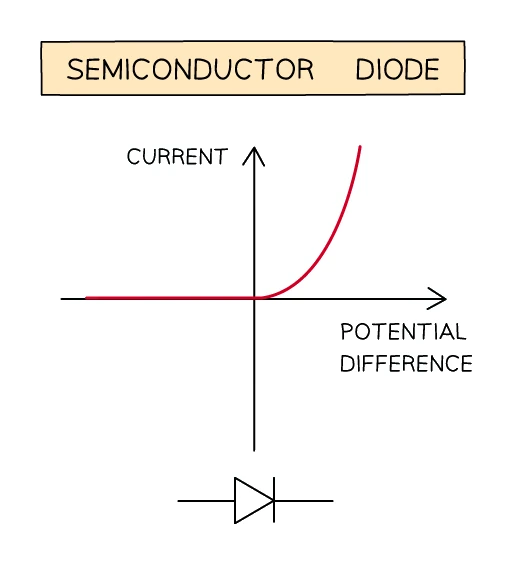
I-V graph for a semiconductor diode
- The diode is a one-way conductor: it lets current pass in the direction of its arrowhead symbol only, which is called forward bias
- In forward bias, almost no current flows until the voltage exceeds about 0.6–0.7 V; past that threshold, the current climbs very sharply with very little extra voltage. The resistance is effectively infinite below the threshold and very small above it
- In reverse bias, no current flows at all (over the normal operating range); the diode's resistance is enormous
- The I-V graph therefore sits flat on the V axis for negative V, hugs the V axis from 0 to about 0.6 V, then rises almost vertically
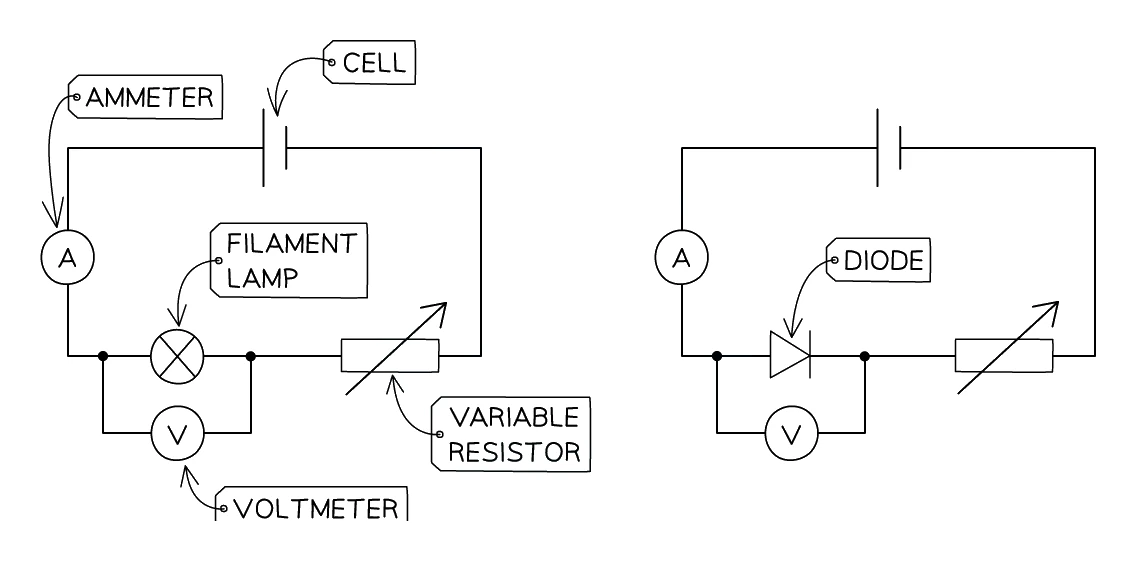
Investigating an I-V curve in the lab
- Apparatus:
- the component under test (resistor, filament lamp or diode)
- an ammeter wired in series with the component to read the current through it
- a voltmeter wired in parallel across the component to read the voltage across it
- a variable resistor in series with the component to vary the current
- a cell or low-voltage supply
- Method:
- Build the circuit and set the variable resistor to its highest resistance (so the initial current is small)
- Record the voltmeter and ammeter readings
- Reduce the resistance of the variable resistor by a small step; record V and I again
- Repeat until a wide range of voltages has been swept (do not exceed the rated voltage of the component, or it may burn out)
- To capture the negative side of the curve, reverse the cell's connections and repeat
- Plot I against V with the recorded data points and join them with a smooth curve
Common exam question
Drawing the circuit for a current-voltage investigation
Question: Draw, complete or describe a circuit a student could use to investigate how the current in a component varies with the voltage across it, usually from a list of equipment (3–4 marks).
The four marks: correct symbols in a complete circuit; the variable resistor in series with the component (a variable power supply or potential divider is accepted); the ammeter in series with it; the voltmeter in parallel across the component only. Asked in 7 of the 24 papers. A voltmeter across the variable resistor and the component together is rejected, an imperfect but identifiable meter symbol is condoned, and a thermistor or LDR offered as the means of variation is ignored.
Asked to describe the method instead, say what you measure (current and voltage), how you vary it (adjust the variable resistor), that you repeat and average each reading, and that you switch off between readings so the component does not heat up.