MathematicsExam code: 0580
Further Graphs and Tangents
Coordinate Geometry and Graphs
The families you must know
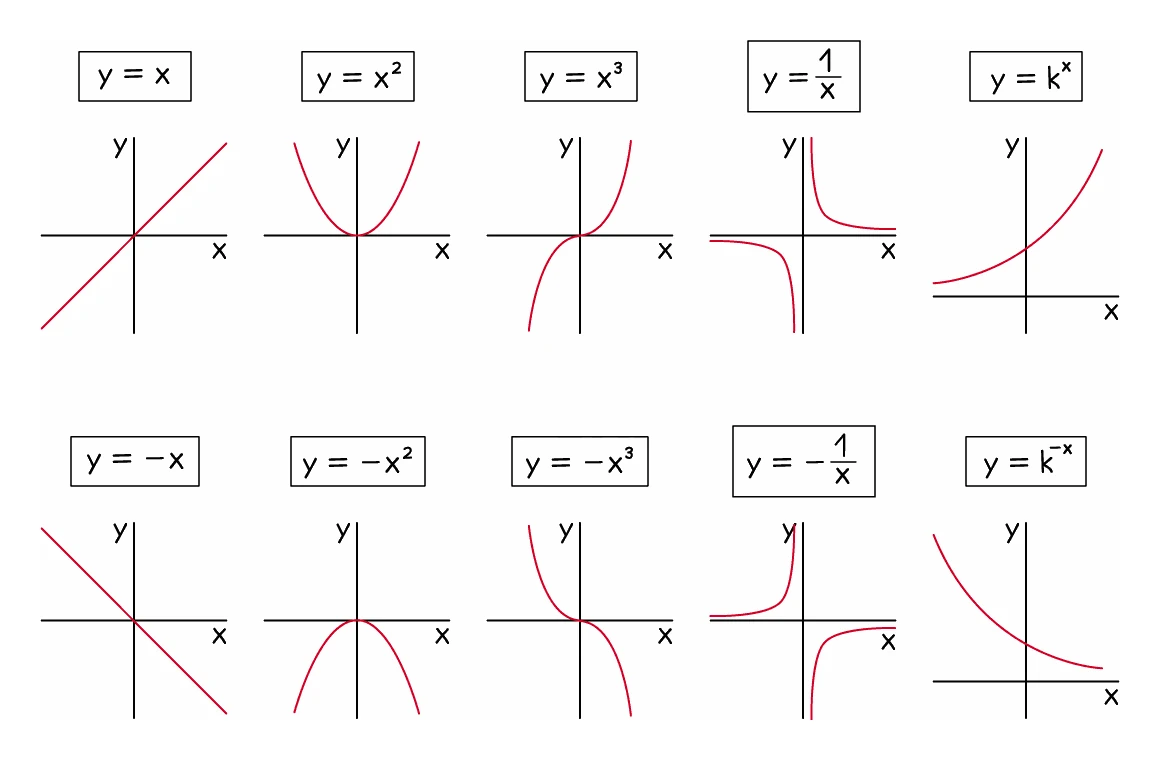
- Being able to match an equation to the right picture saves plotting and catches plotting errors
- Linear, written y = mx + c, or equivalently as ax + by = c, is a straight line
- Quadratic, written y = ax² + bx + c, is a single u-shape or n-shape with one turning point
- Reciprocal, written y = a ÷ x or y = a ÷ x + b, is two separate branches that never meet the y-axis, and y = a ÷ x never meets the x-axis either
- Cubic, written y = ax³ + b or y = ax³ + bx² + cx, has a long S-like sweep and can turn twice
- Exponential, written y = akˣ + b with x in the power, climbs or falls ever more sharply and flattens towards a horizontal line
- The sign of the leading number reflects each shape vertically, so a negative cubic falls where a positive one rises
Fractional powers
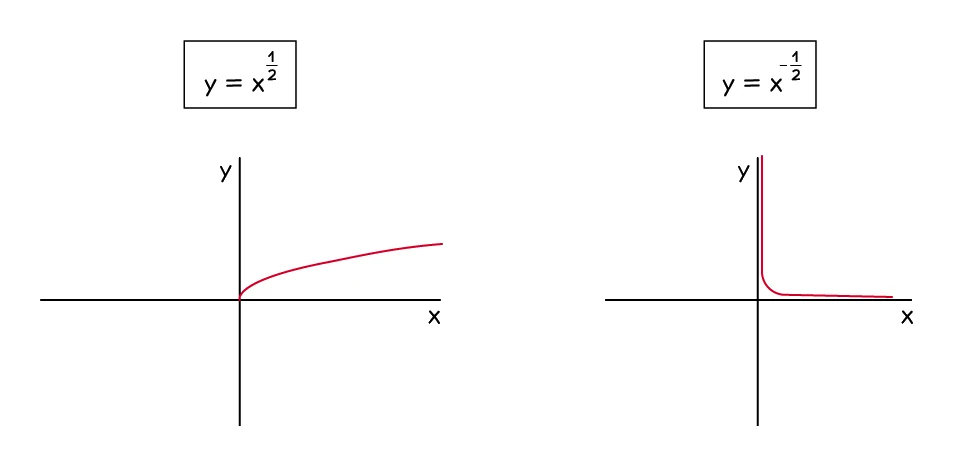
- Two further shapes appear because this specification allows powers of ½ and −½
- The power ½ gives y = √x, a curve that starts at the origin and rises ever more gently
- The power −½ gives y = 1 ÷ √x, a curve that drops steeply away from the y-axis and flattens towards the x-axis
- Neither exists for negative x, so both curves live entirely to the right of the y-axis
Worked example
Matching an equation to its shape
Say what shape each of these graphs has: (a) y = 2x + 3 (b) y = x² − 4 (c) y = 6/x (d) y = 3ˣ
Solution:
- Read the highest power of x first, because that is what fixes the family
- (a) The highest power is 1, so it is a straight line, sloping up with gradient 2
- (b) The highest power is 2, so it is a parabola, u-shaped because the number in front of x² is positive
- (c) x is on the bottom of a fraction, so it is a reciprocal graph: two separate branches, one in each of two opposite quadrants
- (d) x is in the index, not the base, so it is an exponential graph: it never touches the x-axis and climbs ever more steeply
- The difference between (b) and (d) is exactly which position x occupies, and reading y = 3ˣ as a cubic is the standard slip
Worked example
Where a cubic meets the axes
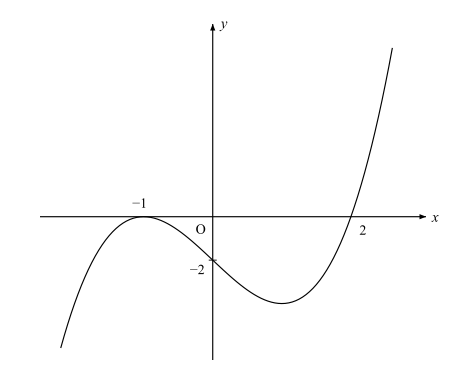
(a) Sketch the graph of y = (x − 2)(x + 1)², showing the values where it meets the axes.
(b) Find the exact x-coordinates of the three points where the graph of y = x³ − 6x crosses the x-axis.
Solution:
- (a) y = 0 when a factor is zero: x − 2 = 0 gives x = 2, and x + 1 = 0 gives x = −1
- The factor (x + 1) is squared, so x = −1 is a repeated root: the curve touches the x-axis there and turns back instead of crossing it
- At x = 0, y = (0 − 2) × (0 + 1)² = −2, so the curve cuts the y-axis at (0, −2)
- Multiplied out, the first term is +x³, so this is a positive cubic: it rises from the bottom left and leaves at the top right
- So the curve climbs to touch the axis at (−1, 0), falls through (0, −2) to a minimum, then rises to cross the axis at (2, 0)
- Label −1 and 2 on the x-axis and −2 on the y-axis
- (b) Take out the common factor x: x³ − 6x = x(x² − 6) = 0
- Either x = 0, or x² = 6, which gives x = √6 or x = −√6
- The crossing points have x-coordinates −√6, 0 and √6, left exact as the question asks