MathematicsExam code: 0580
Differentiation
Coordinate Geometry and Graphs
The Gradient Function
What differentiating produces
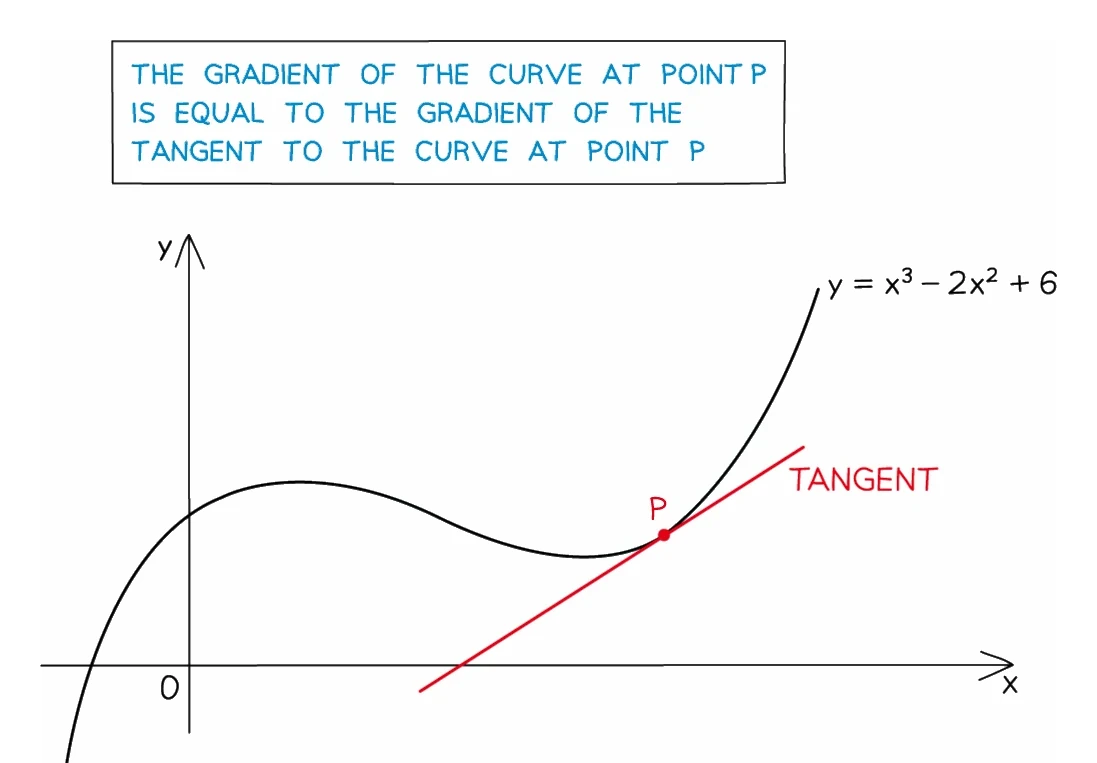
- A straight line has one gradient, but a curve is steeper in some places than others, so its gradient depends on where you are
- Differentiating turns the equation of a curve into a second equation that gives the gradient at any point
- That second equation is the gradient function, also called the derivative, and it is written dy/dx
- Substituting an x value into dy/dx returns the gradient of the curve there, and the y value is never needed
- Drawing a tangent and measuring it estimates the same number; differentiating gives it exactly
- Write "y =" in front of the curve and "dy/dx =" in front of the derivative every time, so the two never get confused
The rule
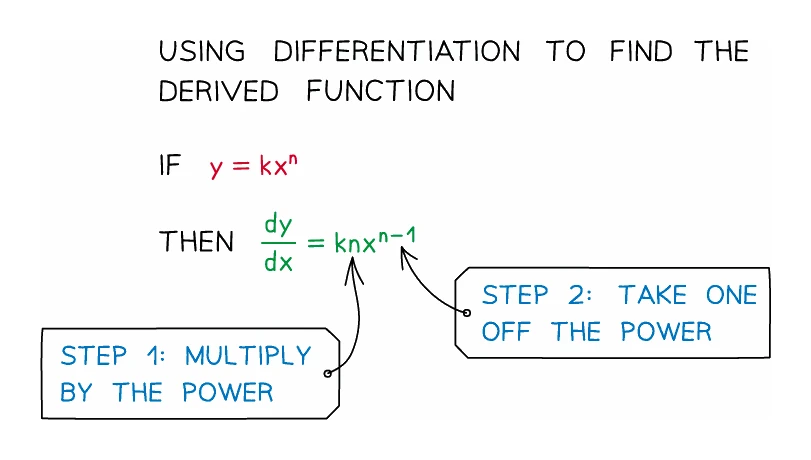
- Differentiating a power of x means multiplying by that power, then knocking one off it
- x⁶ differentiates to 6x⁵
- 3x⁴ differentiates to 12x³
- In general, kxⁿ differentiates to knxⁿ⁻¹
- Two cases look different but follow the same rule
- A term in x alone loses its x: 7x differentiates to 7, which matches the gradient of the line y = 7x
- A number on its own differentiates to 0, which matches the gradient of a horizontal line
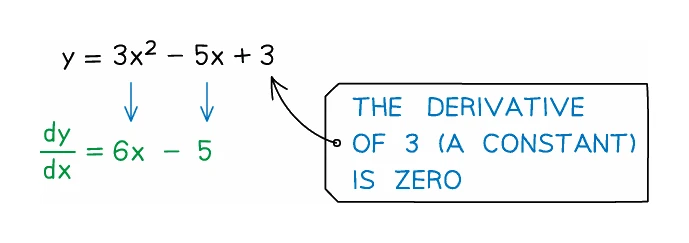
- Differentiate a sum term by term, taking each one separately and keeping the signs between them
- This specification only asks for powers of x that are positive whole numbers or zero, and for sums of at most three such terms
Worked example
Differentiating and using the result
A curve has equation y = 4x³ + 7x − 2. Find dy/dx, and hence the gradient of the curve where x = 2.
Solution:
- Differentiating turns the equation of a curve into its gradient function, which gives the gradient at any point rather than one fixed number
- The rule is to multiply by the power and then reduce the power by one, applied to each term separately
- 4x³: multiply by 3 and drop the power to 2, giving 12x²
- 7x is 7x¹: multiply by 1 and drop the power to 0, and x⁰ = 1, so it gives 7
- −2 is a constant with no x at all, so it differentiates to 0: a constant shifts the curve up or down without changing its steepness
- So dy/dx = 12x² + 7
- The gradient at a point comes from substituting that x into the derivative, not into the curve
- At x = 2: 12 × 2² + 7 = 48 + 7 = 55
Worked example
Finding unknown powers and coefficients
A curve has equation y = axⁿ + 4x³ − 9, and its gradient function is dy/dx = 35x⁶ + bx². Find the values of a, n and b.
Solution:
- Differentiate the curve term by term, keeping the letters: axⁿ gives naxⁿ⁻¹, 4x³ gives 12x², and −9 gives 0
- So dy/dx = naxⁿ⁻¹ + 12x², which must match 35x⁶ + bx² term by term
- Find the power first, because the number in front is a × n and cannot be split until n is known
- Powers: n − 1 = 6, so n = 7
- Numbers in front: na = 35, so 7a = 35 and a = 5
- The x² terms: b = 12
- a = 5, n = 7 and b = 12
- Check: y = 5x⁷ + 4x³ − 9 differentiates to 35x⁶ + 12x², as given
Working backwards from a gradient
- A question may give a gradient and ask where the curve has it
- Set dy/dx equal to that number and solve the equation, which is usually a quadratic
- Each solution is an x value, so put it back into the curve's own equation to obtain the matching y
- Take care to read which side the number sits on: making the derivative equal 5 is a different instruction from replacing x by 5