MathematicsExam code: 0580
Differentiation
Coordinate Geometry and Graphs
Turning a problem into a curve
- A question may ask for the largest or smallest value a quantity can take, and the turning point gives it
- The quantity must first be written as an equation in one letter only
- Where two letters appear, the question always supplies a second fact linking them, so rearrange that and substitute
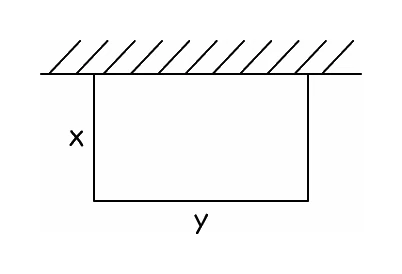
- Then differentiate, set the derivative to zero, and solve to find the value of the letter
- Substitute that value back into the original formula, because the question asks for the quantity, not for the letter
- Other letters work the same way, so a formula for A in terms of t differentiates to dA/dt
- To justify that the answer is a maximum, name the shape: a negative quadratic can only turn at a maximum
Worked example
The largest rectangle from a fixed length
A piece of wire 36 cm long is bent to form a rectangle. Find the greatest possible area.
Solution:
- Let one side be x cm, so the two sides of that length use 2x cm of wire
- The remaining wire is 36 − 2x cm, shared between the other two sides, so each is 18 − x cm
- Area A = x(18 − x), which expands to A = 18x − x²
- Differentiate: dA/dx = 18 − 2x
- Set it to zero: 18 − 2x = 0, so x = 9
- Substitute back into the formula for A: A = 18 × 9 − 81 = 162 − 81
- The greatest area is 81 cm²
- A = 18x − x² is a negative quadratic, so its only turning point is a maximum
- The rectangle turns out to be a 9 cm square, and its perimeter checks as 2(9 + 9) = 36