MathematicsExam code: 0580
Differentiation
Coordinate Geometry and Graphs
Where the gradient is zero
- At the very top or the very bottom of a curve the tangent is horizontal, so the gradient there is zero
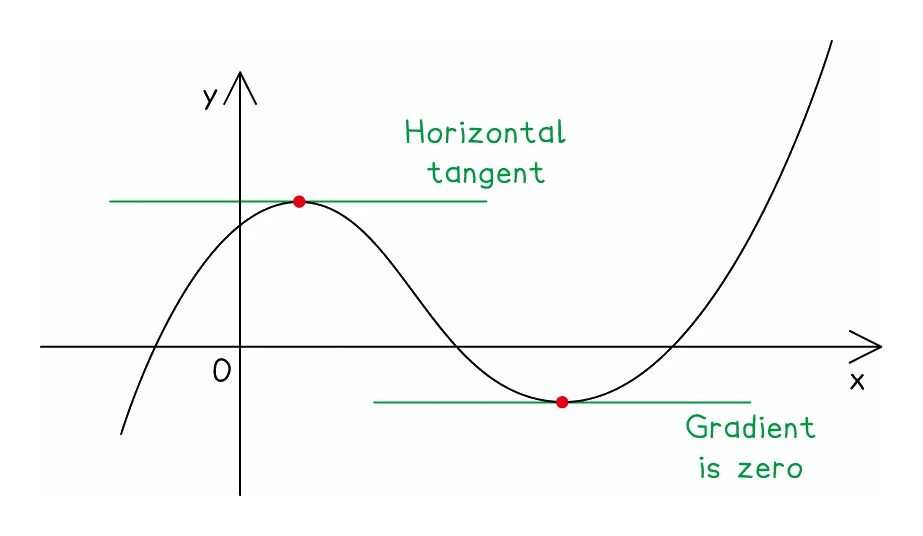
- Such a point is a turning point, also called a stationary point
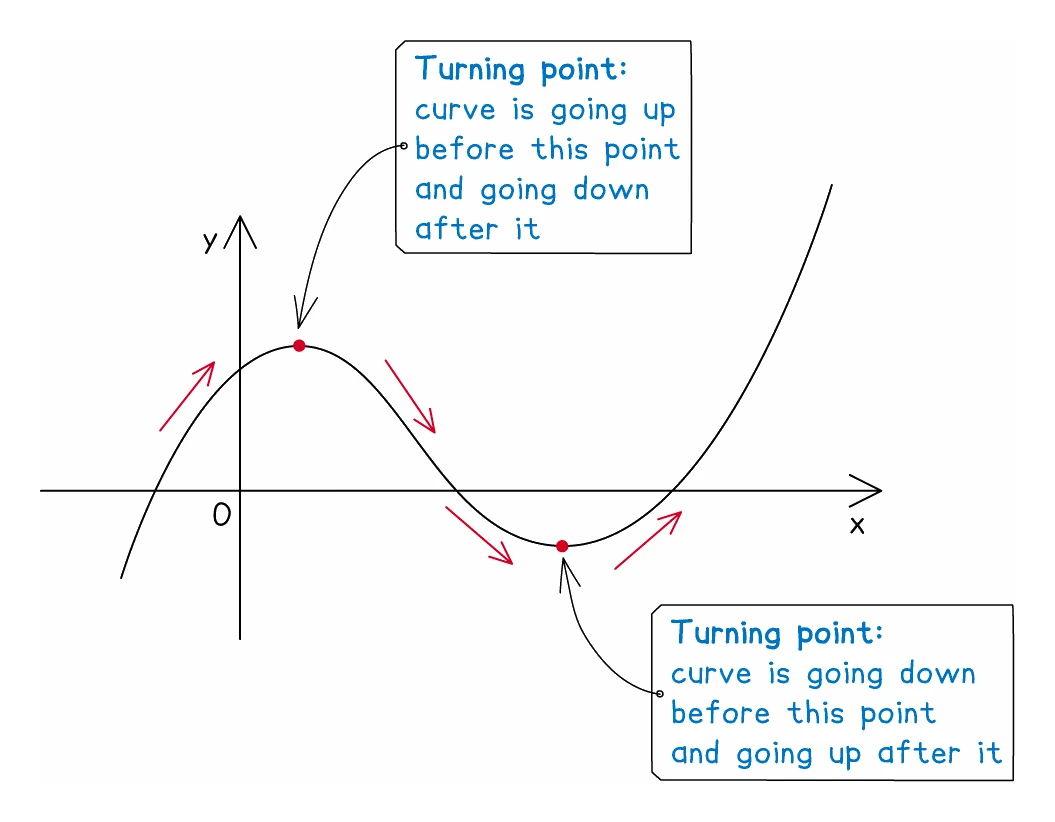
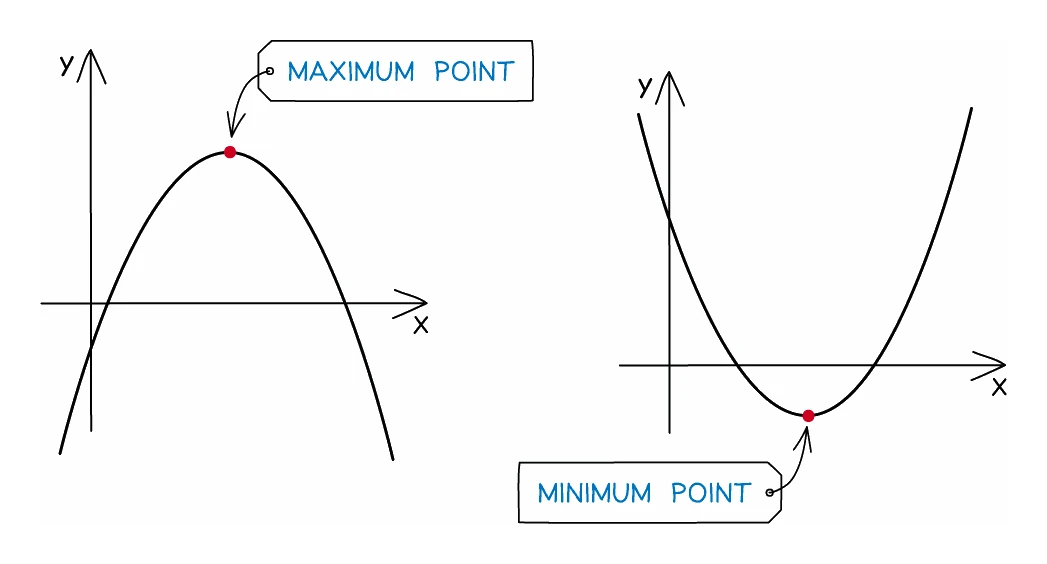
- A maximum is a peak and a minimum is a trough, and both are found the same way
- The method is always the same three steps
- Differentiate the equation of the curve
- Put the derivative equal to zero, then solve that equation
- Take each x found and substitute it into the curve, not the derivative, for the matching y
- A cubic normally has two turning points, so expect two answers and give both as coordinates
- Writing the line "dy/dx = 0" is itself worth a mark, so put it down before solving
Worked example
Finding both turning points of a cubic
The curve y = x³ − 27x + 4 has two turning points. Find their coordinates.
Solution:
- A turning point is where the curve stops rising and starts falling, or the reverse, so the gradient there is zero
- Differentiate first: dy/dx = 3x² − 27
- Then set the derivative to zero: writing the line dy/dx = 0 earns a mark by itself
- 3x² − 27 = 0
- Divide through by 3: x² − 9 = 0, so x² = 9
- Taking the square root gives two answers, x = 3 and x = −3, and forgetting the negative root loses a whole turning point
- Those are only the x coordinates; the y coordinates come from substituting back into the equation of the curve, never into the derivative
- At x = 3: 3³ − 27 × 3 + 4 = 27 − 81 + 4 = −50
- At x = −3: (−3)³ − 27 × (−3) + 4 = −27 + 81 + 4 = 58
- The turning points are (3, −50) and (−3, 58)
Exam tip
Keep going after a slip in the derivative
If your derivative has a slip, carry on with it. The schemes usually give one method mark for setting your own derivative equal to zero and another for a correct method of solving your own quadratic, so both are still there to earn. Write each solving step down, as the example above does, whether by square roots, factorising or the formula: from a wrong derivative, the x values alone cannot show that method.