MathematicsExam code: 0580
Differentiation
Coordinate Geometry and Graphs
Three accepted methods
- The syllabus accepts any method and lists these three, so use whichever is quickest unless the question says which one to use
- A sketch. Use the shape you already know: a positive cubic rises overall, so its maximum comes first and its minimum second, and a negative cubic is the other way round. A positive quadratic has only a minimum, a negative quadratic only a maximum
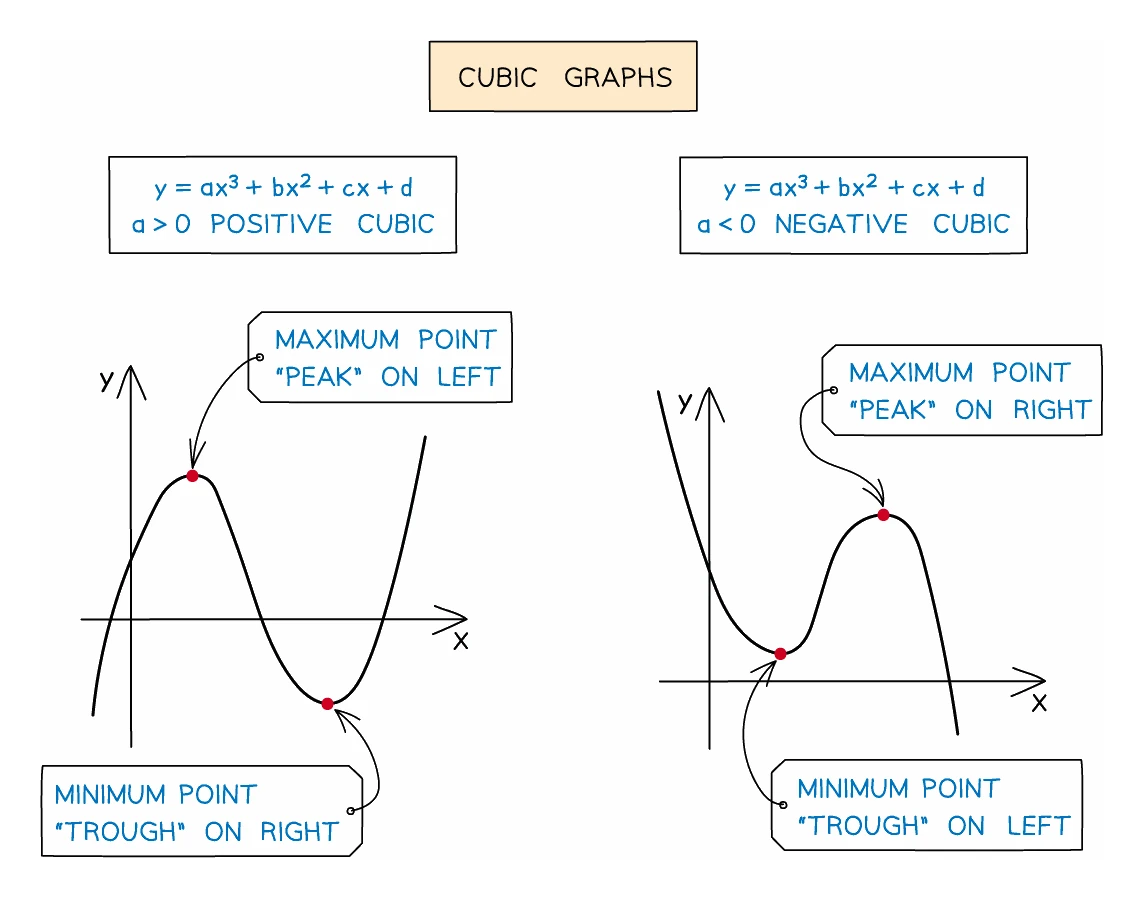
- The gradient either side. Substitute an x just below and just above the turning point into dy/dx. Positive then negative means a maximum; negative then positive means a minimum
- The second derivative. Differentiating a second time produces d²y/dx², into which the turning point's x value is substituted
- A negative result means a maximum, which is the opposite of what most people expect
- A positive result means a minimum
- A result of zero settles nothing, so fall back on one of the other two methods
- You are not expected to identify points of inflection on this specification
Worked example
Classifying with the second derivative
The curve y = x³ − 27x + 4 has turning points at (3, −50) and (−3, 58). Determine which is a maximum and which is a minimum.
Solution:
- The second derivative measures how the gradient itself is changing, which is what separates a maximum from a minimum
- Start from the first derivative: dy/dx = 3x² − 27
- Differentiate it again, term by term: 3x² gives 6x, and −27 is a constant so it gives 0
- d²y/dx² = 6x
- Substitute each turning point's x value
- At x = 3: 6 × 3 = 18, which is positive, so the gradient is increasing through that point and (3, −50) is a minimum
- At x = −3: 6 × (−3) = −18, which is negative, so the gradient is decreasing there and (−3, 58) is a maximum
- Positive means minimum and negative means maximum, which is the way round most often misremembered
- The result matches the shape of a positive cubic, which rises to a maximum, falls, then rises again, so the maximum lies to the left of the minimum, exactly as −3 lies left of 3
Exam tip
Decide maximum or minimum with a labelled sketch
The schemes credit a sketch every time you decide whether a turning point is a maximum or minimum, and when the question asks for a sketch, nothing else scores: draw one even if you have also used the second derivative. Draw the cubic the right way up (for a positive x³ term: up to the maximum, down to the minimum, up again), place each turning point where its coordinates put it, and label each one maximum or minimum.