MathematicsExam code: 0580
Geometry Toolkit
Geometry
Describing lines
- A line segment is the part of a line between two named points, so the segment from A to B is written AB
- Two lines are parallel when they run in the same direction and never meet, and arrows on a diagram mark them as such
- Two lines are perpendicular when they meet at a right angle, shown by a small square in the corner
- Equal lengths are marked with matching dashes: one dash for one pair, two dashes for a different pair
- Never judge a diagram by eye, since most are printed "NOT TO SCALE" and the markings carry the information
- A perpendicular bisector cuts a segment in half at a right angle, and a bisector of an angle cuts it into two equal parts
Exam tip
Calculate lengths and angles rather than measuring
Unless a question says its diagram is accurate or tells you to measure, work every length and angle out and write the working down. The marking principles at the front of every scheme give no marks for a scale drawing where a calculation is required. A diagram marked not to scale only shows which side or angle is which, so a value read off it with a ruler or protractor is only a guess.
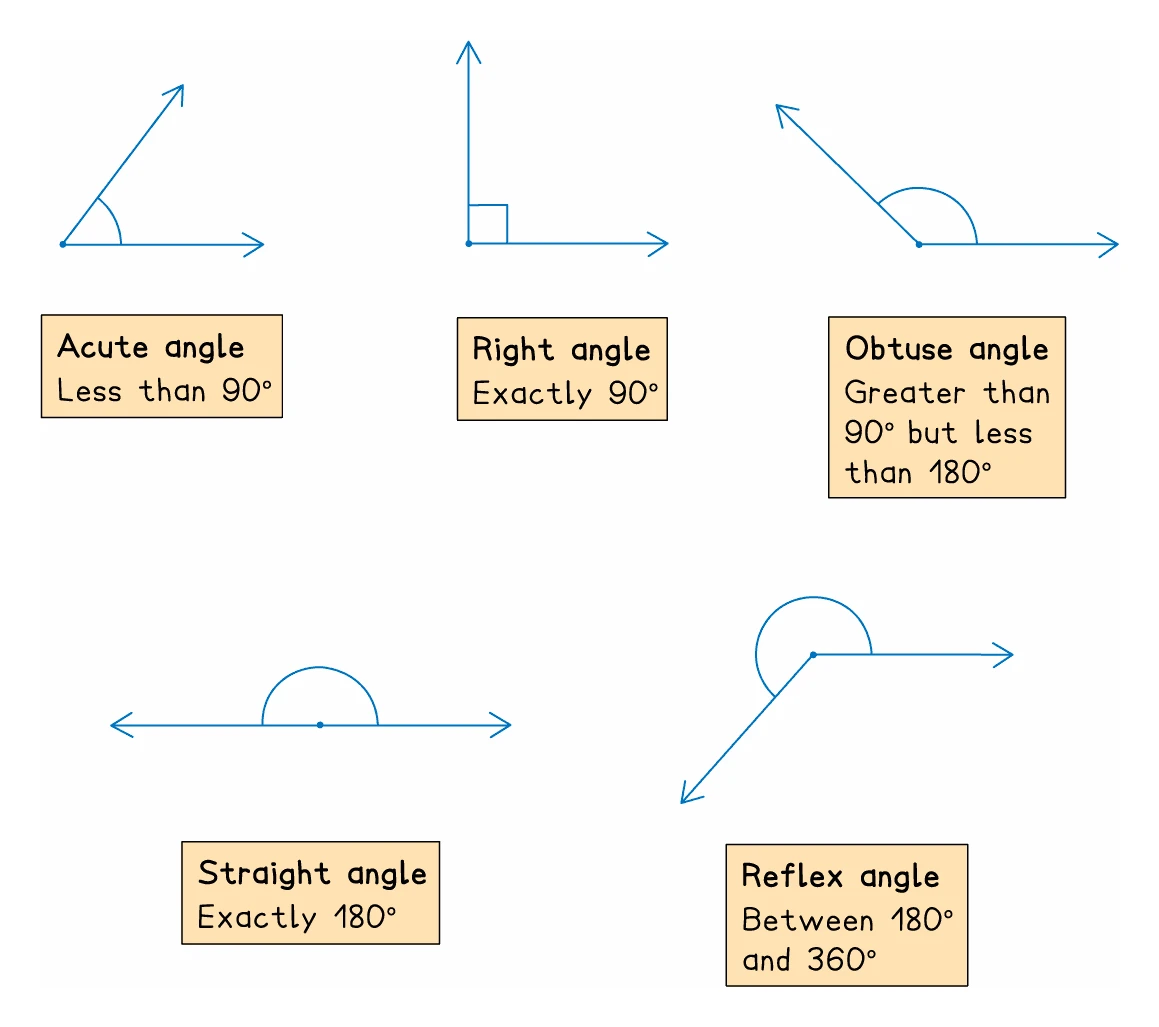
Naming angles by size
| Name | Size |
|---|---|
| Acute | less than 90° |
| Right angle | exactly 90° |
| Obtuse | between 90° and 180° |
| Straight angle | exactly 180° |
| Reflex | between 180° and 360° |
- Angles on a straight line add to 180°, and angles meeting at a point add to 360°
- Two angles adding to 180° are supplementary, and two adding to 90° are complementary
- Interior angles are inside a shape and exterior angles lie between one side and the extension of the next
- Three-letter notation names an angle by the point at its vertex in the middle, so angle ABC has its vertex at B