MathematicsExam code: 0580
Geometry Toolkit
Geometry
Slicing a solid in two
- Slice a solid so that the two pieces are identical mirror images, and the flat surface of that cut is a plane of symmetry
- Two rules cover almost every case asked
- For a prism, count the mirror lines in the cross-section, then add one more for the cut made halfway along its length
- For a pyramid, the count is simply the number of mirror lines in the base
- Applying those rules gives the standard results
- A cuboid with three different edge lengths has 3
- A cube has 9: the prism rule gives only 5, but a cube is a prism in all three directions, and counting each plane once over the three gives 9
- A cylinder has infinitely many
- A pyramid on a square base has 4
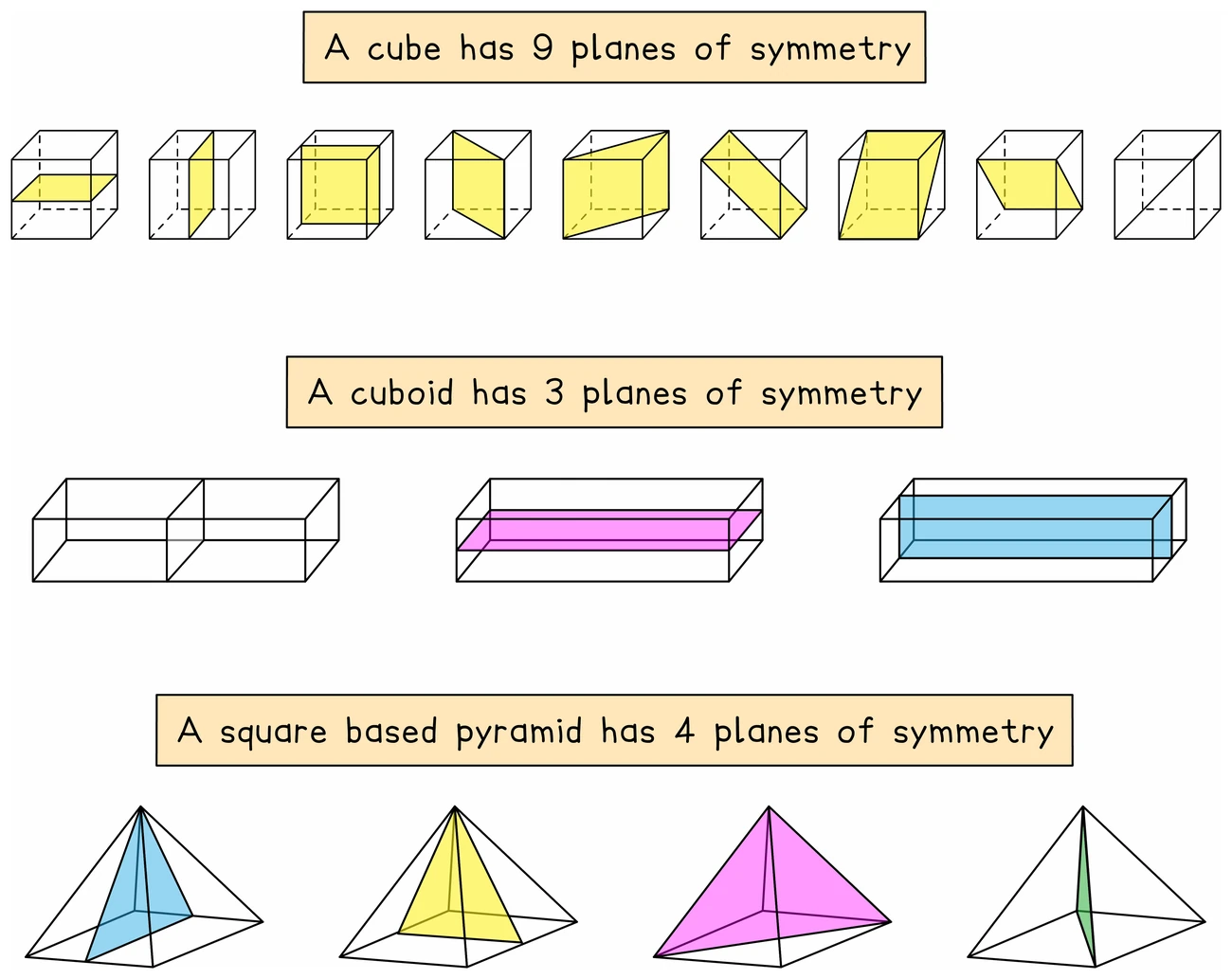
- The rules run backwards too, which is how the harder version of the question is set
Worked example
Working back from the number of planes
A prism has 7 planes of symmetry, and its cross-section is a regular polygon. Name the polygon.
Solution:
- For a prism the count is the mirror lines in the cross-section, plus one for the cut halfway along
- So the cross-section must have 7 − 1 = 6 mirror lines
- A regular polygon with n sides has exactly n of them, so n = 6
- The cross-section is a regular hexagon
- Check: a regular hexagon has 6 lines of symmetry, and 6 + 1 = 7
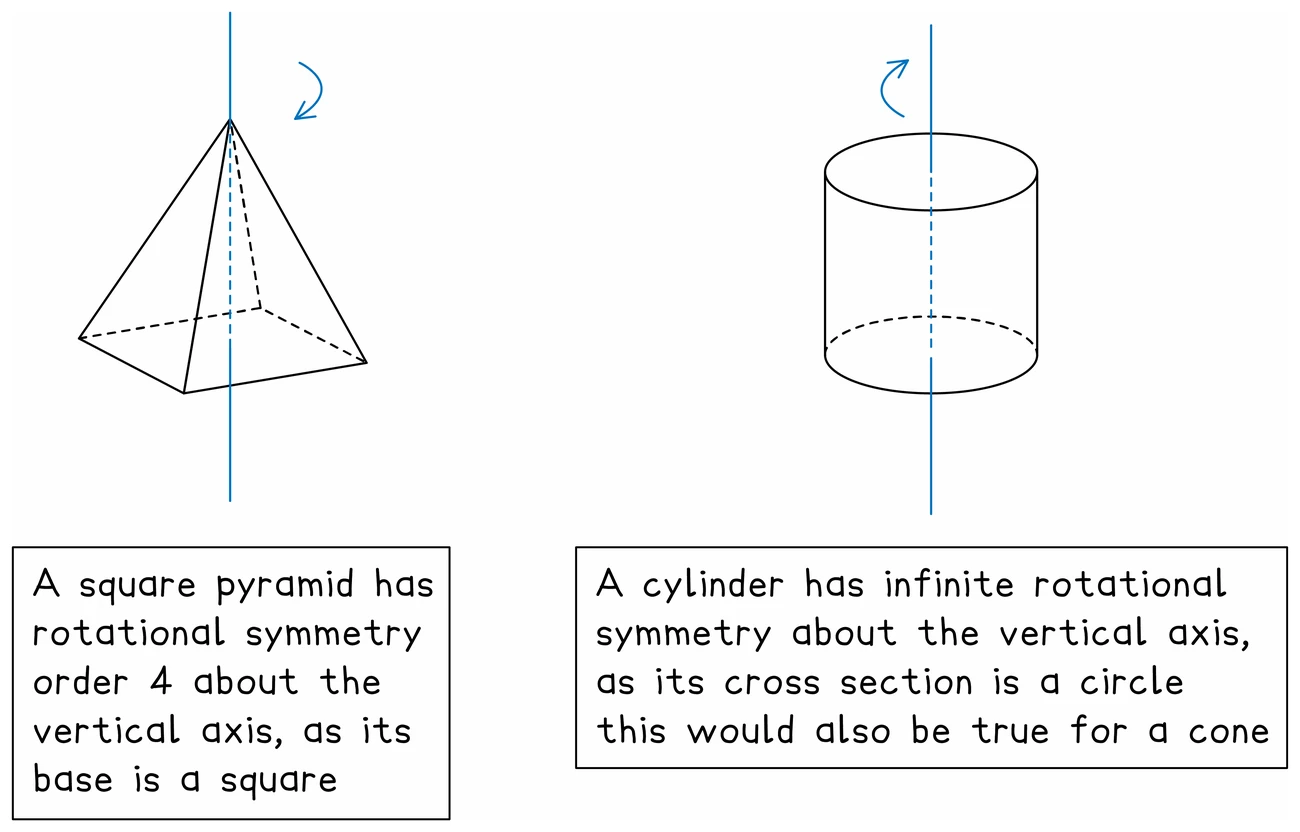
- A solid can also have rotational symmetry about an axis, and the syllabus asks you to recognise this for prisms, cylinders, pyramids and cones