MathematicsExam code: 0580
Angles in Polygons and Parallel Lines
Geometry
The Basic Angle Facts
Four facts that start every question
- Angles meeting at a point add to 360°
- Angles on one side of a straight line add to 180°
- Vertically opposite angles, formed where two straight lines cross, are equal
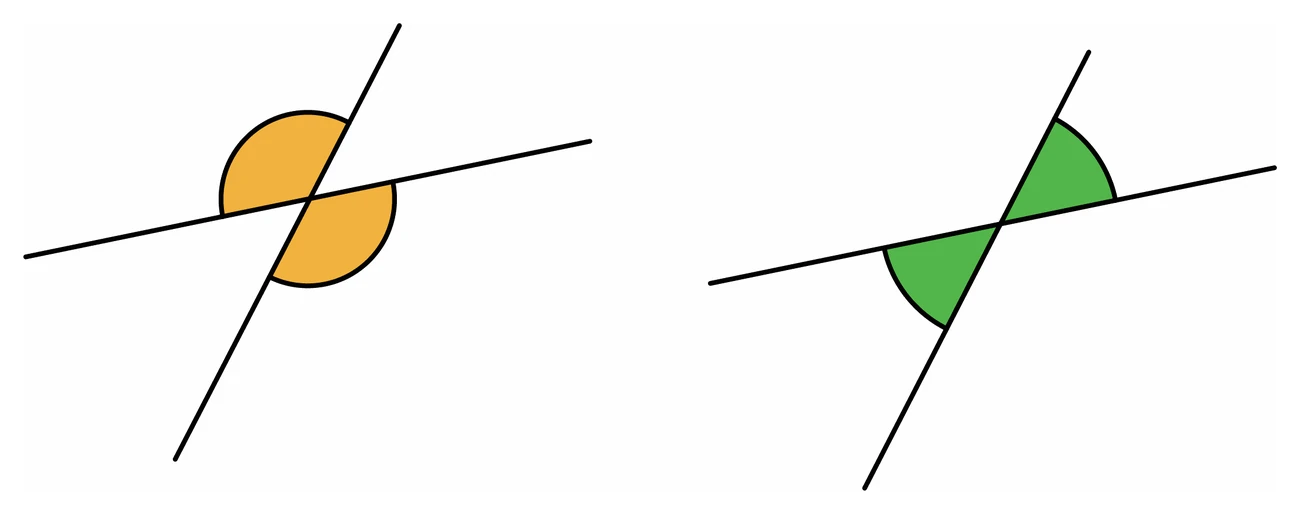
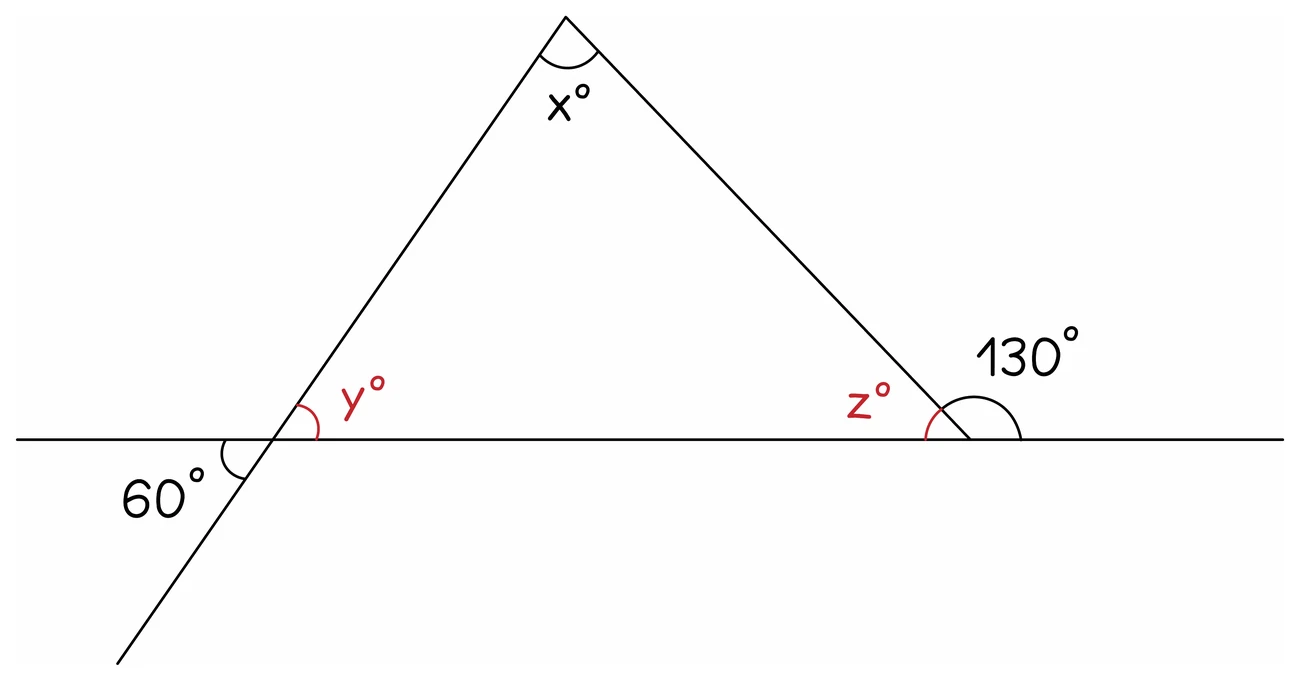
- The angles inside a triangle add to 180°, and the angles inside a quadrilateral add to 360°
- Naming uses three letters with the vertex in the middle, so angle ABC is the angle at B, and it means the angle smaller than 180° rather than the reflex one
- Diagrams are usually marked "NOT TO SCALE", so work from the numbers and the markings rather than from how the picture looks
Filling in what you can
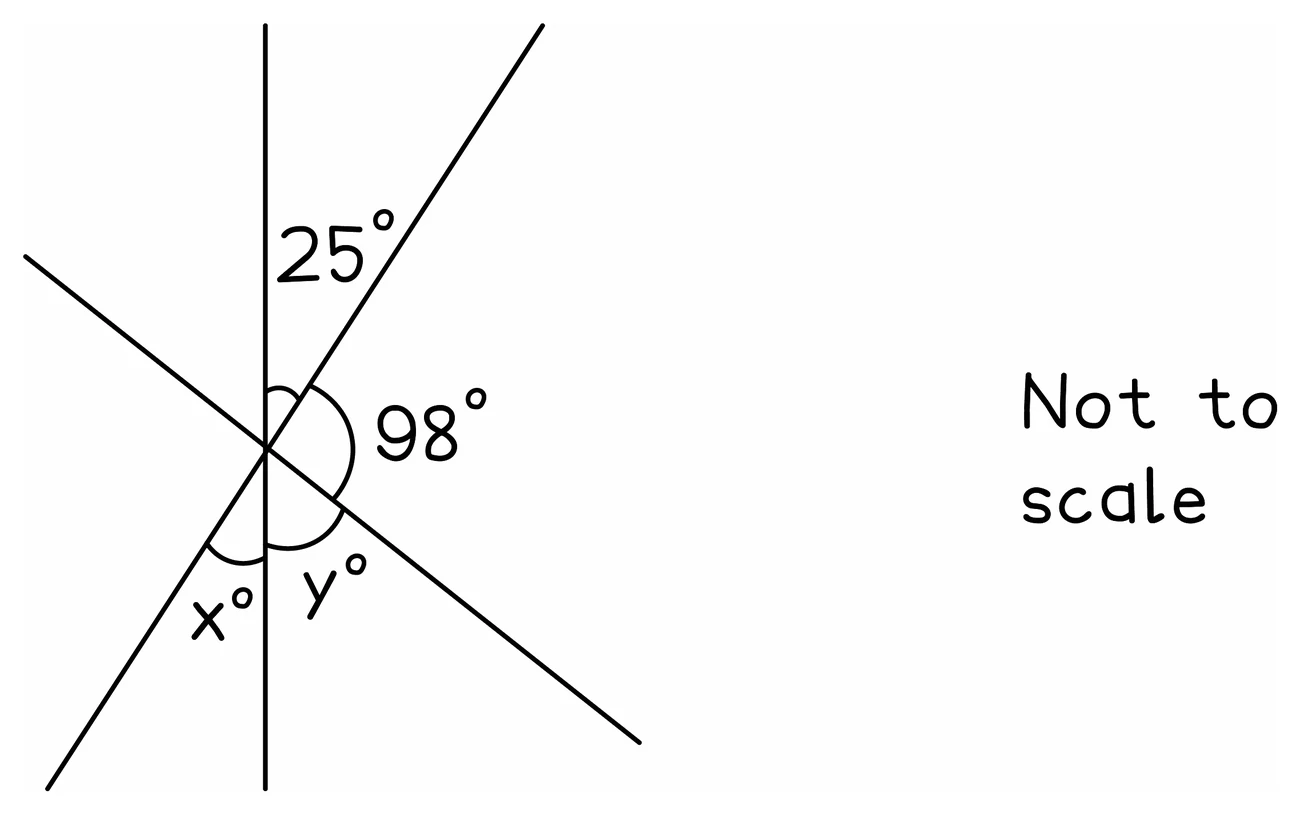
- Mark every angle you can work out on the diagram, even ones the question has not asked for
- One of them is almost always the step that unlocks the angle you actually want
- A question worth more than one mark expects the intermediate angles to appear in the working
Worked example
Crossing lines and a straight line
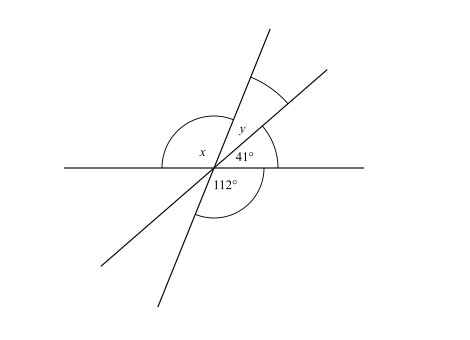
Three straight lines meet at a point. One angle is 112°, and x is vertically opposite it. On the straight line through that point sit x, y and an angle of 41°. Find x and y.
Solution:
- x is vertically opposite the 112° angle, and vertically opposite angles are equal
- So x = 112
- The three angles x, y and 41° lie on a straight line, so they add to 180°
- 112 + y + 41 = 180
- 153 + y = 180
- So y = 27
- Check: 112 + 27 + 41 = 180
Exam tip
Label every angle you work out
Many angle questions give a mark for a correct angle found on the way, even when the final answer is wrong, as long as it is clear which angle it is. So write each angle on the diagram in its exact position, or name it with three letters in your working (angle PQR = 47°). A number standing alone in the working does not show which angle it is.