MathematicsExam code: 0580
Angles in Polygons and Parallel Lines
Geometry
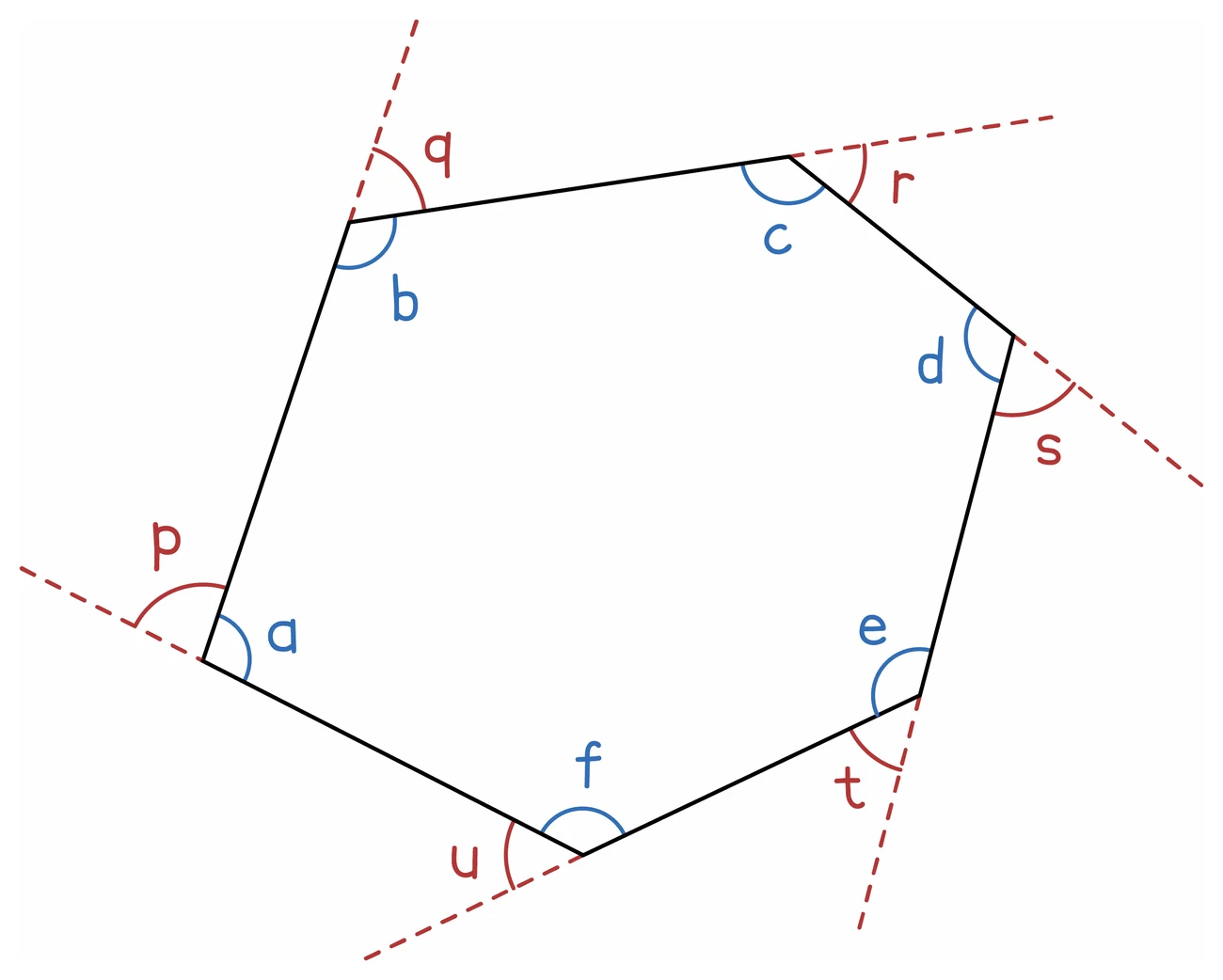
Interior and exterior angles
- An interior angle sits inside the polygon at a corner
- An exterior angle sits between one side and the extension of the next side
- At every corner the interior and exterior angles lie on a straight line, so they add to 180°
- Whatever the polygon and however many sides it has, its exterior angles total 360°
- For the inside angles the total depends on n: a polygon with n sides splits into n − 2 triangles, so they come to 180° × (n − 2)
- A triangle gives 180°, a quadrilateral 360°, a pentagon 540° and a hexagon 720°
Regular polygons
- A regular polygon has all sides equal and all angles equal, so its angles can be found by dividing
- Each exterior angle is 360° ÷ n, and this is usually the quicker route
- Each interior angle is then 180° minus that exterior angle
- The same result comes from 180(n − 2) ÷ n, so either method is acceptable
- Working backwards, n = 360° ÷ exterior angle; when a question gives the interior angle, take it from 180° first
| Regular polygon | Sides | Interior sum | Each interior | Each exterior |
|---|---|---|---|---|
| Equilateral triangle | 3 | 180° | 60° | 120° |
| Square | 4 | 360° | 90° | 90° |
| Pentagon | 5 | 540° | 108° | 72° |
| Hexagon | 6 | 720° | 120° | 60° |
| Octagon | 8 | 1080° | 135° | 45° |
| Decagon | 10 | 1440° | 144° | 36° |
Worked example
Finding the number of sides
Each exterior angle of a regular polygon is 24°. Work out the number of sides, and the size of each interior angle.
Solution:
- The exterior angles of any polygon add to 360°
- For a regular polygon they are all equal, so the number of sides is 360 ÷ 24
- The polygon has 15 sides
- The interior and exterior angles at each corner lie on a straight line
- Each interior angle is 180 − 24 = 156°
- Check with the other method: 180 × (15 − 2) = 2340, and 2340 ÷ 15 = 156
Worked example
Number of sides from an interior angle
Each interior angle of a regular polygon is 168°. Find the number of sides.
Solution:
- The interior and exterior angles at each corner lie on a straight line, so each exterior angle is 180 − 168 = 12°
- The exterior angles add to 360° and are all equal, so the number of sides is 360 ÷ 12
- The polygon has 30 sides
- Check with the other method: 180(n − 2) ÷ n = 168 gives 180n − 360 = 168n, so 12n = 360 and n = 30
Dividing 360 by the interior angle itself gives 360 ÷ 168, which is not a whole number: a sign that the step to the exterior angle was missed.
Irregular polygons
- The interior angle sum formula works for any polygon, so an irregular one with a missing angle is found by subtraction
- Add every angle you are given, then take the total from 180° × (n − 2)
- Five angles of a hexagon are 100°, 145°, 98°, 130° and 122°, which total 595°
- A hexagon's interior angles total 720°, so the missing angle is 720 − 595 = 125°
- The exterior angles still add to 360° whether the polygon is regular or not