MathematicsExam code: 0580
Solving and Graphing Inequalities
Coordinate Geometry and Graphs
Working backwards
- The reverse question shows a region already marked R and asks which inequalities define it
- Start by identifying the equation of every line that bounds the region, leaving the inequality signs aside for the moment
- A vertical line is x = k and a horizontal line is y = k
- A sloping line needs its gradient and where it meets the vertical axis, giving y = mx + c
- Getting those equations right earns marks by itself, even before any inequality sign is decided
- Then turn each equation into an inequality by looking at where R lies relative to that line
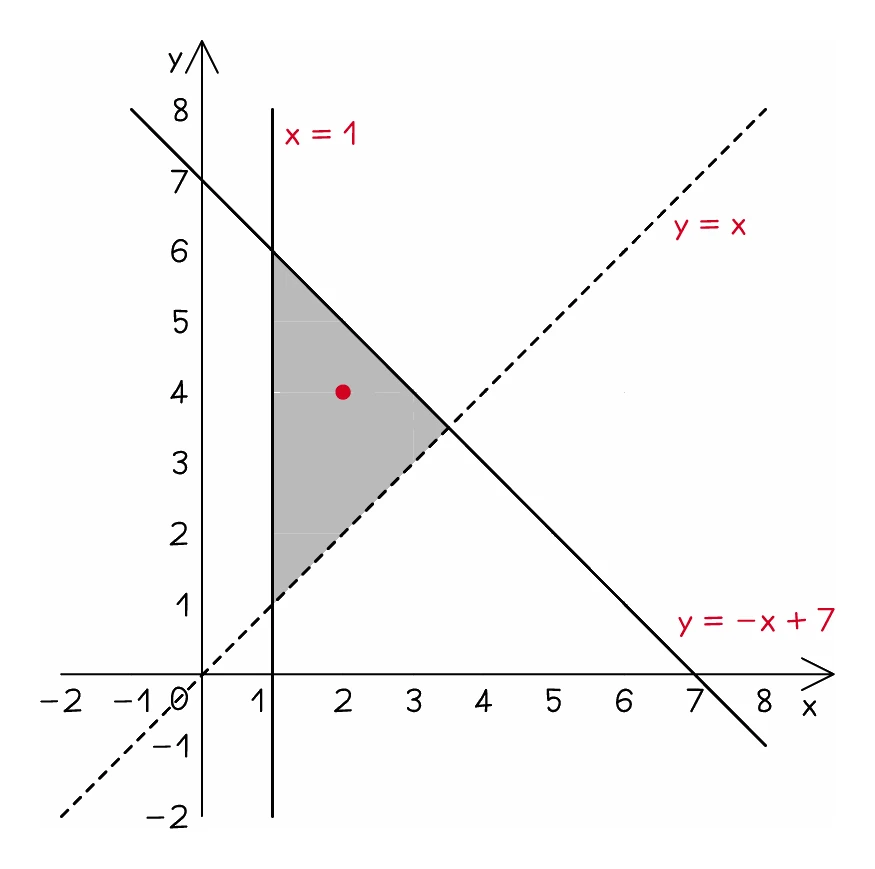
- Solid means ⩽ or ⩾ and broken means < or >, so the style of the line settles which pair of signs to use
- Confirm every one by substituting the coordinates of a point inside R, which takes seconds and catches a reversed sign
Worked example
Finding the inequalities that define a region
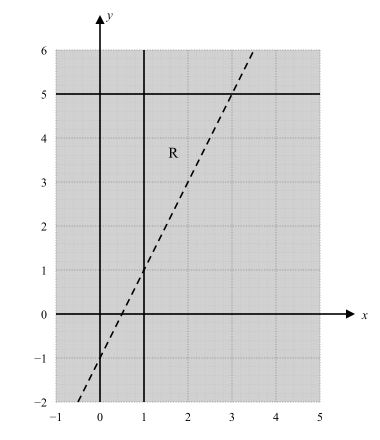
A region R is bounded by a solid vertical line at x = 1, a solid horizontal line at y = 5, and a broken line through (0, −1) and (2, 3). R lies to the right of the vertical line, below the horizontal one, and above the sloping one. Write down the three inequalities.
Solution:
- The vertical line gives x = 1, and R is to the right of a solid line, so x ⩾ 1
- The horizontal line gives y = 5, and R is below a solid line, so y ⩽ 5
- The sloping line rises 4 for a run of 2, so its gradient is 2, and it meets the vertical axis at −1, giving y = 2x − 1
- R is above that line and the line is broken, so y > 2x − 1
- The three inequalities are x ⩾ 1, y ⩽ 5 and y > 2x − 1
- Check with (2, 4), a point inside R: 2 ⩾ 1, 4 ⩽ 5 and 4 > 3 all hold