MathematicsExam code: 0580
Solving and Graphing Inequalities
Coordinate Geometry and Graphs
The convention this specification uses
- On this specification you shade the side you do not want, unless a question says otherwise
- Shading away the unwanted parts of every line leaves the region you do want as the one patch of clear grid
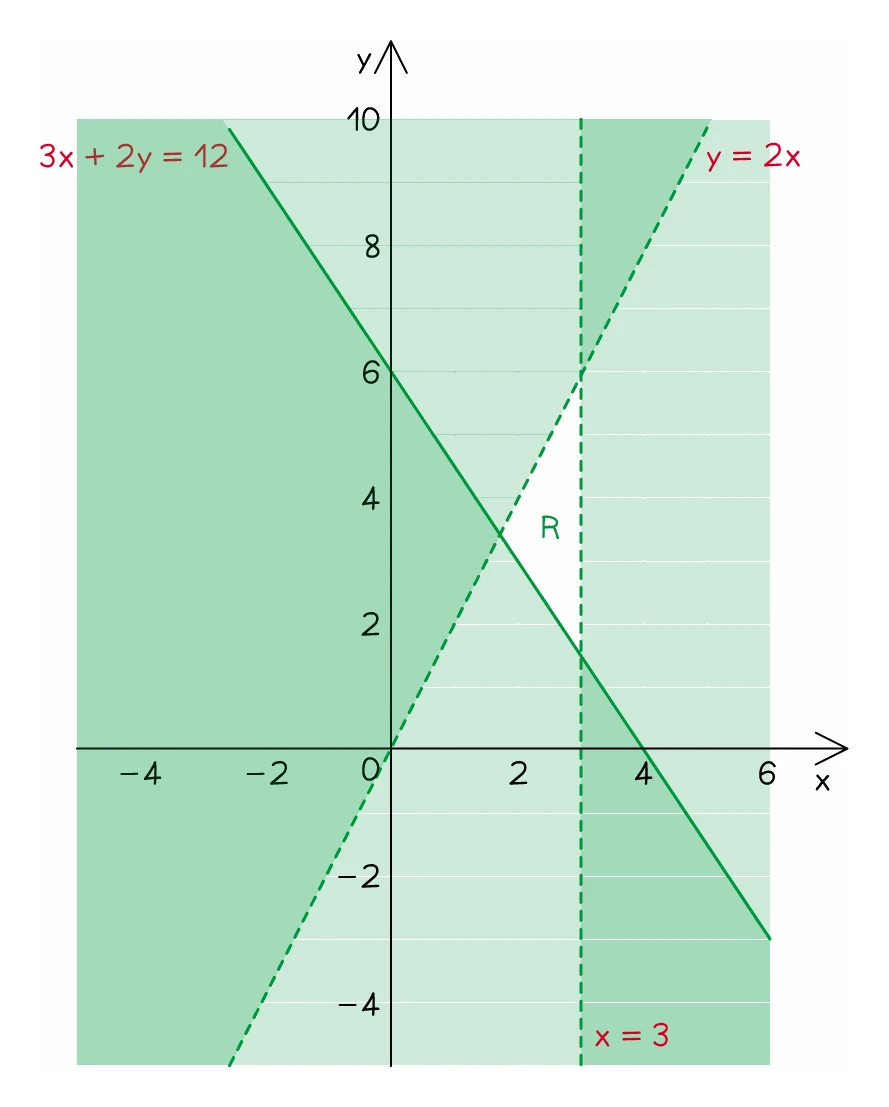
- The alternative, shading what you want, buries the answer under several overlapping layers, which is why the convention runs the other way
- Label the clear patch R. With R labelled the examiner treats the lines around it as your boundaries and ignores the shading, so the label can rescue an answer whose shading is untidy
Deciding which side is unwanted
- For y ⩾ or y >, the wanted side is above the line, so shade below it
- For y ⩽ or y <, the wanted side is below the line, so shade above it
- For x ⩾ or x >, the wanted side is to the right, so shade to the left, and the other way round for x ⩽ and x <
- When you are unsure, pick any point clearly off the line, substitute it, and see whether the statement comes out true
- The origin is the easiest test point whenever the line does not pass through it
Worked example
Drawing a region from three inequalities
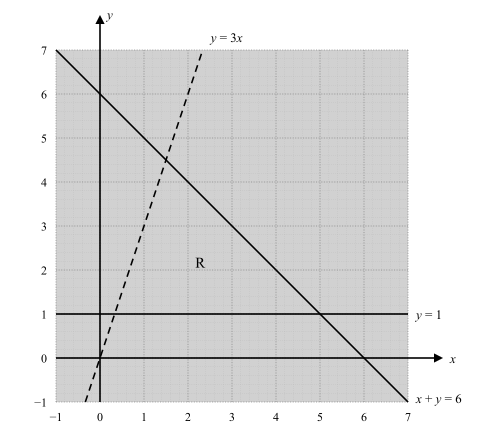
Shade the unwanted regions to show the region R where y ⩾ 1, x + y ⩽ 6 and y < 3x all hold, and label R.
Solution:
- Draw y = 1 as a solid horizontal line, since the sign is ⩾
- Draw x + y = 6 as a solid line through (0, 6) and (6, 0), since the sign is ⩽
- Draw y = 3x as a broken line through the origin, since the sign is <
- For y ⩾ 1 the wanted side is above, so shade below y = 1
- For x + y ⩽ 6 test the origin: 0 + 0 ⩽ 6 is true, so the origin is wanted and the far side is shaded
- For y < 3x the origin sits on the line, so test (1, 0) instead: 0 < 3 is true, so (1, 0) is wanted and the other side is shaded
- One clear triangle is left, with corners near (⅓, 1), (5, 1) and (1.5, 4.5)
- Label that clear triangle R
- Check with a point inside it, such as (2, 2): 2 ⩾ 1, 2 + 2 ⩽ 6 and 2 < 6 all hold