MathematicsExam code: 0580
Quadratic Graphs
Coordinate Geometry and Graphs
Using the crossings
- If the graph shows both x-axis crossings, write the equation as y = a(x − x₁)(x − x₂) using those two values
- Then substitute one further known point, usually the y-axis crossing, and solve for a
- Expanding at the end is optional unless the question asks for a particular form
- Give the line of symmetry as an equation, x = p, rather than as a single number
Worked example
Building the equation from the crossings
Find the equation of the curve shown.
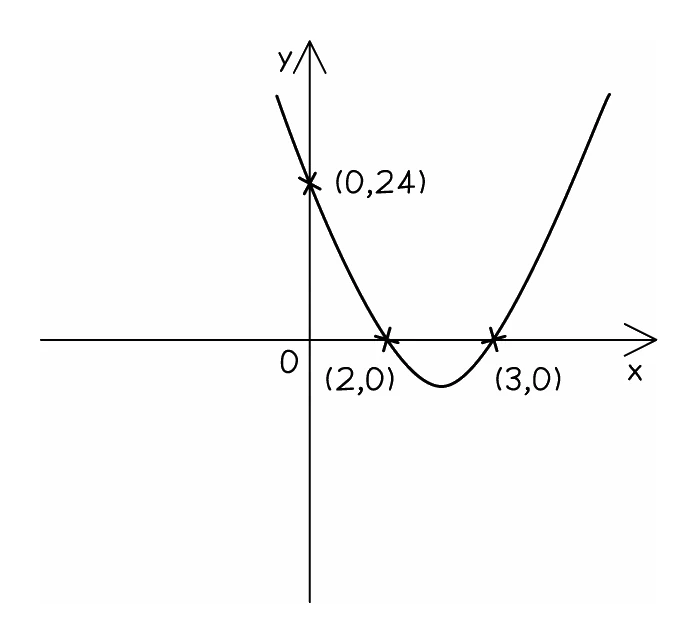
Solution:
- The two x-axis crossings are at x = 2 and x = 3, so start from y = a(x − 2)(x − 3)
- Substitute the third point, x = 0 and y = 24
- 24 = a(0 − 2)(0 − 3)
- 24 = a × (−2) × (−3), so 24 = 6a and a = 4
- The equation is y = 4(x − 2)(x − 3)
- Expanded, that is y = 4x² − 20x + 24
- Check: substituting x = 0 gives 24, which is the y-axis crossing shown
Using the turning point
- If the graph shows the turning point instead, write the equation as y = a(x − p)² + q with those coordinates filled in
- Substitute one other point on the curve and solve for a
Worked example
Building the equation from the turning point
Find the equation of the curve shown.
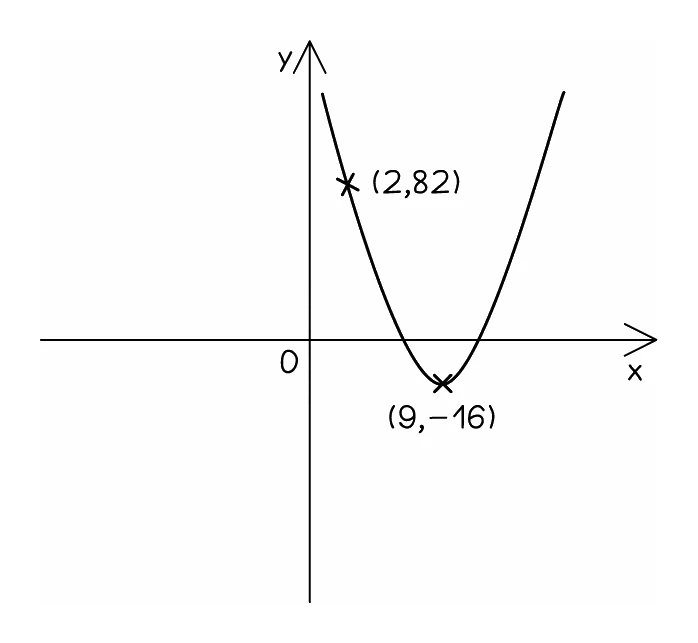
Solution:
- The turning point is at (9, −16), so start from y = a(x − 9)² − 16
- Substitute the other point, x = 2 and y = 82
- 82 = a(2 − 9)² − 16
- 82 = a × (−7)² − 16, so 82 = 49a − 16
- 98 = 49a, giving a = 2
- The equation is y = 2(x − 9)² − 16
- Expanded, that is y = 2x² − 36x + 146