MathematicsExam code: 0580
Quadratic Graphs
Coordinate Geometry and Graphs
Shape and symmetry
- A quadratic graph has equation y = ax² + bx + c, with a not zero
- The curve is smooth and has a vertical line of symmetry, and it is drawn freehand rather than with a ruler
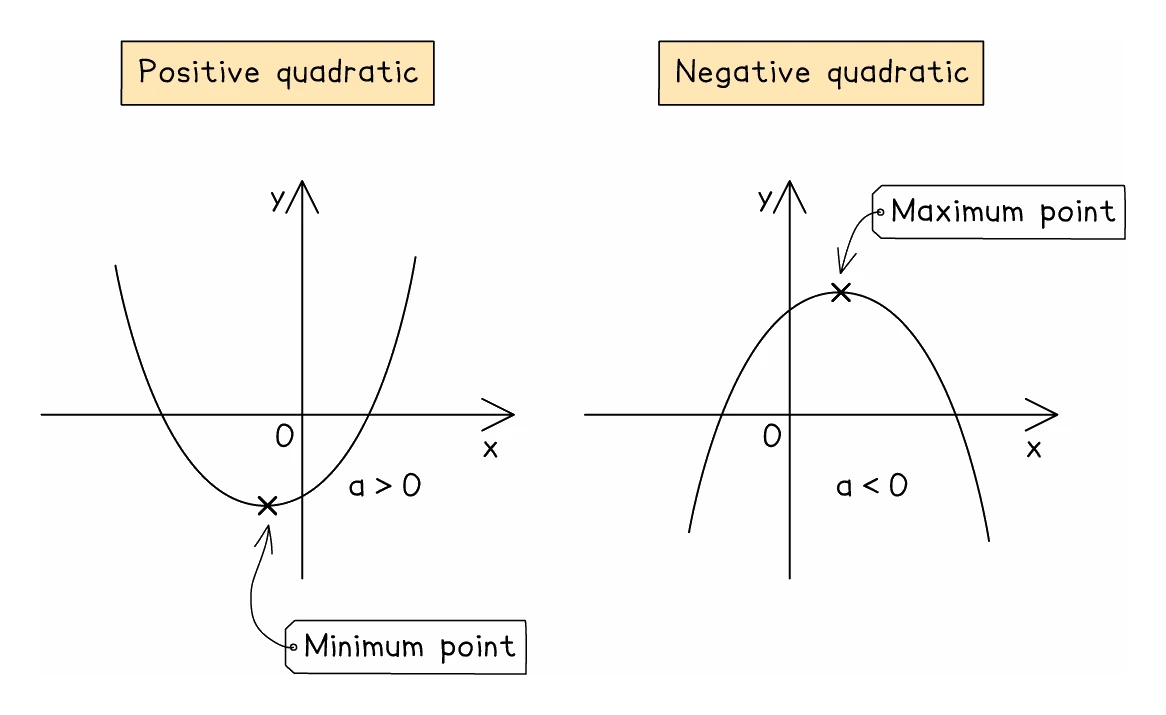
- A positive a opens the curve upwards, giving a u-shape with a lowest point
- A negative a opens it downwards, giving an n-shape with a highest point
- That highest or lowest point is the turning point, and the line of symmetry is the vertical line through it
- The curve always meets the y-axis, at (0, c), because substituting x = 0 leaves only the constant
- Against the x-axis there are three possibilities: it cuts through at two points, just touches at one, or misses the axis entirely, depending on where the turning point sits
Where it crosses the x-axis
- The crossing points are the values of x that make y zero, so they come from solving ax² + bx + c = 0
- The quadratic-equation methods find them: factorising when the quadratic factorises, and otherwise completing the square or the formula
- Two crossings mean the turning point is on the opposite side of the axis from the opening; one crossing means the turning point sits exactly on the axis
- No crossing means the whole curve stays on one side of the axis, which the completed square form shows immediately
- The line of symmetry sits half way between two crossings, so averaging them gives its equation quickly