MathematicsExam code: 0580
Quadratic Graphs
Coordinate Geometry and Graphs
What a sketch must show
- A sketch is not a plotted graph: it needs the right shape and the key points labelled, not accurate scales
- Work through the same four things every time
- Decide u-shape or n-shape from the sign of a
- Mark the y-axis crossing at (0, c)
- Solve for the x-axis crossings, if there are any, and mark them
- Mark the turning point if the question asks for it
- Draw the curve through those points, keeping it symmetrical about the vertical line through the turning point
Worked example
A curve that crosses the *x*-axis twice
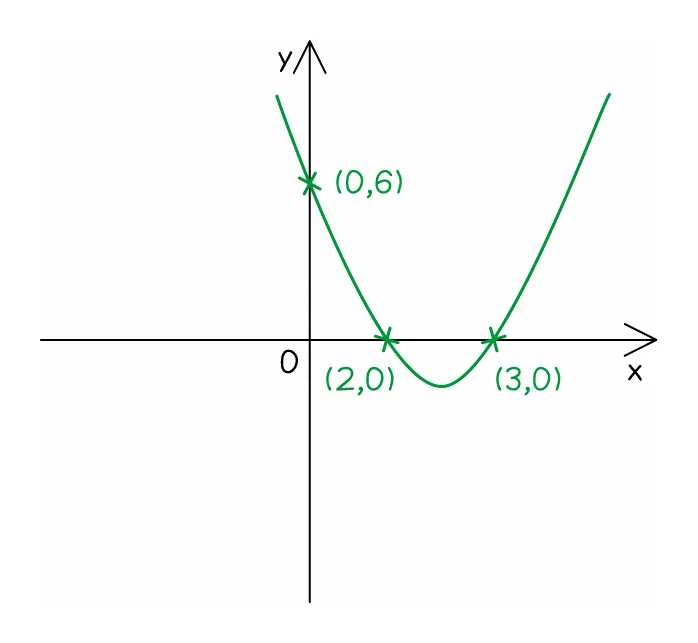
Sketch the curve y = x² − 5x + 6, showing clearly where it meets the axes.
Solution:
- The number in front of x² is positive, so the curve is a u-shape
- The constant term is the y-axis crossing, so the curve passes through (0, 6)
- For the x-axis crossings, solve x² − 5x + 6 = 0
- Two numbers multiplying to 6 and adding to −5 are −2 and −3, so (x − 2)(x − 3) = 0
- The curve meets the x-axis at (2, 0) and (3, 0)
- A u-shaped curve through the three marked points: (0, 6) on the y-axis, and (2, 0) and (3, 0) on the x-axis
Worked example
A curve that never meets the *x*-axis
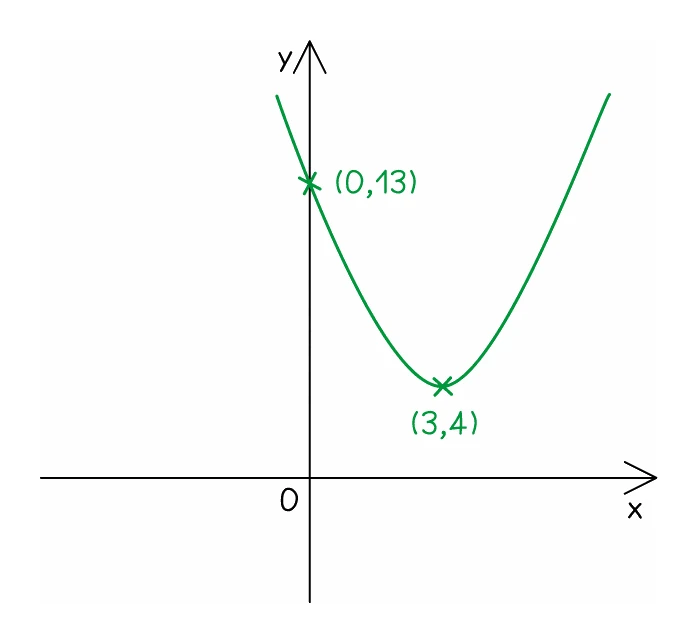
Sketch the graph of y = x² − 6x + 13, showing the y-axis crossing and the coordinates of the turning point.
Solution:
- The number in front of x² is positive, so the curve is a u-shape and its turning point is a minimum
- The y-axis crossing is at (0, 13)
- Complete the square to find the turning point
- Half of −6 is −3, so x² − 6x is (x − 3)² − 9
- y = (x − 3)² − 9 + 13, which is y = (x − 3)² + 4
- The turning point is at (3, 4)
- That minimum sits above the x-axis on a u-shaped curve, so the curve never crosses the x-axis at all
Worked example
A curve that touches the *x*-axis once
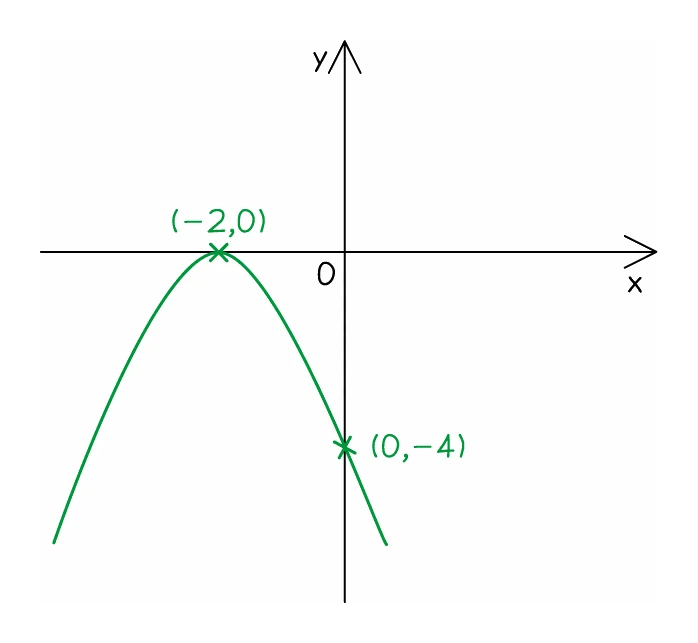
Sketch the graph of y = −x² − 4x − 4, showing the root, the y-axis crossing and the turning point.
Solution:
- The number in front of x² is negative, so the curve is an n-shape with a maximum
- The y-axis crossing is at (0, −4)
- Factorise: −x² − 4x − 4 = −(x² + 4x + 4) = −(x + 2)²
- Setting y = 0 gives (x + 2)² = 0, so x = −2 is the only solution
- A repeated solution means the curve touches the x-axis rather than cutting through it, so (−2, 0) is both the root and the turning point