MathematicsExam code: 0580
Further Graphs and Tangents
Coordinate Geometry and Graphs
Lines the curve approaches but never reaches
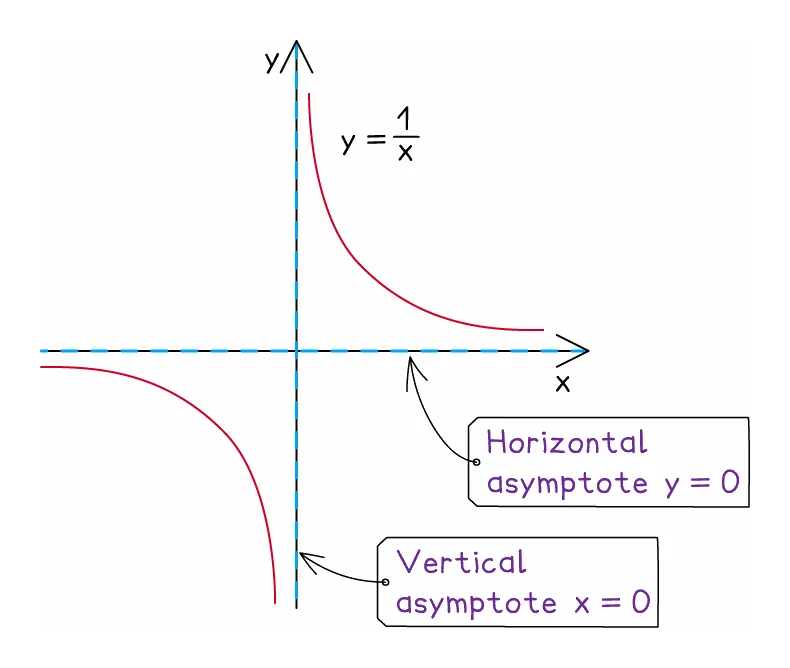
- An asymptote is a straight line that a curve gets closer and closer to without ever touching
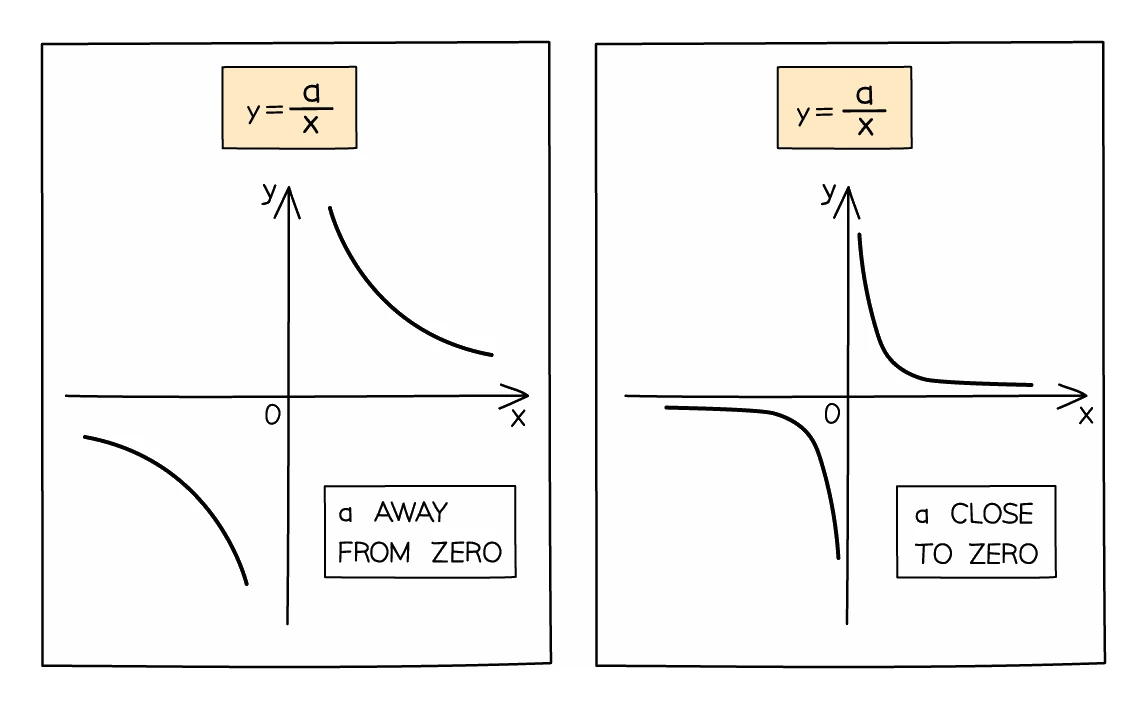
- Two of them belong to y = a ÷ x: the y-axis, x = 0, and the x-axis, y = 0
- The vertical one comes from the value that would make the bottom zero
- The horizontal one is where the curve settles as x grows very large in either direction
- Adding a constant lifts the whole curve, so y = a ÷ x + b has the horizontal asymptote y = b while the vertical one stays at x = 0
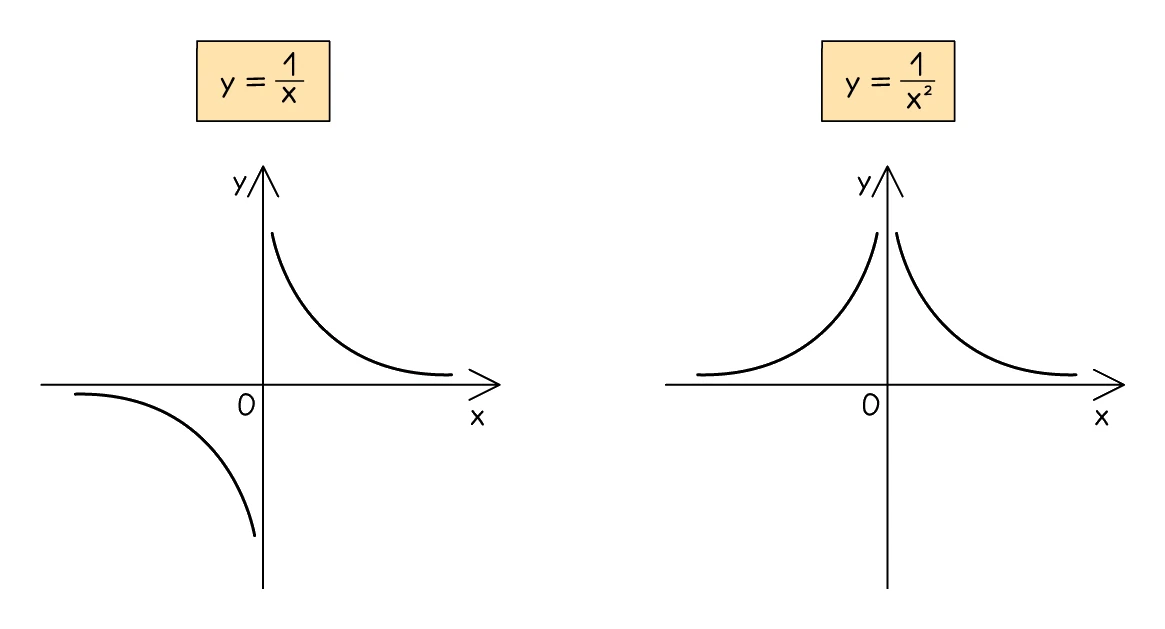
- For positive a, the curve y = a ÷ x² is always positive and both branches sit above the x-axis, unlike y = a ÷ x whose branches sit in opposite quadrants
Exponential curves
- The curve y = kˣ passes through (0, 1) whatever k is, and has the single asymptote y = 0
- It grows when k is greater than 1 and decays towards zero when k lies between 0 and 1
- Stretching and shifting gives y = akˣ + b, which meets the y-axis at (0, a + b) and has asymptote y = b
- In a growth or decay context, b is the value the quantity settles at in the long run and a + b is its starting value
- Asymptotes are written as equations of lines, so the answer is x = 0 or y = 3, never a bare number
Worked example
Writing down the asymptotes
Write down the equations of the asymptotes of y = 6/x, and of y = 2ˣ + 3.
Solution:
- An asymptote is a line the curve approaches but never meets, and it is written as an equation, not a number
- For y = 6/x, no value of y comes from x = 0, because dividing by zero is undefined
- So the curve never crosses the vertical line x = 0, which is the y-axis
- However large x becomes, 6/x shrinks towards zero without reaching it
- So the curve never meets y = 0, which is the x-axis
- For y = 2ˣ + 3, the 2ˣ part shrinks towards zero as x becomes large and negative, but never reaches it
- The whole curve therefore stays above 3, getting ever closer to it on the left, giving the asymptote y = 3
- The asymptotes are therefore x = 0 and y = 0 for the first curve, and y = 3 for the second, each given as the equation of a line