MathematicsExam code: 0580
Further Graphs and Tangents
Coordinate Geometry and Graphs
Drawing the tangent
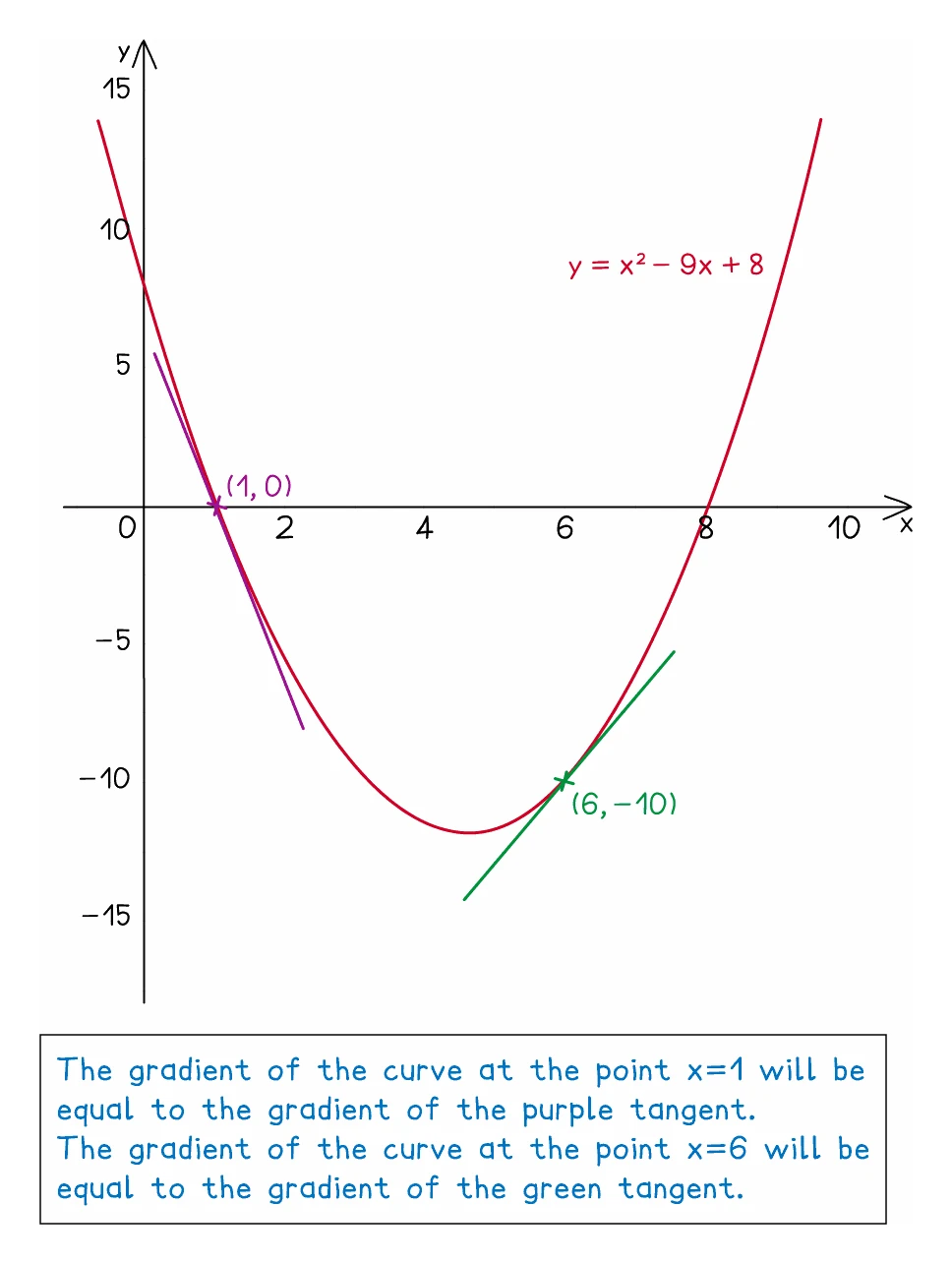
- The gradient of a curve changes from point to point, and the gradient at one point is the gradient of the tangent there
- A tangent is a straight line that touches the curve at that point without cutting across it
- Rest a ruler against the curve at that point and extend the line right across the grid, so the triangle you read from is large
- Read two points far apart on the tangent, ideally on grid intersections, and find the vertical change divided by the horizontal change
- A tangent passing through (1, 2) and (5, 14) has gradient 12 ÷ 4 = 3
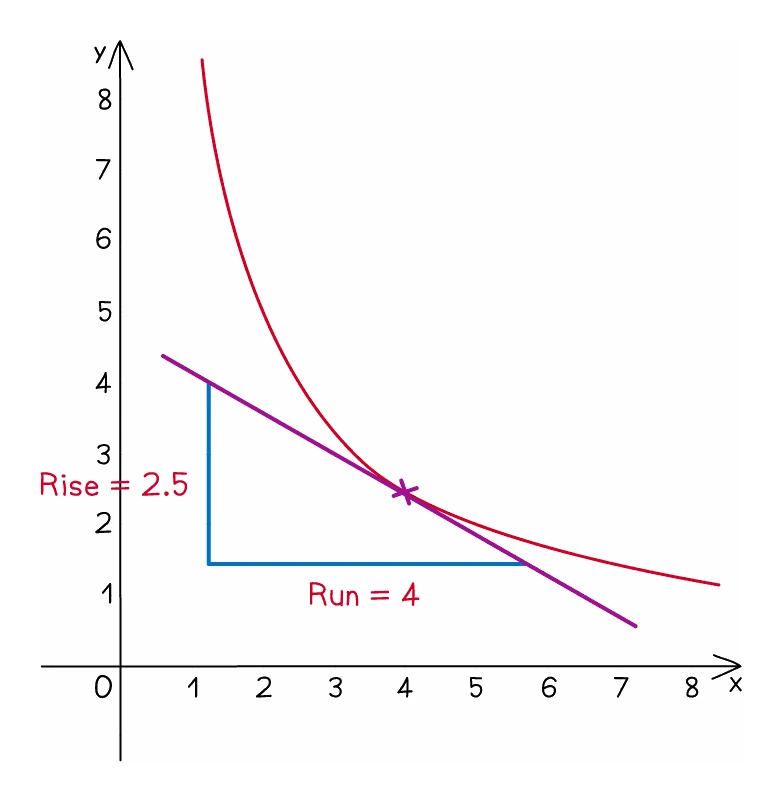
- Going downhill gives a negative gradient, so put the sign in yourself
- The answer is only an estimate, because the tangent is positioned by eye
What the gradient means
- The gradient is the rate at which the vertical quantity changes as the horizontal one increases by 1
- Its units are the units on the vertical axis divided by the units on the horizontal axis
- On a distance–time graph that rate is the speed, and on a speed–time graph it is the acceleration
- Answering "what does the gradient represent" needs the quantity named, with its units, not just a number
Exam tip
Leave a ruled tangent on the graph
The tangent itself earns a mark, so rule it on the printed graph, touching the curve at the required point without cutting across it. When the question asks for the gradient of the curve at that point, such as an acceleration, the estimate is credited only alongside a correct tangent or a close attempt at one, so a value with no tangent drawn scores nothing.
Worked example
Reading a tangent off the grid
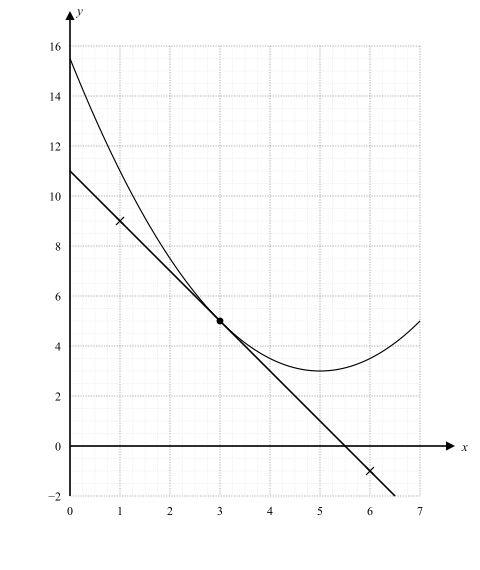
A tangent drawn to a curve at x = 3 passes through the grid points (1, 9) and (6, −1). Estimate the gradient of the curve at x = 3.
Solution:
- Vertical change from the first point to the second: −1 − 9 = −10
- Horizontal change over the same span: 6 − 1 = 5
- Divide the two: −10 ÷ 5 = −2
- The gradient of the tangent is −2, and the curve has the same gradient where the tangent touches it
- So the gradient of the curve at x = 3 is approximately −2
- The tangent slopes downhill, which agrees with the negative answer