Synthetic Polymers
Organic Chemistry
What a polymer is
- A polymer is a very long molecule built by joining together a large number of small repeating units
- The small repeating starting molecules are called ; each monomer becomes one in the polymer chain
- Polymerisation reactions join hundreds to thousands of monomers end-to-end through covalent bonds, giving a single chain molecule of high relative molecular mass
- Synthetic polymers are manufactured by industry (plastics, nylon, polyester fabrics, polystyrene cups); natural polymers occur in living things (starch, cellulose, proteins, DNA)
Addition polymerisation
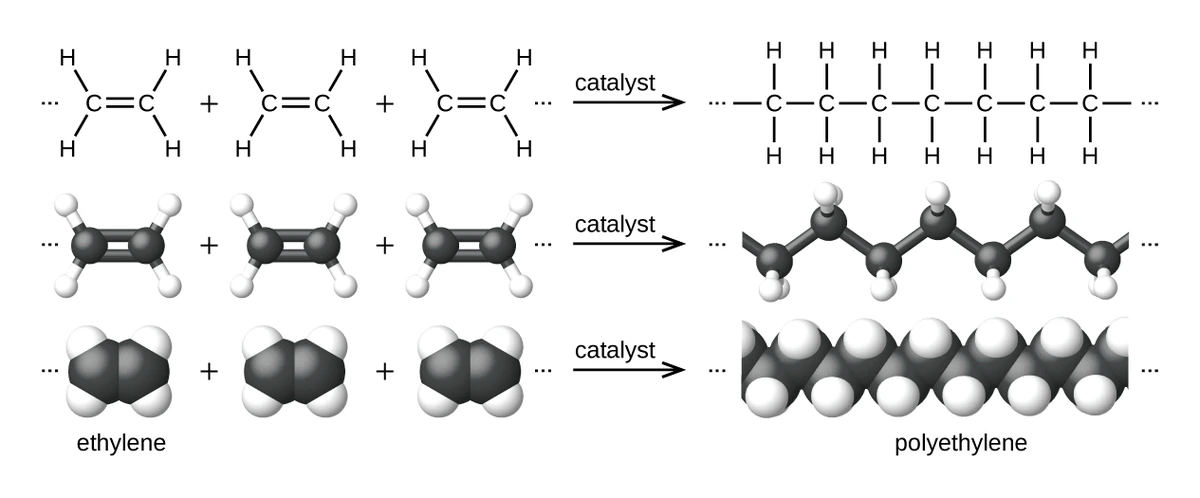
- joins monomer molecules that each have a C=C double bond
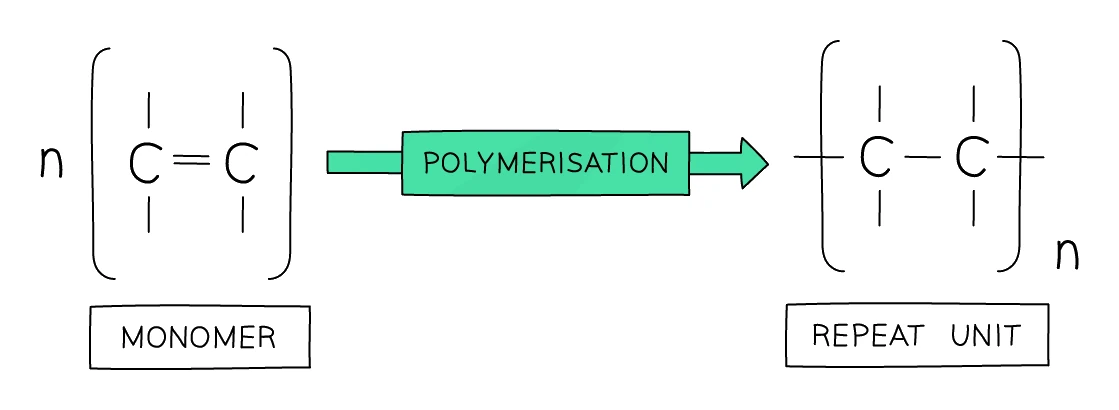
- One of the two bonds in the C=C of each monomer opens up; the spare bonds from neighbouring monomers link together to form a long single-bond chain
- No other product is made — the polymer is the only outcome (compare with condensation polymerisation in section 3)
- The molecular formula of the polymer is just n times the molecular formula of the monomer
- General equation:
n CH2=CHR → −(CH2−CHR)−n
- where R is whatever atom or group is attached to the second carbon of the monomer
Exam tip
The monomer is the molecule with the C=C
Whenever a question asks you to pick out or name a monomer, look for the C=C double bond: a two-carbon molecule with one chlorine and a double bond is chloroethene, not chloroethane, and from a box of substances the one that can form a polymer is the alkene, ethene. Asked to describe the differences between ethene and poly(ethene), give three separate points, one mark each: the polymer has a far longer carbon chain, it has only single bonds (ethene is unsaturated, the polymer saturated), and ethene is a gas whereas the polymer is a solid.
Exam tip
Counting the monomers in one polymer molecule
Addition polymerisation loses nothing, so the relative molecular mass of a polymer molecule is the number of monomers multiplied by the monomer's Mr. A show-that question giving a polymer molecule an Mr of a few million wants two steps, one mark each: the Mr of the monomer first (62.5 for chloroethene, 42 for propene), then the polymer's Mr divided by it. Write down the unrounded result of the division before rounding it to the approximate figure the question quotes.
The four named addition polymers
| Monomer | Polymer | Repeat unit | Typical use |
|---|---|---|---|
| Ethene, CH2=CH2 | Poly(ethene) | −(CH2−CH2)−n | Plastic bags, bottles, food wrap |
| Propene, CH2=CHCH3 | Poly(propene) | −(CH2−CH(CH3))−n | Crates, ropes, food containers |
| Chloroethene, CH2=CHCl (vinyl chloride) | Poly(chloroethene) — PVC | −(CH2−CHCl)−n | Drainpipes, window frames, electrical cable insulation |
| Tetrafluoroethene, CF2=CF2 | Poly(tetrafluoroethene) — PTFE / Teflon | −(CF2−CF2)−n | Non-stick coatings, plumber's tape, low-friction bearings |
Drawing a polymer's repeat unit from its monomer
- A four-step recipe:
- Write out the displayed formula of the monomer
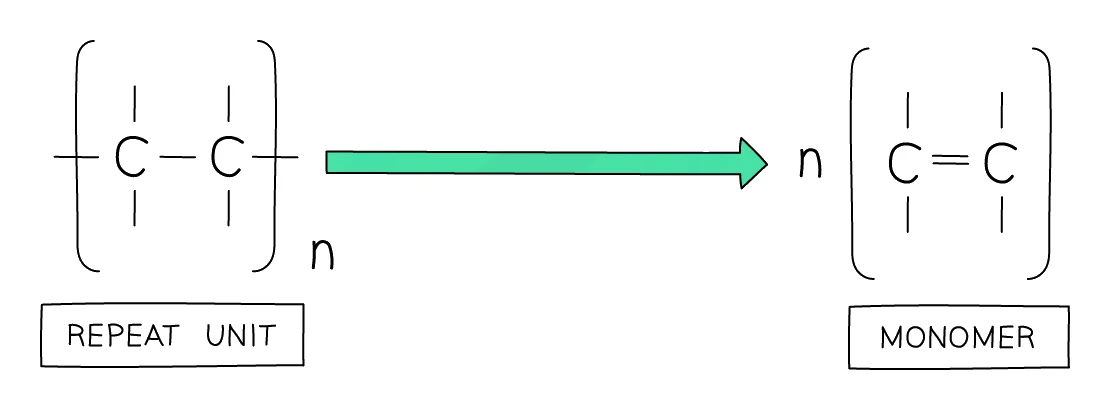
- Change the C=C double bond to a single C−C bond
- Add a "stub" bond going outward from each carbon, sticking out of the brackets to show where the chain continues
- Enclose the unit in brackets and write a subscript n outside the bracket
- Worked example: poly(chloroethene) from chloroethene
- Monomer: CH2=CHCl
- Open the double bond to a single bond and add extension bonds: −(CH2−CHCl)−
- Add the subscript: −(CH2−CHCl)−n
Common exam question
Drawing the repeat unit of an addition polymer
Question: Draw the repeat unit of the polymer formed from a given alkene, or complete its polymerisation equation (1–2 marks).
Asked in 6 of the 23 papers, all on Paper 1, for poly(propene) or poly(chloroethene). The first mark is the structure: the two carbons joined by a single bond, each hydrogen, chlorine or CH₃ still on its own carbon. In the two-mark version the second mark is for the two extension bonds, the brackets and the n together, and only if the structure is right; extension bonds need not pass through the brackets and n may sit anywhere after them.
In the one-mark version brackets and n are ignored, but one scheme rejects a unit drawn without extension bonds, so always draw them. A variant prints four carbons in a row and asks for the section of poly(propene) made from two molecules: one mark is for two of the carbons each carrying two H, the other for the other two each carrying one H and one CH₃, with nothing on any of the joining bonds, including the open ends. The two marks are independent.
Reading the monomer from a polymer's repeat unit
- Reverse the recipe: take the repeat unit, remove the extension bonds and the subscript n, and turn the C−C single bond between the two carbons back into a C=C double bond
- Worked example: poly(propene) repeat unit −(CH2−CH(CH3))−n
- Remove the brackets and the subscript: CH2−CH(CH3)
- Put the double bond back: CH2=CH(CH3) — propene
- This skill is exam-mark assessable in both directions: monomer → polymer and polymer → monomer