4CH1
Esters
Organic Chemistry · 1 question type
Goal of the practical
- Make a small, fragrant sample of by reacting ethanol with ethanoic acid under acid catalysis:
CH3COOH(l) + C2H5OH(l) → CH3COOC2H5(l) + H2O(l)
Apparatus
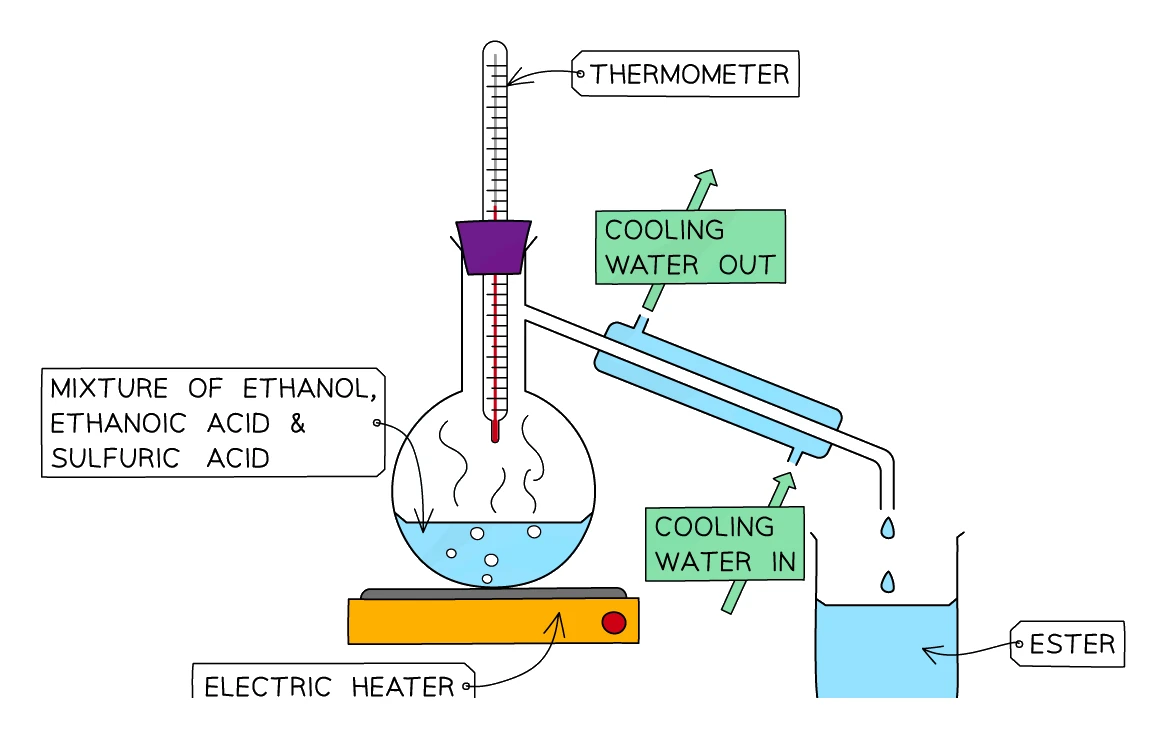
- Pear-shaped or round-bottom flask, fitted with a still-head and a Liebig (water-cooled) condenser
- Collection flask (small conical or round-bottom) for the distillate
- Thermometer
- Heating mantle, electric heater, or water bath — not a Bunsen burner, since ethanol vapour is highly flammable
- Reagents: ethanol, ethanoic acid (glacial), concentrated sulfuric acid (the catalyst), sodium carbonate solution (for the work-up wash)
Method
- Step-by-step:
- Add about 5 cm3 of ethanol and 5 cm3 of glacial ethanoic acid to the reaction flask
- Carefully add about 2 cm3 of concentrated sulfuric acid (this is corrosive — wear gloves and safety glasses)
- Drop in a few anti-bumping granules (they keep the boiling smooth)
- Fit the still-head, condenser and collection flask
- Heat the mixture gently with the electric heater or in a hot water bath
- As the mixture warms, the ester forms and distils off through the condenser, where it cools back to a liquid and collects in the receiving flask
- The ester has the lowest boiling point in the flask (about 77 °C, against ethanol 78 °C, water 100 °C and ethanoic acid 118 °C), so it is the first substance to come over the condenser
- Because ethyl ethanoate and ethanol boil within about 1 °C of each other, the distillate is a crude mixture; the work-up step below cleans it up
- The distillate has a noticeably sweet, fruity, glue-like smell — this is the diagnostic sign that the ester has been made
Working up the crude distillate
- The crude distillate also contains a small amount of unreacted ethanol, ethanoic acid and a trace of sulfuric acid carried over
- These can be removed before bottling the pure ester:
- Add a small volume of sodium carbonate solution to the distillate; it neutralises any acid carried over, releasing CO2 (visible ) until no more bubbles form
- Anhydrous calcium chloride can then be added to absorb any residual ethanol
- Decant the now-clear ester layer into a clean stoppered bottle
Why the ester is distilled off as it forms
- The esterification reaction is reversible: leaving the ester in the hot flask with water and the acid catalyst would let the reverse reaction (hydrolysis of the ester back to acid + alcohol) take place
- Distilling the ester out of the reaction mixture as soon as it forms removes one of the products and pulls the equilibrium toward more ester — a direct application of Le Chatelier's principle from topic 20
Exam tip
Identifying an ester product and stating its uses
What comes up: "Describe what you would observe to show an ester has been made" or "State a use of esters" (1 mark each).
Write: For observation: the product has a sweet or fruity smell (or: a distinct pleasant aroma). For uses: esters are used in perfumes, as food flavourings, or as solvents.
Watch out: answering "food colourings" as a use scores zero — the mark scheme explicitly rejects this. Stick to perfumes, flavourings, or solvents.