Synthetic Polymers
Organic Chemistry
What a condensation polymer is
- joins two different monomers, each carrying a functional group on each of its two ends
- For every link that forms between the monomers, a small molecule (usually water, sometimes HCl) is split out
- This is the key contrast with addition polymerisation:
- Addition → polymer only (no by-product)
- Condensation → polymer + a small molecule (e.g. water) per link
Common exam question
Naming the type of polymerisation that forms a polyester
Question: Give or explain the name of the type of polymerisation in which a diol and a dicarboxylic acid form a polyester, and name the other product (1–2 marks).
Asked in 3 of the 23 papers, all on Paper 2. The answer is condensation polymerisation; every scheme writes polymerisation in brackets, so the word that scores is condensation. When the question says explain, the second mark is the reason for the name: a small molecule, water, is also produced (or eliminated) each time a link forms. Where the other product is asked for on its own, water or H₂O is the one-mark answer.
One paper went on to ask what a biopolyester is: one mark for a polyester that is biodegradable, and saying it can be broken down by bacteria, or decomposed, is accepted.
Polyesters
- The example to know is a polyester — a polymer built from many ester linkages (the −COO− group seen in topic 27)
- Two monomers are needed:
- A dicarboxylic acid — a molecule with a carboxylic acid (−COOH) group at each end
- A diol — an alcohol that carries one hydroxyl group at each end of its chain (two −OH groups per molecule)
- Each −COOH on one monomer reacts with an −OH on the other monomer, forming an ester linkage and splitting out a water molecule (just like the esterification in topic 27, but happening over and over down the chain)
- The chain alternates: ...diol−ester−diacid−ester−diol−ester−diacid... and so on for thousands of units
A named example: terylene
- Terylene is a polyester — its full chemical name is poly(ethylene terephthalate), often abbreviated to PET, which is the same material that drinks bottles are made from. It is built from:
- Terephthalic acid — a benzene ring with a −COOH on opposite carbons (a dicarboxylic acid)
- Ethane-1,2-diol — a two-carbon molecule with an −OH on each carbon (a diol)
- The two monomers react end-to-end, splitting out one water molecule per ester link, and yield a chain of alternating units suitable for being drawn into fibres or moulded into bottles
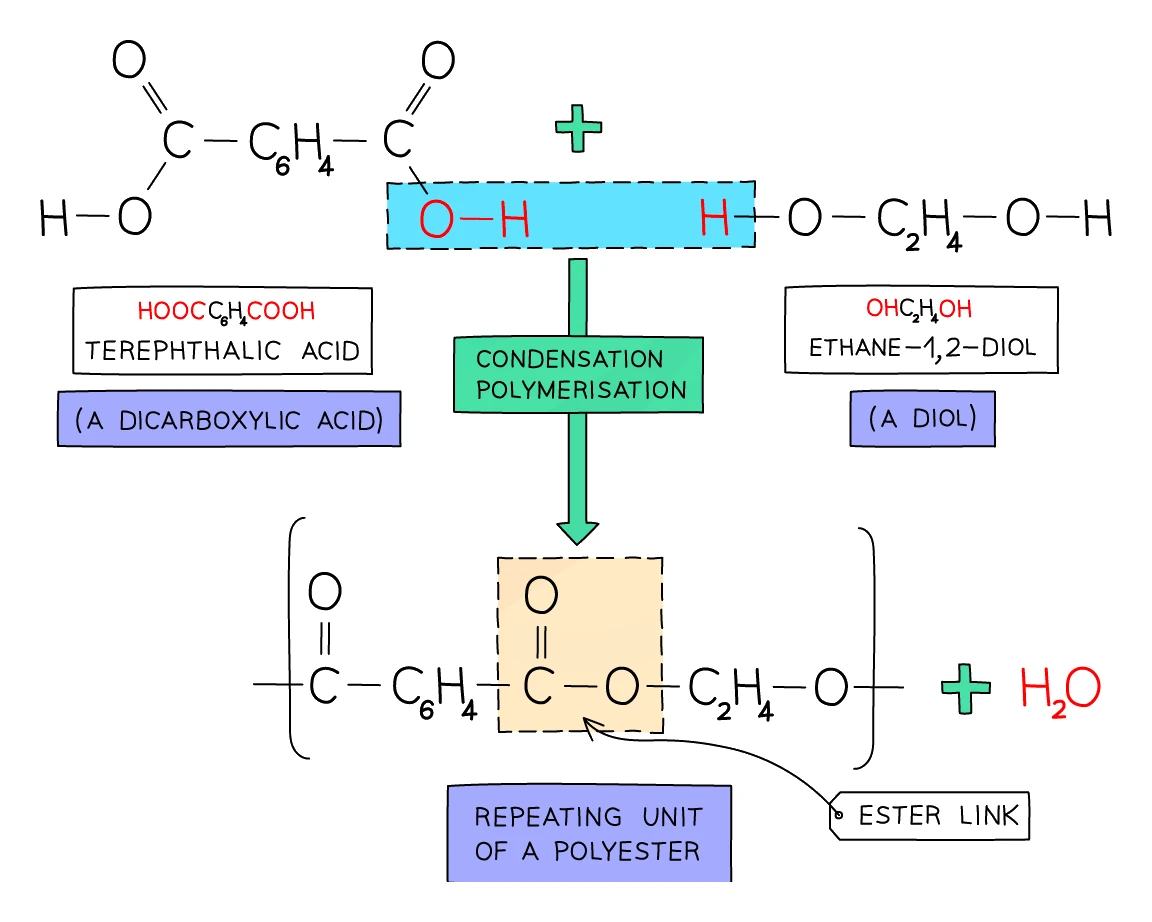
Working backward: identifying the diol and diacid from a polyester
- Given the displayed formula of a polyester section, you can find the two monomers by treating the polyester as if it were hydrolysed back into its starting materials
- A step-by-step approach:
- Identify every ester linkage −COO− in the chain
- Break the chain at the single bond between the carbonyl carbon and the next oxygen — the section ending in "−C(=O)−" came from the dicarboxylic acid, and the section ending in "−O−" came from the diol
- Add an −OH to the carbonyl carbon to rebuild the carboxylic acid −COOH
- Add an −H to the oxygen of the diol fragment to rebuild the alcohol −OH
- The two resulting molecules are the diacid and the diol from which the polyester was made
Common exam question
Drawing the repeat unit of a polyester
Question: Draw the displayed formula of the repeat unit of a polyester made from a given dicarboxylic acid and diol (2 marks).
Asked in 4 of the 23 papers, all on Paper 2. The first mark is a correctly drawn ester linkage, its C=O and single-bonded O shown in full; the second is the rest of the unit: the acid's carbons on one side of the linkage, the diol's on the other, with an −OH lost from each acid group and an −H from each alcohol group at the join. In two of the four schemes the second mark depends on the first. Extension bonds are allowed but not required, brackets and n are ignored, and one scheme accepts the unit written in either direction.
The reverse question, giving the two monomers from a printed repeat unit, was set once: one mark per monomer, and structural formulae are accepted, so you need not draw every bond.
Biopolyesters
- Most synthetic polyesters (terylene, PET) are derived from petrochemicals and do not biodegrade quickly
- Biopolyesters are a newer family made from monomers obtained from plant sugars and plant oils, often with the help of microorganisms
- The chains contain ester linkages (and sometimes amide or ether linkages) that bacteria in the soil can attack, so the material gradually breaks down into harmless small molecules
- Biopolyesters are used in compostable packaging, single-use cutlery, and surgical sutures that the body can absorb after a wound heals
| Feature | Addition polymerisation | Condensation polymerisation |
|---|---|---|
| Number of monomer types | One | Two (each with a functional group on each end) |
| Monomer functional group | C=C double bond | −COOH and −OH (for polyesters) |
| Products | Polymer only | Polymer + a small molecule (usually water) per link |
| Example polymer | Poly(ethene), poly(propene), PVC, PTFE | Terylene (polyester), nylon (polyamide) |
| Repeat unit ends in | Single C–C bonds along the backbone | Ester linkages (−COO−) along the backbone |