4CH1
The Reactivity Series
Inorganic Chemistry · 1 question type
Conditions for rusting
- Rust is the orange-brown flaky oxide that forms on iron and steel
- Both air (oxygen) and water must be present for iron to rust — neither on its own is enough
- The chemical name for rust is hydrated iron(III) oxide, Fe2O3·xH2O
Investigating the conditions
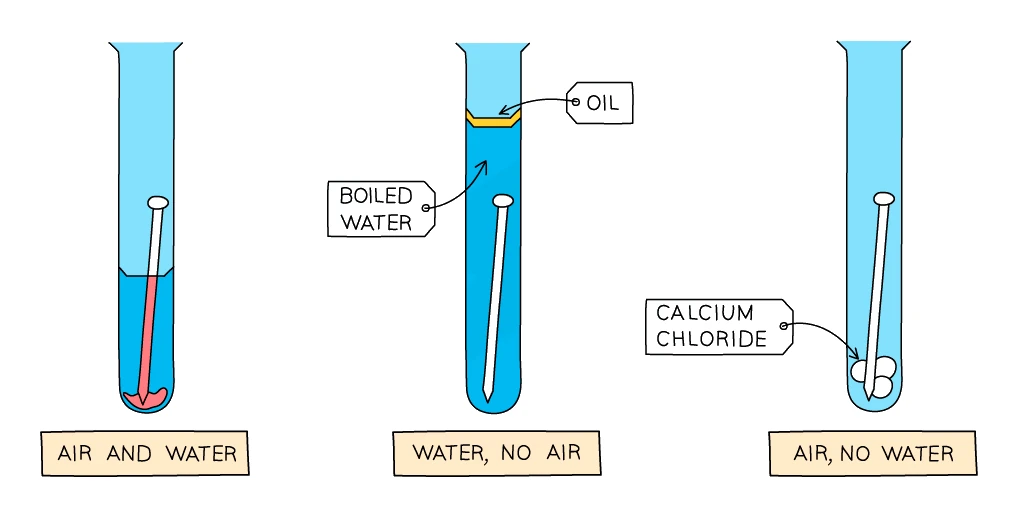
- Set up three test tubes, each containing a clean iron nail:
- Tube A — open to the air, partly filled with tap water (contact with both air and water)
- Tube B — partly filled with water that has been boiled to drive off dissolved oxygen, then sealed with a layer of oil on top (contact with water but not air)
- Tube C — contains a drying agent such as anhydrous calcium chloride, sealed with a stopper (contact with air but not water)
- After several days:
- The nail in tube A is rusty
- The nails in tubes B and C are unchanged
- Conclusion: both oxygen and water are required; removing either prevents rusting
Why rusting is a problem
- Rust is soft and flakes off the metal, exposing a fresh iron surface underneath
- Once started, rusting therefore continues right through the bulk of the iron, weakening structures over time
- This is different from the protective oxide that forms on aluminium, which seals the surface and stops further reaction
Prevention by barrier methods
- Coating iron physically isolates the metal from oxygen and water
- Common barrier coatings: paint, oil, grease, plastic, and an electroplated layer of an unreactive metal (such as tin on tin cans)
- Drawback: if the coating is scratched, the bare iron is exposed and rust begins, often spreading under the coating
Prevention by sacrificial protection
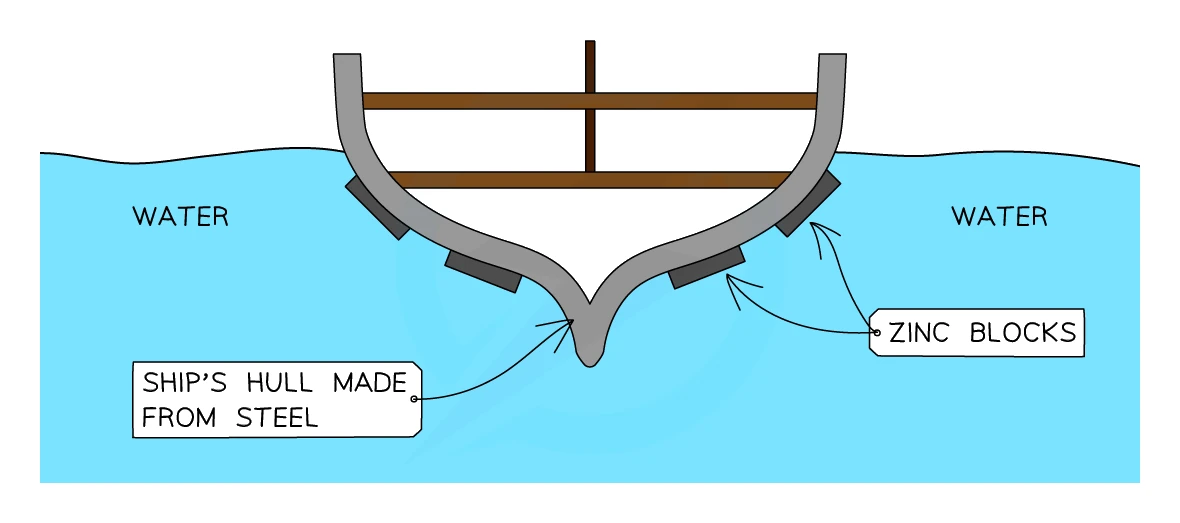
- A more reactive metal is bolted to the iron object
- The more reactive metal corrodes preferentially because it loses electrons more readily, so the iron stays intact
- Zinc blocks attached to the steel hulls of ships are a textbook example: the zinc corrodes away first and is replaced periodically
Galvanising
- coats the iron with a layer of zinc, applied by dipping the iron into molten zinc or by electroplating
- The zinc layer protects in two ways at once:
- As a barrier, it keeps oxygen and water away from the iron underneath
- As , if the coating is scratched the zinc still corrodes preferentially, so the exposed iron is not attacked
Exam tip
Explaining why galvanising prevents rusting (two marks)
What comes up: the exam asks you to explain why galvanising works as a method of rust prevention, often in the context of a scratched zinc coating still protecting the iron beneath.
Write (two marks): (1) zinc is more reactive than iron (or: zinc is higher in the reactivity series than iron). (2) zinc therefore oxidises, corrodes, or reacts with oxygen in preference to iron — so the iron is protected even when the coating is damaged.
Watch out: the mark scheme rejects "zinc rusts" as a description of what the zinc does — rust refers specifically to iron. Say zinc oxidises or corrodes instead.
A note on terminology
- Corrosion is the general term for the slow chemical attack of a metal surface by its environment
- Rusting is specifically the corrosion of iron — every rusting reaction is a corrosion reaction, but not every corrosion reaction is rusting