The Reactivity Series
Inorganic Chemistry · 1 question type
In terms of oxygen
- Oxidation is the gain of oxygen by a substance
- Reduction is the loss of oxygen from a substance
- The two always happen together in the same reaction — a redox reaction
- In Zn + CuO → ZnO + Cu:
- Zinc gains oxygen → zinc is oxidised → zinc is the (it caused the reduction of CuO)
- Copper(II) oxide loses oxygen → it is reduced → CuO is the
In terms of electrons
- The more general definitions use electron transfer:
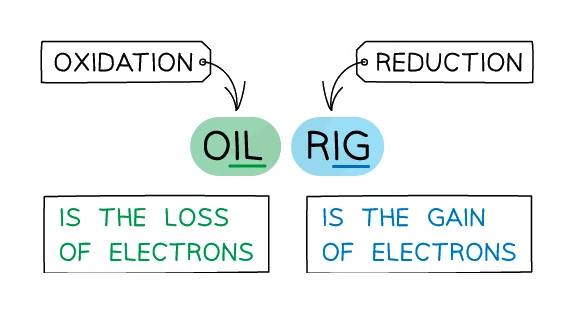
- is loss of electrons
- is gain of electrons
- Mnemonic: OIL RIG (Oxidation Is Loss, Reduction Is Gain)
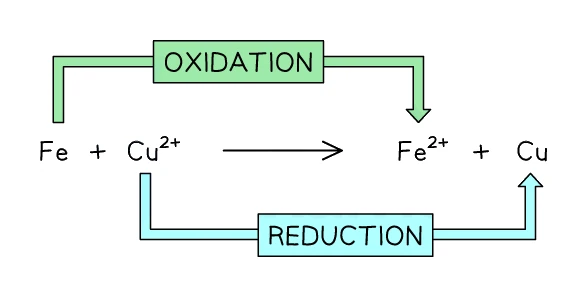
- For the displacement reaction Mg(s) + Cu2+(aq) → Mg2+(aq) + Cu(s):
- Mg → Mg2+ + 2 e− (oxidation — Mg loses electrons)
- Cu2+ + 2 e− → Cu (reduction — Cu2+ gains electrons)
- Mg is the reducing agent (gives away electrons); Cu2+ is the oxidising agent (accepts them)
Explaining why a displacement reaction is redox (two marks)
What comes up: a two-mark question asks you to explain why a metal displacement reaction (for example, aluminium reducing iron oxide) is a redox reaction.
Write (two marks): (1) one substance gains oxygen (or loses electrons) and is oxidised — state which one. (2) the other substance loses oxygen (or gains electrons) and is reduced — state which one. For example: aluminium gains oxygen and is oxidised; iron(III) oxide loses oxygen and is reduced.
Watch out: the mark scheme rejects "iron loses oxygen" as the description of what is reduced — it is iron(III) oxide (the compound) that loses oxygen, not iron itself. Name the compound, not the metal element.
Spectator ions and ionic equations
- In the full equation Mg(s) + CuSO4(aq) → MgSO4(aq) + Cu(s), the sulfate ion SO42− appears on both sides unchanged
- An ion that is unchanged in a reaction is a spectator ion — it does not take part in the chemistry
- Leaving out the spectator ions gives the ionic equation, which highlights the actual redox change: Mg(s) + Cu2+(aq) → Mg2+(aq) + Cu(s)
A practice prompt
- In the reaction Cu(s) + 2 AgNO3(aq) → Cu(NO3)2(aq) + 2 Ag(s), Cu loses two electrons to form Cu2+ (oxidation) while each Ag+ gains one electron to form Ag (reduction)
- Copper is therefore the reducing agent here, and silver(I) is the oxidising agent