The Reactivity Series
Inorganic Chemistry · 1 question type
The displacement principle
- A more reactive metal will displace a less reactive metal from its compound
- This applies to two situations:
- Heating a metal with a solid metal oxide
- Adding a metal to an aqueous solution of a metal salt
- The reactive metal takes the oxygen, or the negative ion, leaving the less reactive metal as the free element
Displacement from metal oxides
- Heat zinc powder with copper(II) oxide:
Zn(s) + CuO(s) → ZnO(s) + Cu(s)
- Zinc takes the oxygen, leaving copper as the brown solid product
- Zinc is the **reducing agent** (it removes oxygen); copper(II) oxide is the **oxidising agent**
- The thermite reaction uses aluminium to extract iron from iron(III) oxide:
2 Al(s) + Fe2O3(s) → 2 Fe(l) + Al2O3(s)
- The reaction releases enough heat to melt the iron, which is why thermite was used to weld railway tracks
- No reaction occurs if the added metal is less reactive than the metal in the oxide (e.g. silver added to lead(II) oxide does nothing)
Displacement from salt solutions
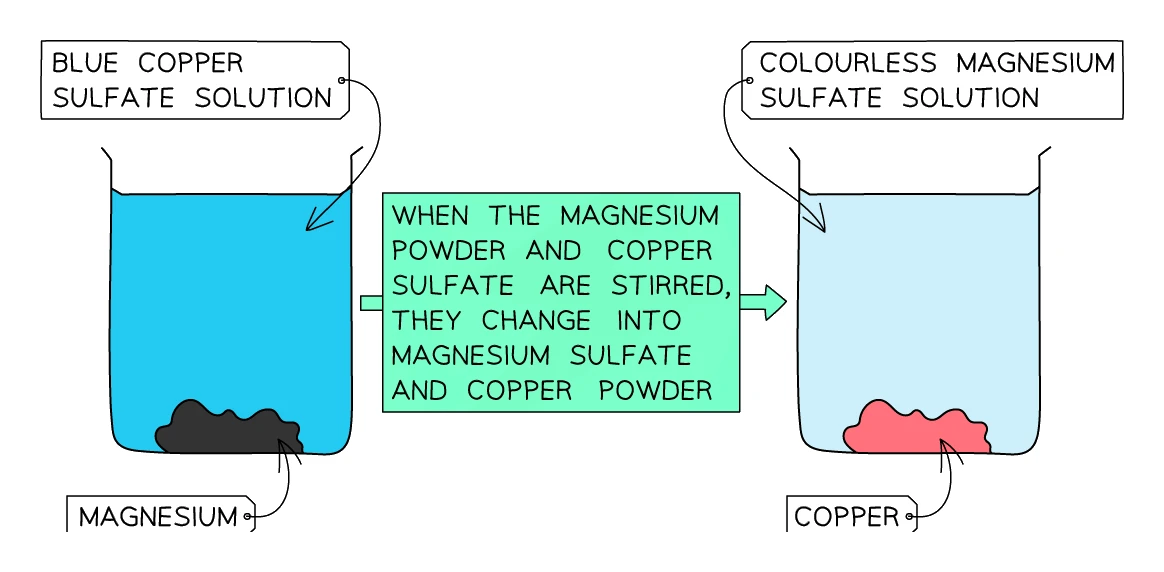
- Add a strip of magnesium to blue copper(II) sulfate solution:
Mg(s) + CuSO4(aq) → MgSO4(aq) + Cu(s)
- The blue colour fades as colourless magnesium sulfate forms
- Pink-brown copper plates onto the magnesium and any loose metal sinks to the base of the beaker
- Add iron filings to copper(II) sulfate solution:
Fe(s) + CuSO4(aq) → FeSO4(aq) + Cu(s)
- Pale-green iron(II) sulfate forms, copper coats the iron
- A metal placed in a salt solution of a more reactive metal gives no reaction (e.g. copper in zinc sulfate does nothing)
Describing observations in a displacement experiment
What comes up: the exam gives you a displacement reaction in solution (for example, adding iron to copper sulfate) and asks you to name the type of reaction and describe what you see.
Write (two marks): (1) name it a displacement reaction (the mark scheme also accepts redox / oxidation and reduction). (2) describe the solid product by colour: for copper depositing, the credited colour is pink-brown or pink; the mark scheme also accepts orange-brown and red-brown but rejects "red" alone, and ignores simply writing "copper".
Watch out: a metal cannot displace itself — a metal in a solution of its own salt gives no reaction because it is not more reactive than its own ions.