Chemical Tests
Inorganic Chemistry · 4 question types
Why use a flame test
- Some metal cations look identical in solution and give similar hydroxide precipitates, so a flame test is used: the cation is recognised from the colour it gives to a hot Bunsen flame
- The test is quick, qualitative, and works on solids or solutions of the metal salt
Carrying out the test
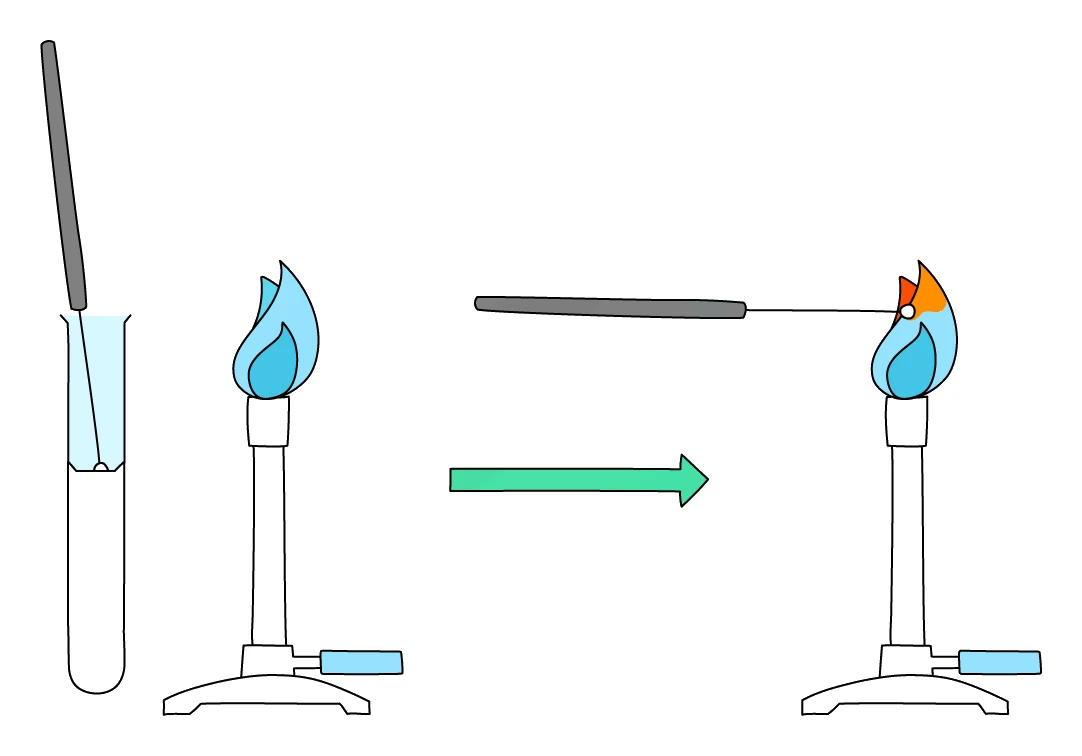
- Dip the loop of a clean nichrome or platinum wire into dilute hydrochloric acid
- Hold the wet loop in the hottest part of a roaring Bunsen flame until any residual colour burns off — this cleans the loop of any previous sample
- Touch the cleaned wet loop into the solid or solution being tested so that a small amount sticks to it
- Place the loaded loop at the edge of the roaring blue Bunsen flame and watch the colour
- Cleaning between tests matters because two different ions on the same loop give a mixed flame in which one colour can mask the other
Flame colours to memorise
| Cation | Flame colour |
|---|---|
| Lithium, Li⁺ | Crimson red |
| Sodium, Na⁺ | Yellow / golden-orange |
| Potassium, K⁺ | Lilac (pale purple) |
| Calcium, Ca²⁺ | Orange-red (brick red) |
| Copper(II), Cu²⁺ | Blue-green |
- The flame must be blue (air-hole open) so the burner's own colour does not mask the result
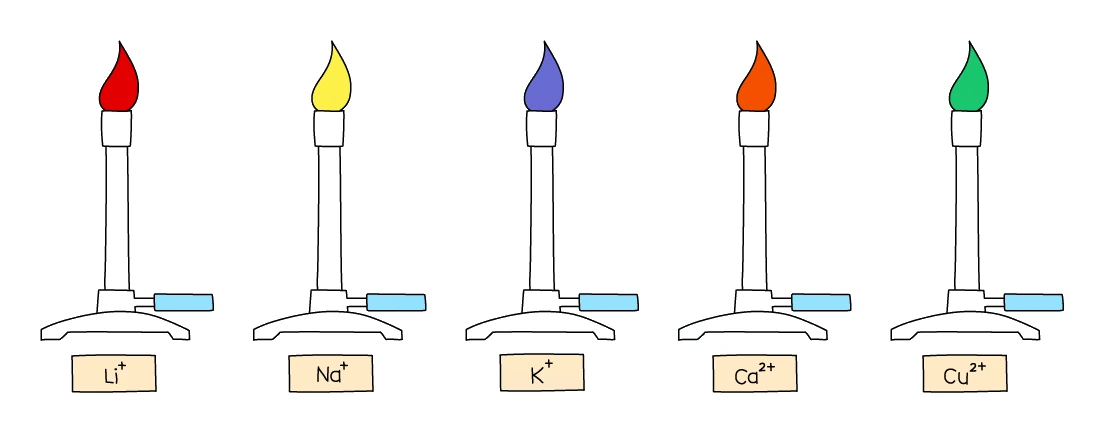
Flame colours and the cleaning step
What comes up: State the flame colour for a given metal ion, or explain why the wire loop must be cleaned between tests.
Write: Lithium gives a crimson (red) flame; sodium gives yellow; potassium gives lilac; calcium gives orange-red; copper(II) gives blue-green. For the cleaning step: (1) dip the wire in acid and hold it in the flame, (2) so that any residue from a previous sample does not interfere with (mask) the colour of the flame.
Watch out: Lithium is crimson or red — the mark scheme rejects brick-red for lithium (in papers where lithium is the target ion). Calcium is orange-red; "red alone" is ignored in some mark schemes, so write orange-red to be safe. Potassium is lilac or purple; other colours score zero. Blue-green is accepted for copper; writing just "green" may be credited, but blue-green is the safest answer.