Chemical Tests
Inorganic Chemistry · 4 question types
Carbonate ion, CO32−
- Add a few drops of dilute acid (HCl or HNO3) to the solid or solution
- (fizzing) is seen as carbon dioxide is released:
CO32−(aq) + 2 H⁺(aq) → CO2(g) + H2O(l)
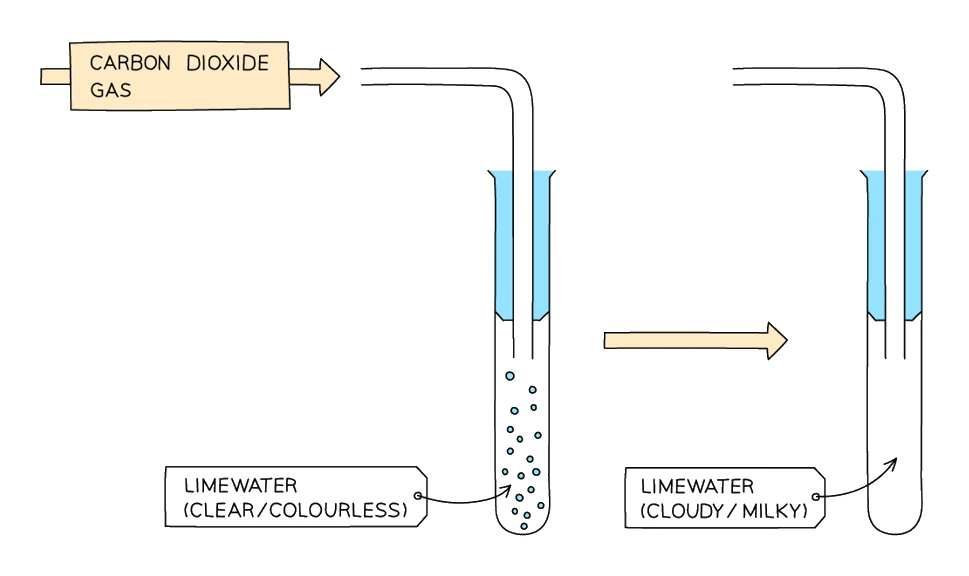
- Confirm the gas is carbon dioxide by passing it through limewater — the turns milky as insoluble calcium carbonate forms:
CO2(g) + Ca(OH)2(aq) → CaCO3(s) + H2O(l)
- The exam-mark wording is "bubble the gas through limewater; if carbonate is present the limewater turns milky" — saying only "limewater turns milky" is the result, not the test
Halide ions, Cl⁻ / Br⁻ / I⁻
- Acidify the sample first with a few drops of dilute nitric acid — this destroys any carbonate impurity that would otherwise give a false-positive precipitate
- Add a few drops of solution, AgNO3(aq)
- A silver halide precipitate forms whose colour identifies the halide:
| Halide | Equation (with KX representing the metal halide) | Precipitate colour |
|---|---|---|
| Chloride, Cl⁻ | KCl(aq) + AgNO3(aq) → AgCl(s) + KNO3(aq) | White |
| Bromide, Br⁻ | KBr(aq) + AgNO3(aq) → AgBr(s) + KNO3(aq) | Cream |
| Iodide, I⁻ | KI(aq) + AgNO3(aq) → AgI(s) + KNO3(aq) | Yellow |
- Use nitric acid (not hydrochloric) for the acidification step — HCl introduces chloride ions and would give a false positive
- Memorise the colour order: white → cream → yellow as the halide moves down the group
Halide ion test — the acid choice matters
What comes up: Describe how to test for chloride, bromide or iodide ions, and state the result.
Write (two marks minimum): (1) Acidify the sample with dilute nitric acid, then add silver nitrate solution. (2) A white precipitate indicates chloride; cream indicates bromide; yellow indicates iodide.
Watch out: The mark scheme rejects hydrochloric acid and sulfuric acid as the acidifying agent — using HCl introduces chloride ions that would give a false positive, and H₂SO₄ is rejected outright. You must use nitric acid. Also: the cream (bromide) and white (chloride) results are only credited if silver nitrate has been added; stating just a "white precipitate" without naming silver nitrate scores nothing for the observation.
Sulfate ion, SO42−
- Acidify the sample with dilute hydrochloric acid — this removes any carbonate impurity that would otherwise precipitate as BaCO3 and confuse the result
- Add a few drops of solution, BaCl2(aq) (barium nitrate also works)
- A white of barium sulfate forms if sulfate ions are present:
Ba²⁺(aq) + SO42−(aq) → BaSO4(s)
- Why HCl this time (not HNO3): no chloride ion would interfere with the BaSO4 result, but a carbonate would form BaCO3 (also white) and give a false positive
Sulfate ion test — which acid to use
What comes up: Describe the test for sulfate ions.
Write (two marks): (1) Add acidified barium chloride solution (or barium nitrate solution) to the sample. (2) A white precipitate of barium sulfate forms if sulfate ions are present.
Watch out: The mark scheme rejects sulfuric acid as the acidifying agent — using H₂SO₄ introduces sulfate ions and would give a false positive. Any other named acid is accepted. The white precipitate mark depends on barium chloride or barium nitrate being named in the previous step; a bare statement of "white precipitate" without identifying the reagent scores nothing.