Chemical Tests
Inorganic Chemistry · 4 question types
The general idea
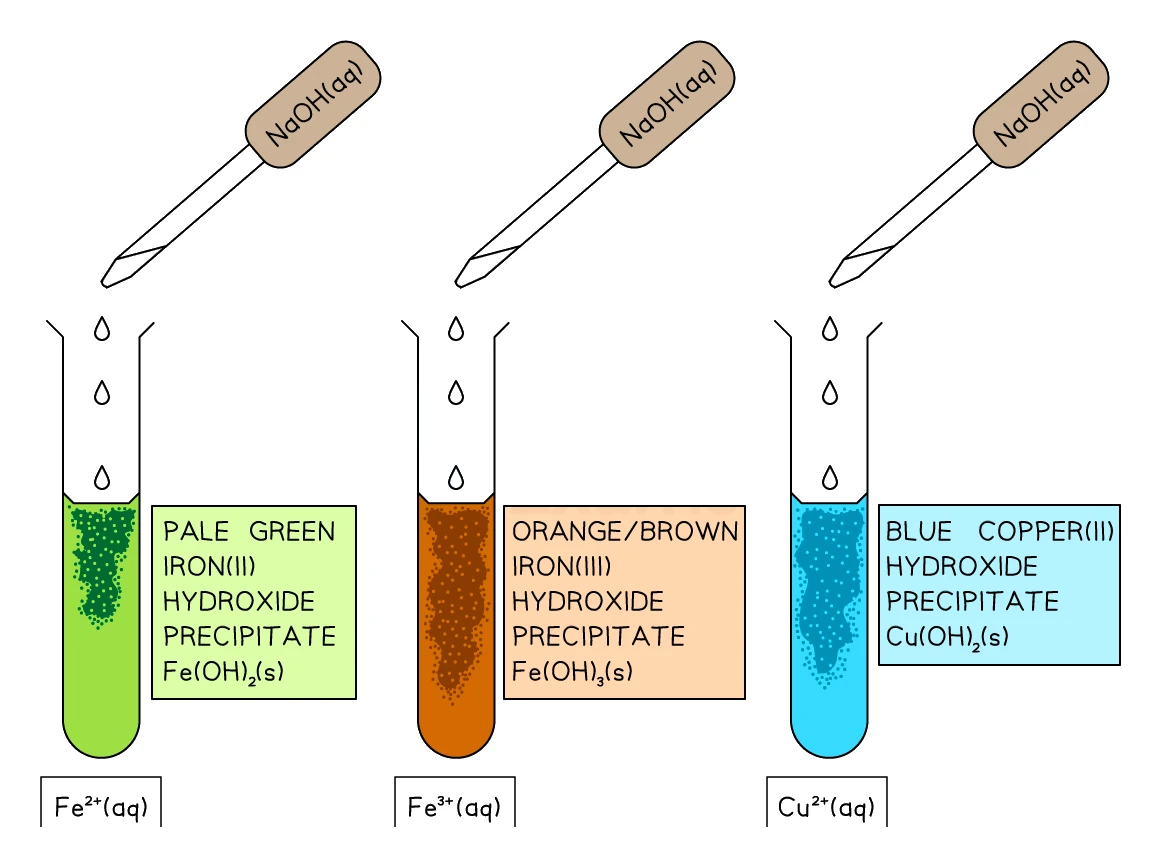
- Aqueous sodium hydroxide is dripped into a solution of the unknown cation
- If the metal hydroxide is insoluble, it appears as a coloured that identifies the metal
- The colour of the precipitate is the diagnostic feature
Iron(II), iron(III) and copper(II)
| Cation | Ionic equation | Precipitate colour |
|---|---|---|
| Fe²⁺ (iron(II)) | Fe²⁺(aq) + 2 OH⁻(aq) → Fe(OH)2(s) | Pale green |
| Fe³⁺ (iron(III)) | Fe³⁺(aq) + 3 OH⁻(aq) → Fe(OH)3(s) | Orange-brown (rust colour) |
| Cu²⁺ (copper(II)) | Cu²⁺(aq) + 2 OH⁻(aq) → Cu(OH)2(s) | Light blue |
- Use the exam wording "light blue" for copper(II); just "blue" can lose marks
- Adding excess NaOH does not redissolve any of these three precipitates, which is why a few drops are enough
Ammonium ion, NH4+
- Add aqueous sodium hydroxide to the unknown sample and warm the mixture gently
- If ammonium ions are present, ammonia gas is released:
NH4+(aq) + OH⁻(aq) → NH3(g) + H2O(l)
- Identify the gas with damp red litmus paper held at the mouth of the tube: the paper turns blue, confirming ammonia and therefore ammonium ions
- Keep the test specifically clear in your answers: NH4+ is the ion in solution; NH3 is the gas released
Identifying Fe²⁺, Fe³⁺ and NH₄⁺ with sodium hydroxide
What comes up: Describe how to distinguish iron(II) from iron(III), or how to confirm an ammonium ion is present.
Write (for iron ions, two marks): (1) Add sodium hydroxide solution to the sample. (2) A green precipitate identifies iron(II); a brown (or red-brown/orange-brown) precipitate identifies iron(III).
Write (for ammonium ion, three marks): (1) Add sodium hydroxide solution and warm the mixture. (2) Test the gas produced with damp red litmus paper held at the mouth of the tube. (3) The litmus paper turns blue, confirming ammonia and therefore ammonium ions are present.
Watch out: For the ammonium test, the litmus paper must be held at the mouth of the tube — not dipped into the solution. The mark scheme does not award the observation marks if you test the solution directly with litmus. Also note: for iron(III), orange-brown and red-brown are accepted alongside brown, but make sure to distinguish it clearly from the pale green of iron(II).