Forces, Movement & Changing Shape
Forces & Motion
What terminal velocity is
- Terminal velocity is the largest steady speed a falling object reaches once the air pushing up on it has grown enough to balance its weight
- At terminal velocity:
- the upward push from matches the downward pull of exactly in size
- the resultant force is zero
- the object stops accelerating and falls at a constant
The four stages of a falling object
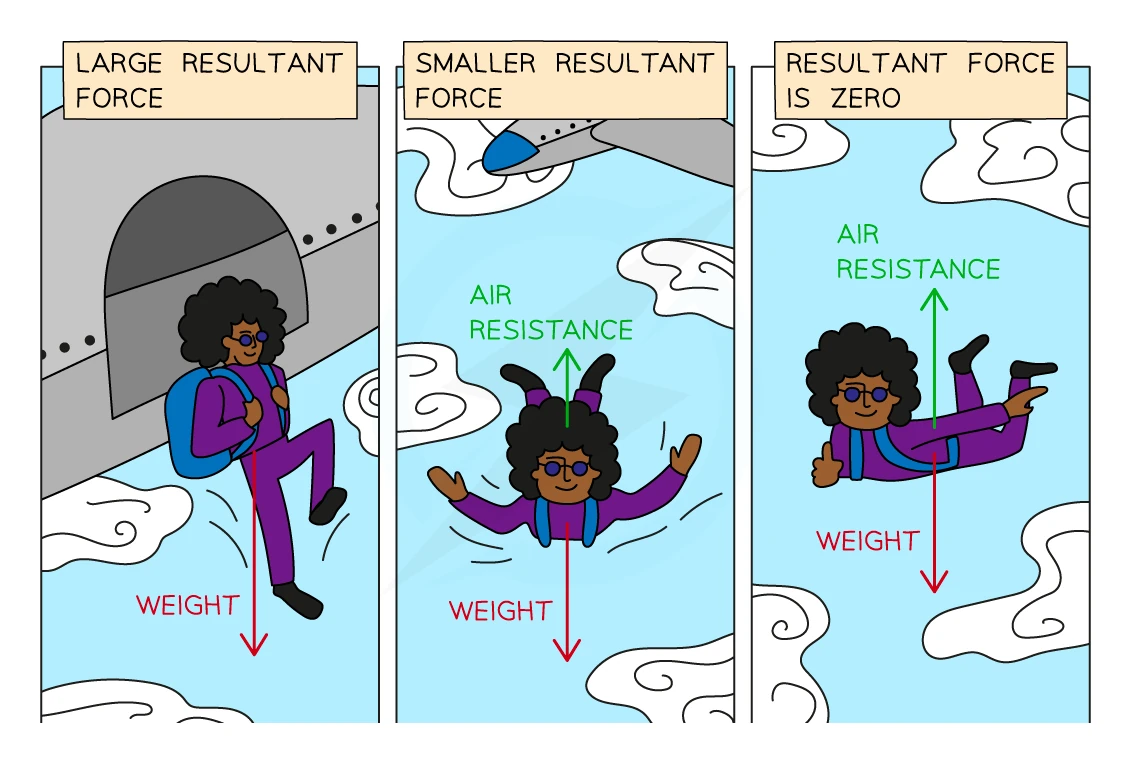
- Stage 1, the moment of release. Only weight acts (air resistance is zero because there is no relative motion through the air). The resultant force is the full weight pulling downwards, so the object accelerates downwards at the acceleration of free fall, g
- Stage 2, early fall. The object now has a small downward speed, so air particles begin to collide with it and a small upward air resistance appears. Weight still wins, so the object continues to accelerate downwards, but at a slightly reduced rate
- Stage 3, as the speed climbs, air resistance climbs with it (more air particles hit per second, and harder). The resultant force shrinks, so the acceleration shrinks. The object is still gaining speed, but more slowly
- Stage 4, the speed reaches the point where air resistance equals weight. Resultant force is now zero, acceleration is now zero, and the object falls at a constant
Common exam question
Explaining the motion of a falling object using forces
Question: Explain how a falling object reaches terminal velocity, or why a parachutist slows when the parachute opens, using ideas about forces (3–5 marks).
Asked in 4 of the 24 papers, each marked from a list of points, so tell the whole story in order. Name weight and drag (air or water resistance): "gravity" on its own is ignored, and so is upthrust. At first weight is larger than drag, so there is a resultant force downwards and the object accelerates. As the speed rises drag rises, so the resultant force and the acceleration decrease. At terminal velocity drag equals weight, the resultant force is zero and the velocity is constant: in one scheme that final point is compulsory. F = ma on its own did not earn the resultant-force point in one scheme, so link it to the unbalanced forces.
When a parachute opens the sequence reverses: air resistance is now larger than weight, so the resultant force and the acceleration are upwards, and the parachutist slows until drag again equals weight. "Decelerates" or "slows down" is ignored where "the acceleration is upwards" is wanted.