Forces, Movement & Changing Shape
Forces & Motion
The law
- states that, up to the , the of an elastic object (such as a spring) is directly proportional to the stretching it
- Directly proportional means:
- doubling the stretching force doubles the extension
- halving the stretching force halves the extension
- a plot of force against extension is a straight line through the origin within the proportional region
Common exam question
Showing Hooke's law on a force-extension graph
Question: Sketch a graph to show that a spring obeys Hooke's law, labelling both axes, or explain from a plotted graph whether it does (1–3 marks).
Asked in 5 of the 24 papers. For the sketch the three marks are: axes labelled force (load or weight) and extension, units ignored and either way round; a straight line with a positive gradient throughout; and the line passing through the origin. A curve at the end is condoned only if you mark where Hooke's law stops, such as the limit of proportionality; one scheme ignored "elastic limit", so the curve then cost the straight-line mark.
For a plotted or printed graph, say the same things in words: force is proportional to extension, the line is straight and it passes through the origin, with no sign that the elastic limit has been passed. A rubber band disobeys it because its line is curved (differing loading and unloading lines also count); "not proportional" alone is ignored. "Extension increases with force" earns one mark, adding that it is linear earns the second, and Hooke's law named with nothing else is worth a single mark.
Limit of proportionality
- Every elastic material has a , a stretching force beyond which extension no longer keeps step with the force
- Past this limit, the force-extension graph bends away from its straight section: each extra newton produces a larger extra extension than before
- The exact value of the limit depends on the material and on its dimensions
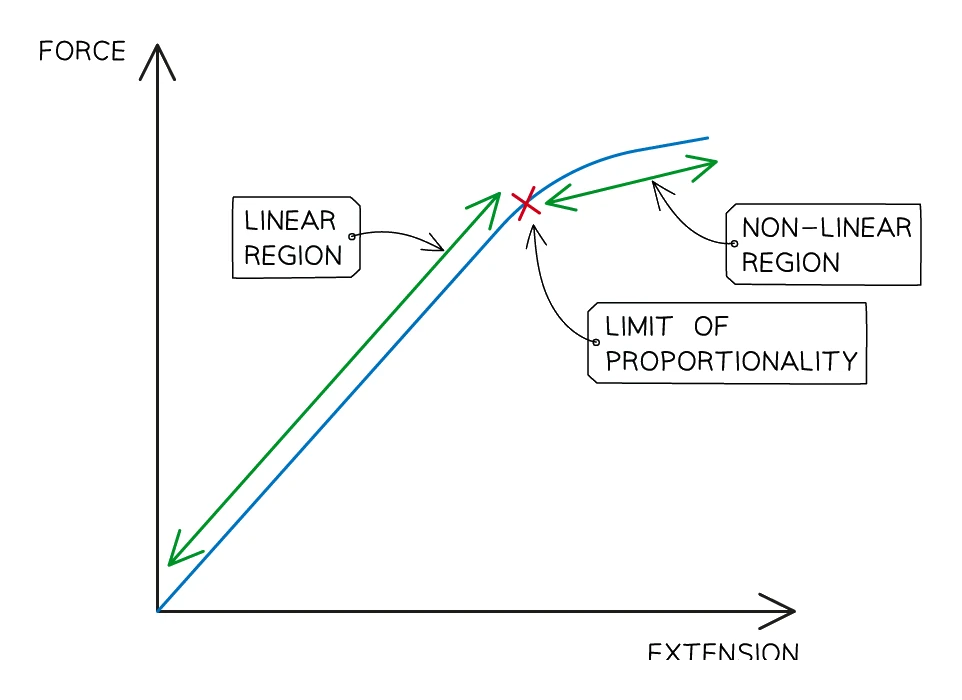
Elastic and inelastic deformation
- Deformation is any change in an object's original shape produced by a force
- Two outcomes are possible when the force is removed:
- , where the object returns to its original shape and size. Examples: a steel spring, a rubber band, most fabrics, a tennis ball after a bounce
- (also called plastic deformation), where the object stays permanently changed even after the force is removed. Examples: a clay tile that has been moulded, a paperclip that has been bent past straightening, a metal drinks can that has been crushed
- Hooke's law is a statement about the elastic region of a material; once a material has been pushed into inelastic deformation, it does not spring back to the origin of the force-extension graph
Common exam question
Elastic behaviour and exceeding the elastic limit
Question: Describe what is meant by elastic behaviour, explain how a loading-unloading graph shows that a material is elastic, or explain what happens to a spring stretched by too large a force (1–2 marks).
Asked in 4 of the 24 papers. Elastic behaviour is two marks, so give both halves: the material returns to its original length or shape, and it does so when the force is removed ("load", "mass" or "weight" are all taken for the force). On a loading-unloading graph the two marks are that the unloading line returns to the origin (no extension) and that it does so once the force is removed; the shape of the loop is ignored. For a force that is too large, the two marks are that the spring passes its elastic limit (limit of proportionality is accepted) and is permanently deformed, no longer returning to its original length; "it breaks" and "it loses its elasticity" are ignored. A spring that has lost its elastic behaviour settles longer than it started, and any value above the original length up to the loaded length is credited.