Forces, Movement & Changing Shape
Forces & Motion
What the resultant force is
- The on an object is the single force that has the same effect as all the individual forces added together, direction included
- It determines:
- the direction the object will move (or accelerate) in
- the magnitude of the net push or pull the object actually experiences
- The resultant alone matters for the motion; once you have it, you can ignore the individual forces
Adding forces along a line
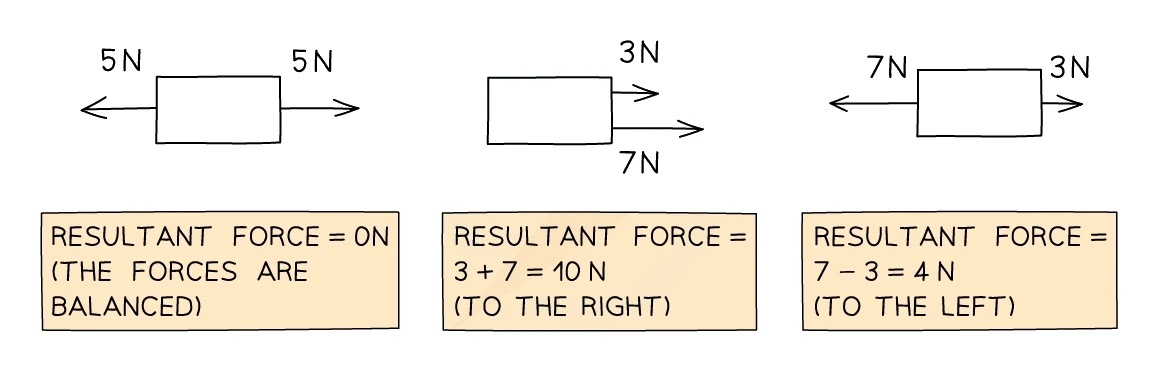
- Forces along the same straight line combine by simple addition, taking sign into account:
- Forces pointing the same way are added together
- Forces pointing in opposite directions are subtracted
- A final answer is only complete when both magnitude and direction are stated, in newtons and as a compass-style direction or left/right/up/down
Common exam question
Finding the resultant of forces along a line
Question: Calculate the magnitude and direction of the resultant force from a diagram of forces acting along one line, or state the resultant force on an object that is at rest (1–2 marks).
Asked in 5 of the 24 papers. Add the forces that point the same way, subtract the opposing total and give the direction as a word (up, left) or as "the same direction as the larger force": the sign of your number is ignored, "west" for left is only condoned and an unqualified "north" is ignored. An object at rest, or floating, has a resultant of 0 N, a one-mark answer in its own right. The resultant often feeds the next part, and a wrong value is carried forward through a correct F = ma method. In one paper the resultant and the larger force were given and the weight had to be found by subtracting one from the other before the mass could be calculated.
Friction inside the resultant
- Friction is the force that opposes motion of an object across or through another material
- On a free-body diagram, a friction arrow points opposite to whichever way the object is sliding
- Drag and air resistance are both special cases of friction: drag inside any fluid, air resistance inside air specifically