PhysicsExam code: 4PH1
Forces, Movement & Changing Shape
Forces & Motion
Types of Forces
What a force is
- A force is a push or a pull that one object exerts on another whenever the two objects interact
- The SI unit of force is the newton (N)
- Force is a vector quantity: it has both a magnitude and a direction (see section 2)
The named forces in the syllabus
- Weight (gravitational force): the pull of a planet on every object that has mass. A bigger mass feels a bigger weight when placed in the same gravitational field
- Reaction force (normal contact force): the push a surface exerts on an object that rests on it. It acts perpendicular to the surface
- Friction: a force that opposes the motion of an object as it slides over another surface. Friction arises because no two surfaces are perfectly smooth at the molecular scale; tiny irregularities catch against one another
- Drag force: friction in a fluid (a liquid or a gas). The fluid's particles bump into the moving object and slow it down
- Air resistance: a special case of drag where the fluid is air. The force grows as the object moves faster, because more air particles hit it per second
- Thrust: a forward driving force produced by an engine, jet or rocket
- Upthrust: the upward push that a fluid exerts on any object floating in or submerged in it
- Electrostatic force: the attraction between opposite charges and repulsion between like charges
- Magnetic force: the attraction between unlike poles and repulsion between like poles
- Tension: the pull that runs along a stretched rope, wire, cable or spring when something is pulling on each end
Three things forces can do
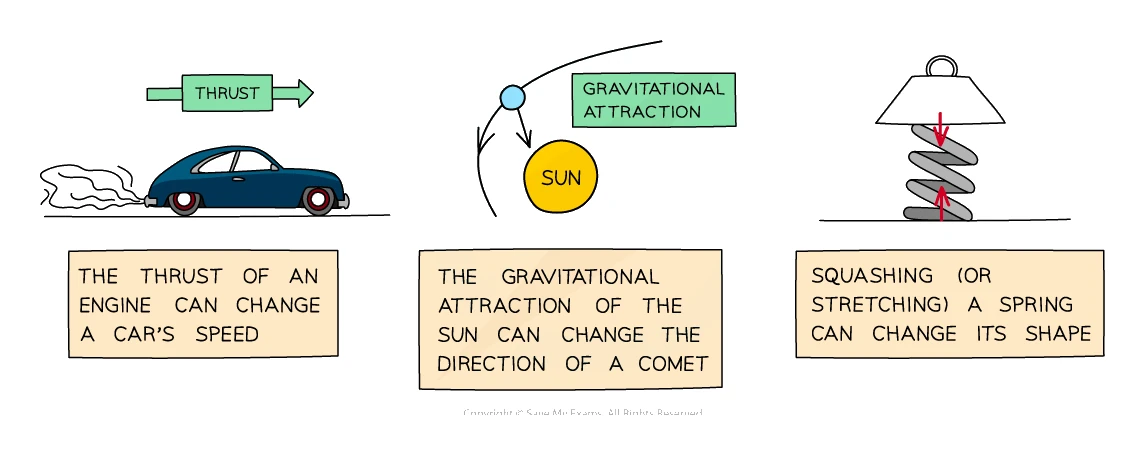
- A force acting on an object can:
- change its speed (cause it to accelerate or decelerate along the same direction)
- change its direction of motion
- change its shape (stretch, squash, bend or twist it)
Vocabulary cautions
- Refer to the gravitational pull on an object as its in exam answers, because the word "gravity" can ambiguously mean either the force or the field strength, and mark schemes often reject it
- For the upward push that a falling object feels, use (or drag). "Wind resistance" is not a physics term, and "air pressure" is a different concept altogether