Forces, Movement & Changing Shape
Forces & Motion
Definition and breakdown
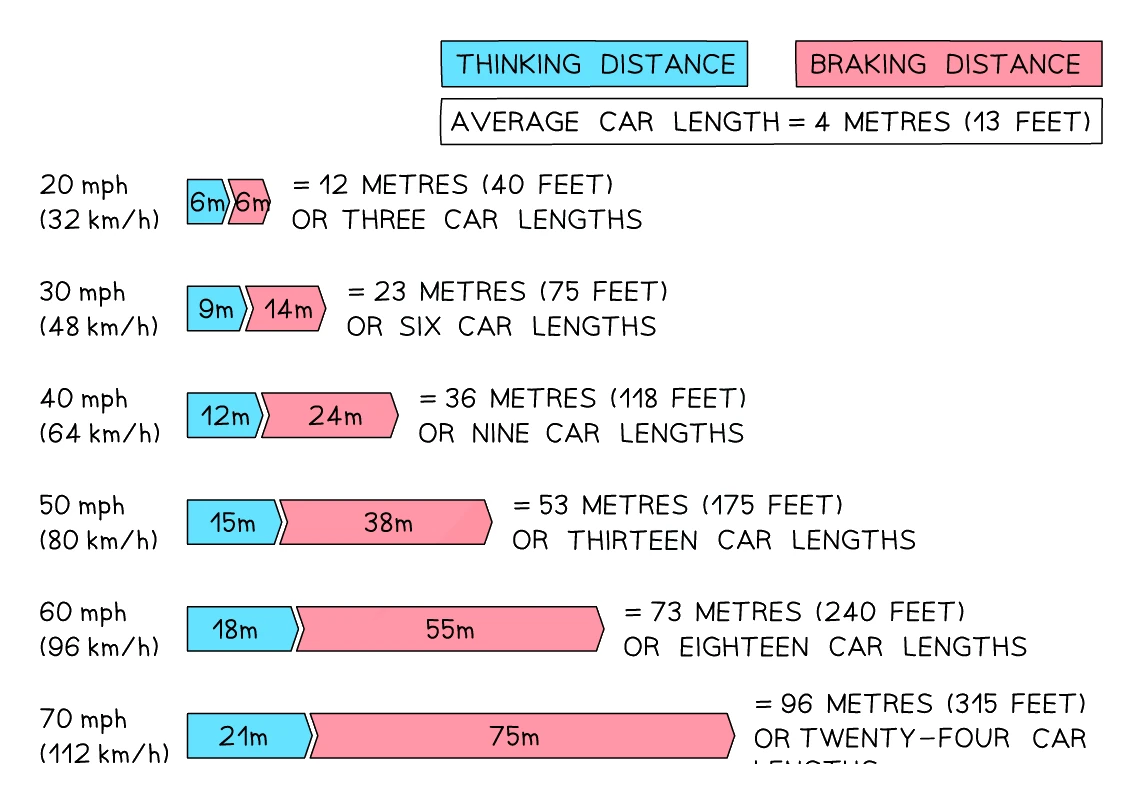
- Stopping distance is the total distance a vehicle travels from the instant the driver spots a hazard to the instant the vehicle finally comes to rest
- It splits into two stages:
stopping distance = thinking distance + braking distance
- Thinking distance = the distance the vehicle covers during the driver's reaction time, before the brakes are even pressed
- Braking distance = the distance the vehicle covers while it is decelerating under the braking force, from the moment the brakes are first applied to the moment it stops
Common exam question
Calculating a braking or stopping distance
Question: Work out the thinking distance, the braking distance or the total stopping distance of a vehicle, from a graph or from the speed, reaction time, mass and braking force (2–4 marks per part).
Set in 3 of the 24 papers, each by a different route. From a graph of thinking and braking distance against speed, read both distances at the given speed and add them: stating stopping distance = thinking distance + braking distance is a mark on its own, and readings are accepted within a small tolerance. From a velocity-time graph, the braking distance is the area under the braking section only. From numbers, chain three steps, each with a substitution mark and an evaluation mark: thinking distance = speed × reaction time, a = F ÷ m, then v² = u² + 2as with v = 0 for the braking distance, a wrong acceleration being carried forward. The s in v² = u² + 2as is the braking distance only: in one scheme, using the stopping distance or the thinking distance instead scored 3 of the 4 marks.
Reaction time and thinking distance
- Reaction time is the time gap between a driver noticing a hazard and starting to act on it
- A typical adult driver's reaction time is about 0.7 s (roughly two-thirds of a second) when alert and undistracted. This is the value the UK Highway Code uses for its stopping-distance tables
- Thinking distance grows with reaction time and with vehicle speed:
- longer reaction time → more time before the brakes are pressed
- higher speed → more metres covered during that reaction time
- Reaction time is lengthened by:
- tiredness
- distractions such as using a phone, eating, or fiddling with controls
- alcohol or drugs
Braking distance
- The braking distance counts every metre the vehicle still rolls forward from the moment the brakes first bite until it finally comes to rest
- For a given braking force, braking distance grows with:
- vehicle speed, because a faster vehicle has more kinetic energy that the brakes must remove
- vehicle , because heavier vehicles need more work done by the brakes to decelerate
- road conditions, because wet, icy or oily roads reduce the friction between tyre and road, lengthening the braking distance
- brake and tyre condition, because worn brakes or bald tyres also lengthen braking distance
Speed dominates
| Speed / mph | Speed / m/s | Approximate stopping distance / m |
|---|---|---|
| 20 | 9 | 12 |
| 30 | 13 | 23 |
| 40 | 18 | 36 |
| 50 | 22 | 53 |
| 60 | 27 | 73 |
- Doubling the speed roughly quadruples the braking distance because braking distance depends on the square of the speed (consistent with v² = u² + 2as)
Common exam question
Effect of a factor on thinking and braking distance
Question: Explain the effect, if any, of a change in the driver (tiredness, alcohol) or in the car and road (ice, tyre grip, brake condition) on the thinking distance and on the braking distance (1–4 marks).
Asked in 2 of the 24 papers, once as two multiple-choice items and once as a four-mark explanation. Deal with the two distances separately. Thinking distance depends on the driver: tiredness, alcohol and distraction lengthen the reaction time, so the thinking distance increases, and that is two marks (the effect, then the reason). Braking distance does not depend on the driver: the credited answer is that there is no effect, because the braking force, and so the braking time, is unchanged, and the idea that human factors do not affect braking distance is accepted as the reason. Ice on the road, worn tyres or weaker brakes lengthen the braking distance, and both distances grow with speed. Writing that tiredness increases the braking distance cannot earn either braking-distance mark.