Forces, Movement & Changing Shape
Forces & Motion
Aim
- Measure the of a spring (or a rubber band, or a length of metal wire) as the stretching on it is increased, and decide whether the two are directly proportional
Variables
- Independent variable: stretching force, F (N), set by hanging known masses
- Dependent variable: extension, e (cm or mm), read off a fixed ruler
- Control variables: the same spring (or rubber band, or wire) used throughout; the same starting attachment point; the same ruler with the same zero alignment
Apparatus
| Equipment | Purpose | Resolution |
|---|---|---|
| Retort stand, clamp and boss, G-clamp | Holds the spring vertically and prevents the stand from toppling as masses are added | — |
| Spring (or rubber band, or thin metal wire) | The object whose extension is being measured | — |
| 100 g slotted masses with a 100 g hanger | Provides the known stretching forces in 1 N steps (since W = 0.1 × 10 = 1 N per mass) | — |
| Vertical ruler clamped beside the spring | Measures the position of a pointer attached to the bottom of the spring | 1 mm |
| Small horizontal pointer (or piece of tape acting as a fiducial marker) | Lets you read the bottom of the spring against the ruler accurately | — |
| For a metal wire: a bench pulley and a wooden block clamped over the wire | Allows the wire to be stretched horizontally with the masses hanging vertically off the bench edge | — |
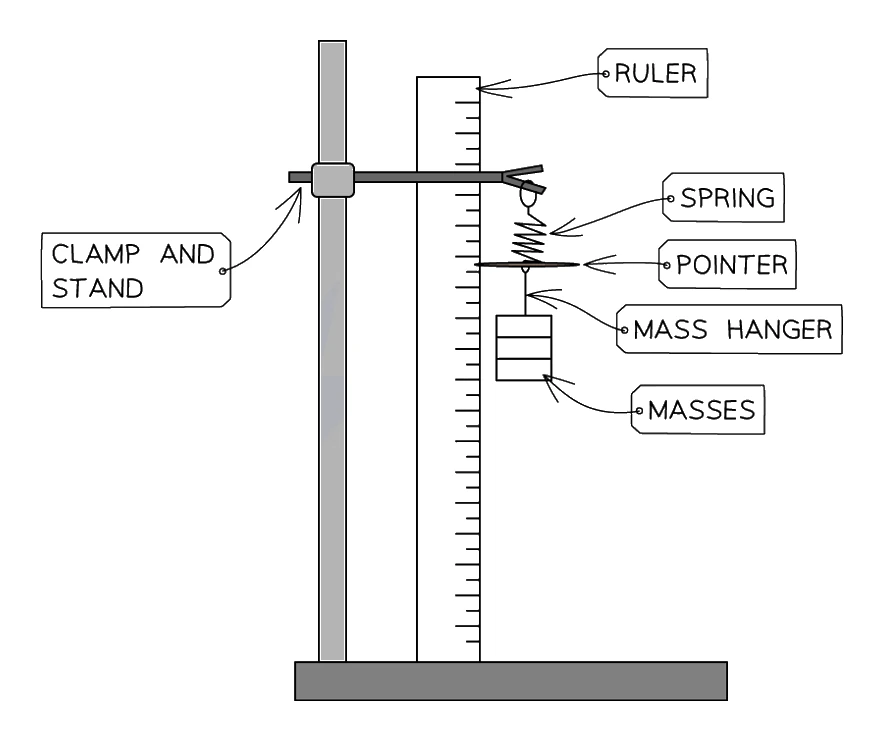
Method
- Hang the spring (or rubber band, or metal wire) from the clamp without any mass attached. Read and record its original length L₀ using the pointer and the clamped ruler
- Place the 100 g mass hanger on the spring. Give the spring a couple of seconds to come to rest, then read the new pointer position L₁ and record it together with the mass
- Add one further 100 g mass to the hanger. Allow it to come to rest, then read and record the new length
- Continue adding masses in 100 g steps until all five are loaded
- Carefully remove the masses one at a time and check that the spring returns to its original length. If it does not, it has been stretched beyond its and the run must be repeated with a fresh spring
- Repeat the whole sequence three times and take the mean of the three readings at each load
- For the metal wire variant: clamp the wire horizontally across the bench, run it over a bench pulley, attach the hanger to the dangling end, and stick a small piece of tape on the wire as a fiducial marker for the ruler
Exam tip
Extension is the new length minus the original length
One five-mark method question on this practical was marked from a list: measure the original length, measure the new length for a range of masses, work out extension as new length minus original length, read a clamped vertical ruler with a pointer at eye level to avoid parallax, always measure to the same point on the spring, and repeat and average. Use "extension" only for the difference and "length" for what the ruler shows: a question that gives a loaded length and an extension and asks for the original length wants the subtraction. For a bending strip the same marks appear as a rule fixed vertically with a plumb line or set square, its zero at the unloaded height.
Analysis
- Convert each loaded mass m (in kg) to a stretching force F with F = m × g, taking g = 10 N/kg (so each 100 g step adds 1.0 N)
- Calculate the e at every load:
e = mean loaded length − original length
- Plot (y-axis) against extension (x-axis), or extension against force, but force-vs-extension is the conventional Hooke's law plot
- A straight line through the origin shows that force and extension are directly proportional, i.e. the material is obeying Hooke's law throughout the tested range
- A region where the line curves away from a straight line shows the material has passed its (see section 9)
Sources of error and safety
- Systematic error, parallax. Always read the pointer against the ruler with your eye exactly level with the pointer
- Random error, equipment movement. A wobble of the stand between readings shifts the apparent zero; the G-clamp removes this
- Random error, slow settling. Let the spring fully stop oscillating before taking each reading; a length read mid-bounce will be off by the amplitude of the wobble
- Safety: wear safety goggles in case the spring or wire snaps and whips back, keep feet clear of the hanging masses, and place a soft mat or tray beneath the masses to catch them if they drop