4PH1
Electrical Power & Mains Electricity
Electricity · 2 question types
Direct current (d.c.)
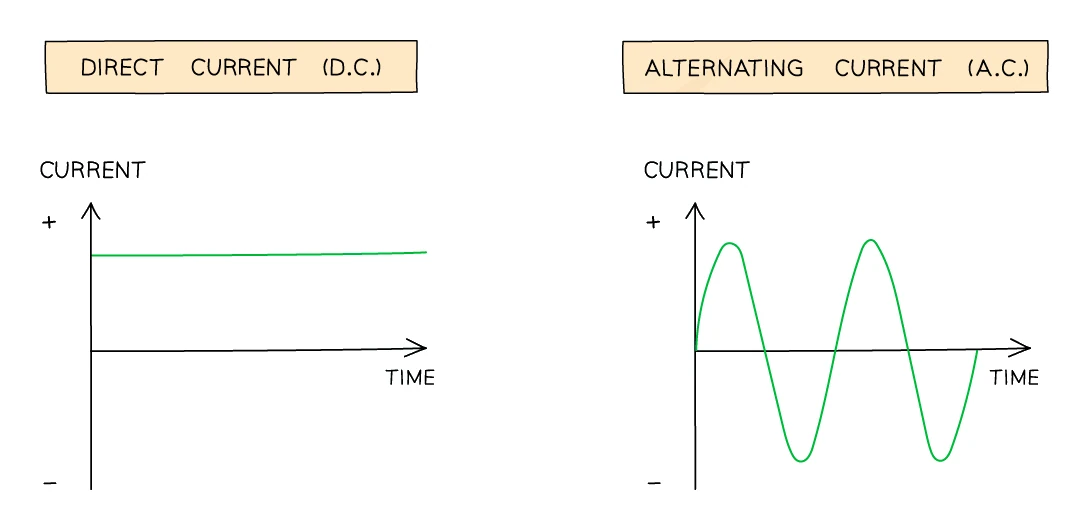
- A direct current (d.c.) is a current that keeps flowing in just one direction around a circuit, starting at the source's positive end and arriving back at its negative end
- The two terminals of a d.c. source keep their roles unchanged: one stays at the higher potential (the positive end) and the other stays at the lower potential (the negative end) for the whole time the source is connected
- Sources of d.c. include cells, batteries, solar panels and d.c. packs used in school labs
Alternating current (a.c.)
- An alternating current (a.c.) is a current whose direction continually reverses, flowing one way, then the opposite way, then back again, many times every second
- The supply's two terminals swap polarity in step with the current; neither terminal is permanently positive
- The frequency of an a.c. supply is the number of complete cycles per second, measured in hertz (Hz)
- In the United Kingdom, the mains supply is a.c. at a frequency of 50 Hz and a voltage of about 230 V
- Sources of a.c. include power-station generators and the sockets in any home
Exam tip
Distinguish d.c. from a.c.
What comes up: state or explain the difference between direct current and alternating current.
Write (two marks): (1) d.c. flows in one direction only; (2) a.c. continuously reverses direction.
Watch out: saying a.c. "changes" without specifying that it reverses direction may not score the second mark — the credited idea is that the direction changes, not just that the current fluctuates.
Comparison of d.c. and a.c. at a glance
| Feature | Direct current (d.c.) | Alternating current (a.c.) |
|---|---|---|
| Direction of flow | One fixed direction | Continually reversing |
| Source terminals | One fixed positive, one fixed negative | Two identical terminals that swap polarity |
| Current-vs-time graph | Flat horizontal line above the zero axis | Sine wave above and below the zero axis |
| Typical sources | Cells, batteries, solar panels, lab power packs | Power-station generators, household mains |
| Typical UK example | 1.5 V AA cell, 12 V car battery | 230 V / 50 Hz mains socket |