4PH1
Electrical Power & Mains Electricity
Electricity · 2 question types
Why mains electricity is dangerous
- UK mains electricity runs at 230 V, and even a brief contact can drive a current through the body that disrupts the heart's rhythm
- A potential difference as small as about 50 V is already enough to cause a serious electric shock if the path through the body is right
- Wet or sweaty skin lowers the body's resistance dramatically, raising the current for a given voltage; this is why mains tools and bathroom appliances need extra protection
Common hazards in domestic wiring
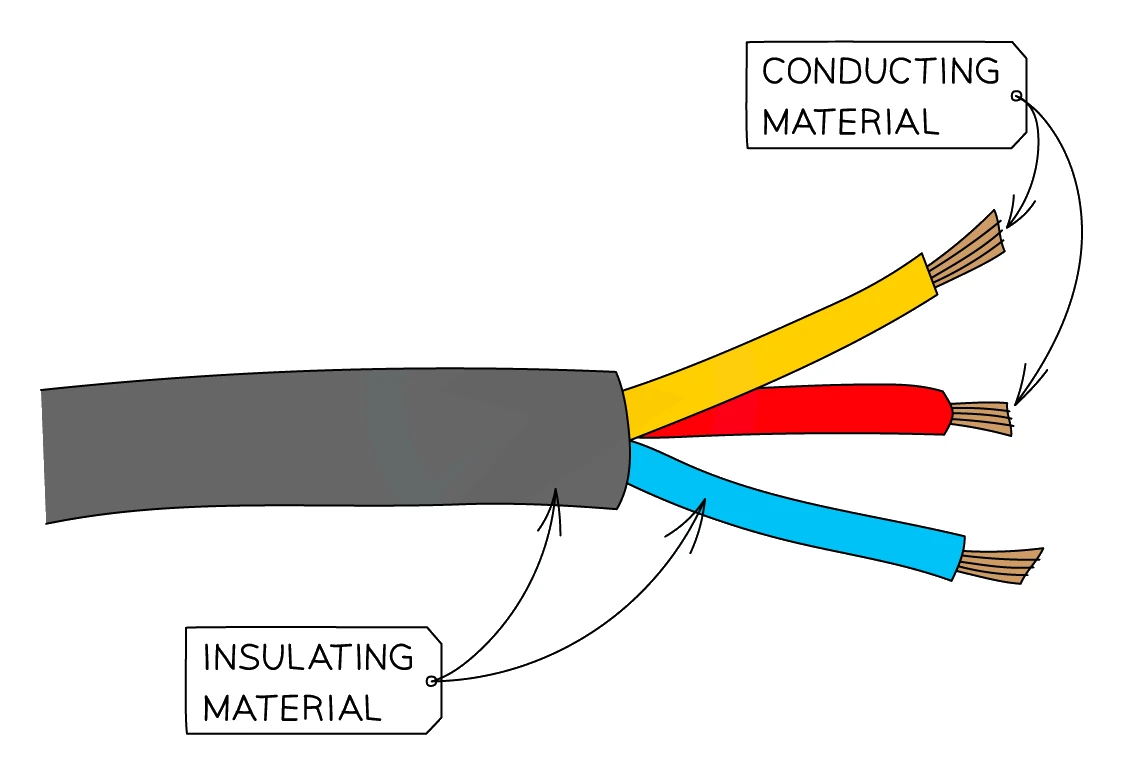
- Damaged insulation: a frayed cable can expose the live wire, electrocuting anyone who touches it
- Overheating cables: running too much current through a cable that is too thin (or letting a heater cable sit tightly coiled) heats the wire enough to melt the surrounding insulation, exposing live metal and risking a fire
- Damp conditions: water on or near live wiring can complete an unintended path through the user's body, both giving a shock and short-circuiting the appliance
Safety features in everyday appliances
- Insulation: every conducting wire is wrapped in a non-conducting plastic or rubber sleeve so that touching the outside of the cable does not expose the user to the live conductor inside
- Double insulation: appliances with plastic (non-metallic) cases (e.g. modern kettles, hair dryers, vacuum cleaners) have two separate insulating layers (the insulation around the wires and the casing itself). They do not need an because there is no metal exterior to electrify in a fault. The double-square symbol (☐ inside ☐) on the appliance shows it is double insulated
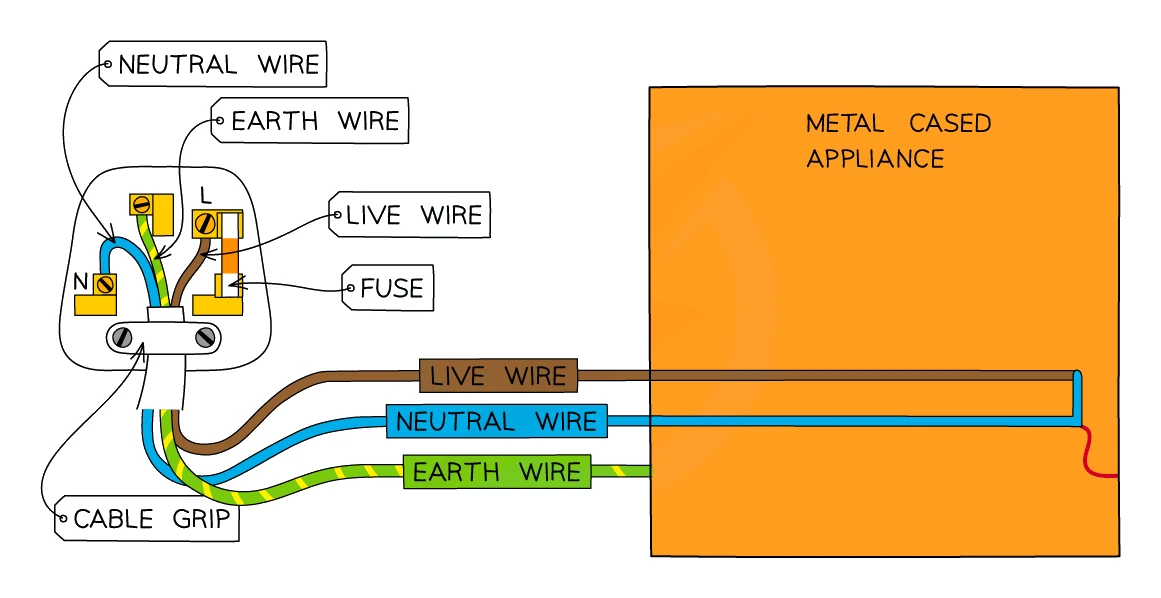
- Earthing: appliances with metal cases carry a third wire (the earth wire) bolted to the casing. If the live wire breaks free internally and touches the casing, the earth wire offers a very low-resistance path to ground, sparing the user from a shock and causing a sudden current surge through the fuse so it blows quickly
- Fuses: covered in section 1; they sit in the live wire and melt to break the circuit if the current exceeds the fuse rating
- Circuit breakers: modern alternatives to fuses (covered below)
How earthing protects a user step by step
- Imagine an iron with a live wire that has worked loose and is now touching the inside of its metal case
- Without an earth wire:
- The casing becomes electrified at 230 V
- Anyone who touches the casing completes a path through their body to ground
- A shock current flows through them
- With an earth wire connected to the casing:
- The casing is bonded by a thick low-resistance wire to the ground
- A huge current surges through the earth wire the moment the casing becomes live
- The same surge passes through the in the live wire
- The fuse wire heats up and melts, breaking the live wire and cutting the supply
- The user is never exposed to the fault voltage
Exam tip
Why earthing and fuses must work together
What comes up: explain how the earth wire and fuse protect a user when a live wire inside an appliance touches the metal casing.
Write (two marks): (1) the earth wire provides a low-resistance path to ground, so a very large current flows when the casing becomes live; (2) that surge of current melts the fuse, breaking the circuit and cutting the supply.
Watch out: neither component alone is sufficient — the earth wire drives the surge, and the fuse breaks the circuit. Mentioning only one of the two steps typically loses a mark.
Circuit breakers vs fuses
- A circuit breaker is an automatic, electrically operated switch that trips open when the current exceeds a set value, breaking the circuit
- Its main internal mechanism is a small electromagnet: when the current grows large, the magnetic field is strong enough to pull a spring-loaded contact apart
- Advantages over a fuse:
- Reset, don't replace: once the fault is fixed, a circuit breaker can simply be flicked back to the on position; a blown fuse has to be thrown away and a new one fitted
- Trips much faster: the electromagnet reacts in milliseconds, while a fuse wire takes longer to heat up to its melting point
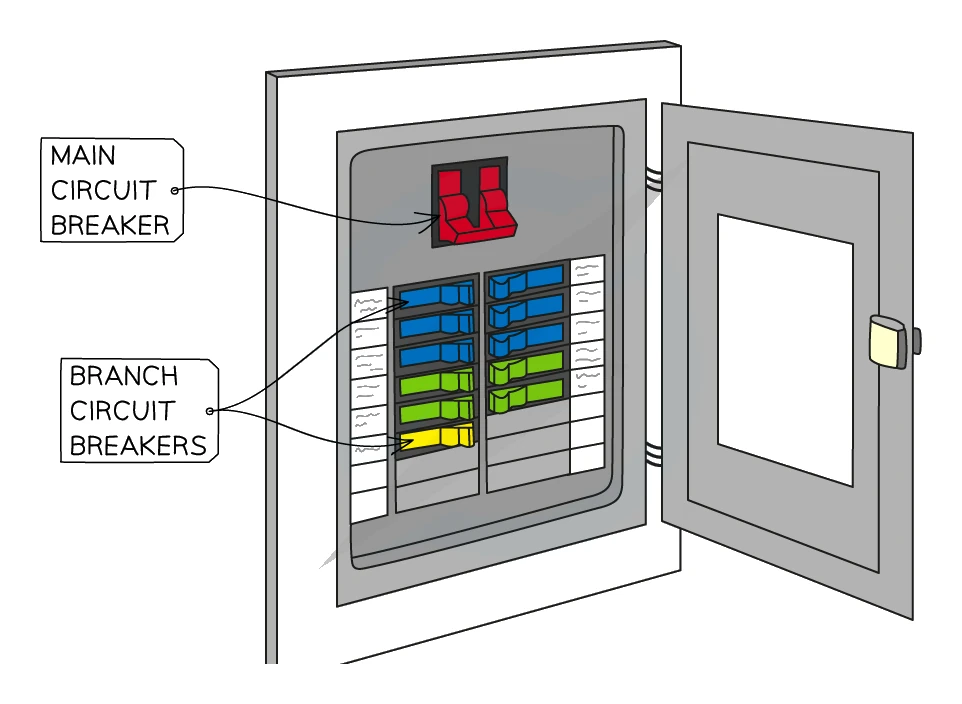
- In a modern house, the consumer unit (sometimes still called a "fuse box" out of habit) contains a row of circuit breakers, each one protecting a different circuit (sockets, lighting, kitchen, shower, etc.). A larger main breaker can disconnect the whole house at once