Computer Architecture
Hardware · 4 question types
The CPU
The Central Processing Unit (CPU) is the part of a computer that runs every program. It is the chip that takes a stream of binary instructions and acts on them, one at a time, billions of times per second.
The job of the CPU is to fetch, decode and execute instructions. Everything else a computer does (showing text on a screen, playing audio, running a game, opening a web page) is built from these three steps.
The CPU sits between the input devices (keyboard, mouse, sensors) that feed it data, and the output devices (monitor, speakers, printer) that show the results. Memory (RAM) and storage (SSD or hard drive) hold the data and instructions the CPU works on.
CPU and microprocessor
These two terms get confused often:
- The CPU is the part of a chip that does the actual fetching, decoding and executing.
- A microprocessor is the physical chip itself. It contains the CPU, and often other circuitry such as memory controllers, cache, and input/output interfaces.
A modern laptop has one microprocessor chip containing several CPU cores plus a lot of supporting hardware. For exam purposes, treat "CPU" as the logical processing unit and "microprocessor" as the physical chip.
The instruction set
A CPU's instruction set is the complete set of all the commands (operations) that the can execute, expressed in machine code.
Every program a CPU runs is ultimately built from commands chosen out of its instruction set. A CPU can only carry out the operations its instruction set defines, so two CPUs with different instruction sets cannot run the same machine-code program directly.
Embedded systems
An embedded system is a computer system built into a larger device to perform one dedicated function, rather than the many general-purpose tasks of a PC or laptop.
The embedded computer is part of the product and usually cannot run arbitrary new software. Everyday examples include the controller in a washing machine, a car's engine-management system, the system inside a pacemaker, and the controllers in lighting systems, security systems and vending machines. This is different from a general-purpose computer (a PC or laptop), which is built to perform many different functions.
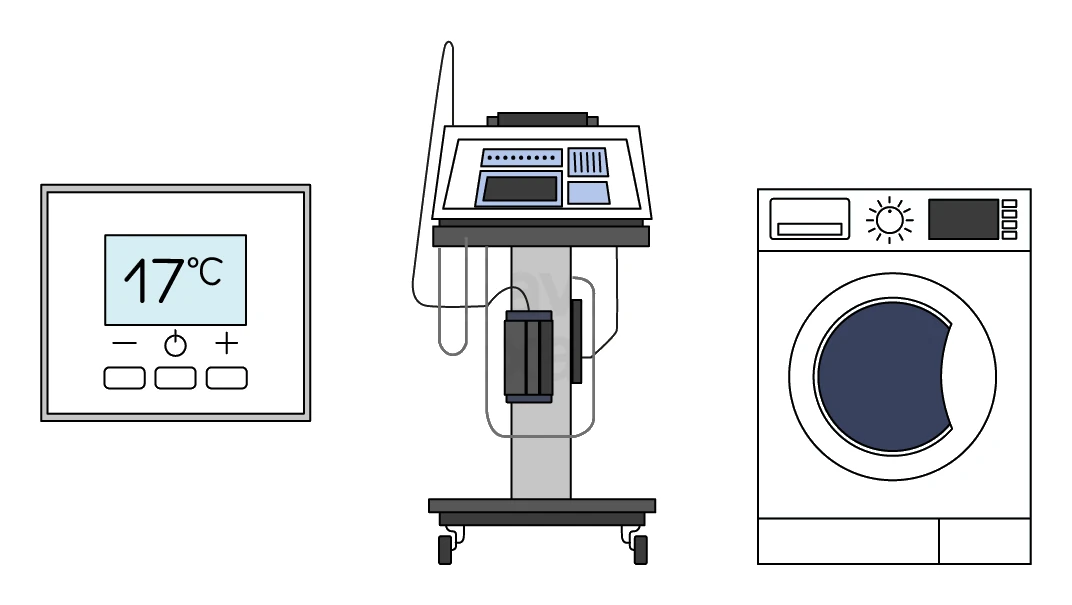
Defining an embedded system and giving examples
Question: State what is meant by an embedded system, give two characteristics, pick the embedded systems from a list of devices, or explain why a single-purpose device is not a general-purpose computer (1–3 marks).
Asked in 3 of the 17 papers, one mark per point. The credited definition is a computer system built into a larger device to perform a single, dedicated function, using a microprocessor and dedicated hardware. Also creditable as characteristics: runs firmware, not normally reprogrammable by the user, works automatically and in real time, small, cheap and low-power.
From a list of devices, pick the security light system, freezer and vending machine; a laptop, PC, smartphone or web server runs many programs, so it is general-purpose. For a single-purpose gadget wrongly called a general-purpose computer, contrast its few dedicated functions with the many a general-purpose computer performs, so it is an embedded system, and add that no other software can be installed and no peripherals plugged in.