Photosynthesis
Structures and Functions in Living Organisms · 5 question types
A leaf is doing two opposite things with the same two gases. Respiration is going on in every living cell all the time, day and night, taking in oxygen and giving out carbon dioxide. Photosynthesis only happens when there is light, taking in carbon dioxide and giving out oxygen. Both involve diffusion of CO₂ and O₂ through the stomata.
What you actually measure leaving or entering the leaf is the net exchange, the balance between the two processes. Because respiration is steady but photosynthesis rises and falls with light, the net direction of gas movement depends on the light intensity.
- In darkness, only respiration happens. The leaf takes in oxygen and gives out carbon dioxide, so there is a net release of CO₂.
- In bright light, photosynthesis runs much faster than respiration. The leaf uses up all its own respiratory CO₂ and more besides, so there is a net uptake of CO₂ and a net release of oxygen.
- At low light, around dawn and dusk, there is a point where photosynthesis and respiration run at exactly the same rate. The CO₂ released by respiration is used up by photosynthesis as fast as it is made, so there is no net exchange with the air.
Core practical: the effect of light on net gas exchange (hydrogencarbonate indicator)
Hydrogencarbonate indicator changes colour with the carbon dioxide concentration of the air or water around it:
| Colour | What it shows |
|---|---|
| Yellow | High CO₂ (more than the atmosphere) |
| Orange / red | Atmospheric CO₂ level (the starting colour) |
| Purple / magenta | Low CO₂ (less than the atmosphere) |
Method:
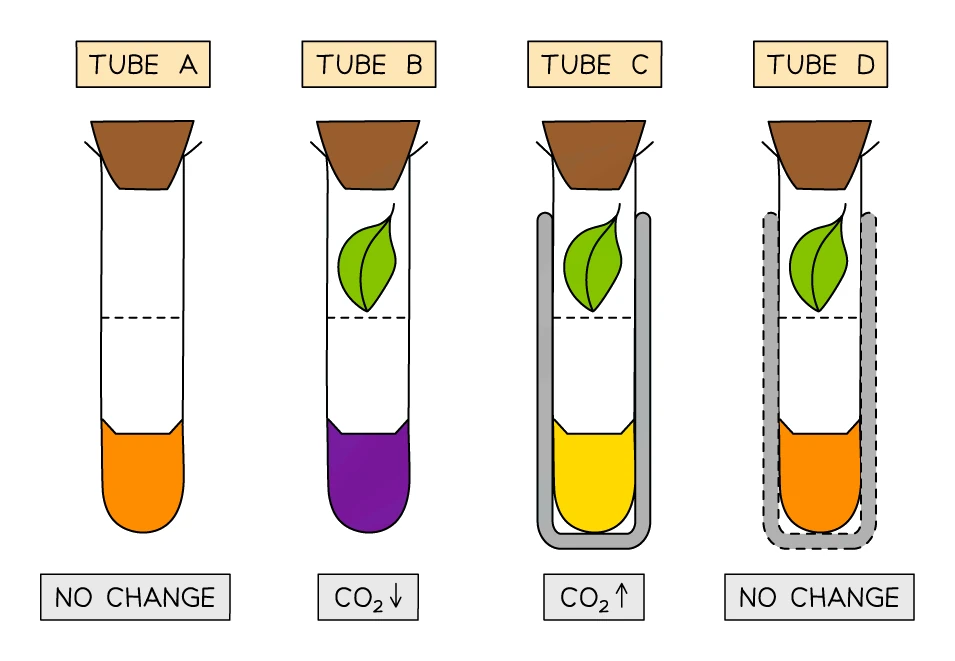
- Set up several sealed tubes, each containing the same volume of hydrogencarbonate indicator at its starting orange/red colour, with a leaf (or a fixed amount of pondweed or algae) inside.
- Expose the tubes to different light intensities: one in bright light, one in dim light, and one wrapped in foil so it gets no light at all.
- Set up a control tube with indicator but no leaf, to show the colour does not change on its own.
- Leave all the tubes for the same length of time, then compare the colours.
Results:
- The foil-covered (dark) tube turns yellow. Only respiration happens, so CO₂ builds up.
- The brightly-lit tube turns purple/magenta. Photosynthesis runs faster than respiration and removes CO₂ from the indicator.
- A dim-light tube can stay close to the starting orange/red colour, where photosynthesis and respiration roughly balance.
This links the colour change directly to the net gas exchange: more light shifts the balance towards net CO₂ uptake.