Nutrition & Digestion
Structures and Functions in Living Organisms
What the digestive system does
The digestive system is an organ system whose job is to convert the large insoluble nutrients in food (starch, proteins, lipids) into much smaller soluble units (glucose, amino acids, fatty acids and glycerol). Once small enough, these units pass through the gut wall into the blood and are carried to every cell in the body.
Two kinds of digestion go on:
- Mechanical digestion physically breaks food into smaller pieces. Examples: teeth chewing, stomach churning, bile emulsifying fat. The resulting smaller pieces have more exposed surface, which gives enzymes more places to bind.
- Chemical digestion breaks the bonds that hold large food molecules together, using . This produces the small soluble molecules that can be absorbed.
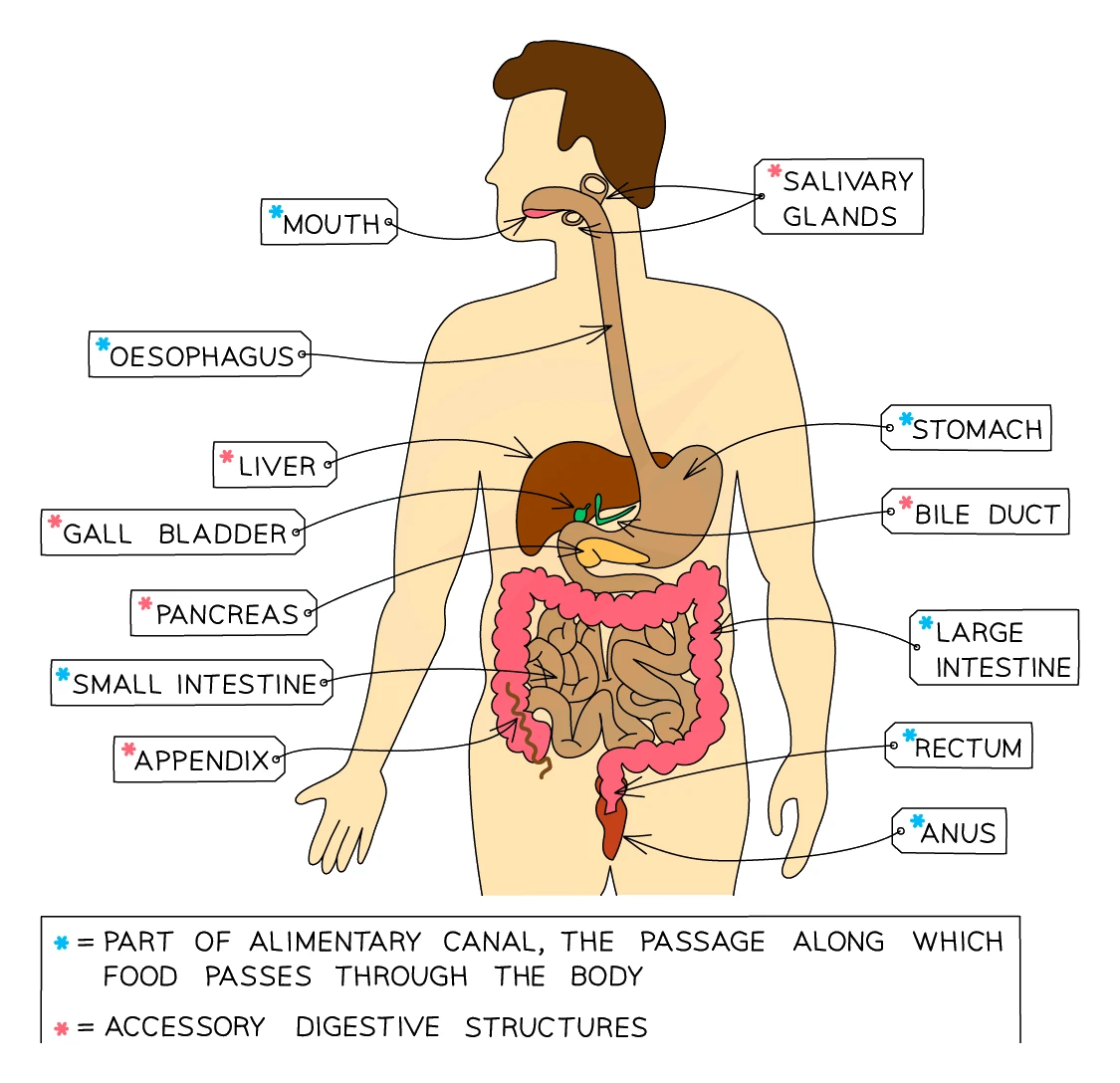
The alimentary canal is the long tube through which food passes from mouth to anus. The accessory organs (liver, gall bladder, pancreas, salivary glands) make digestive juices but food does not pass through them.
Organs of the alimentary canal
| Organ | What happens there |
|---|---|
| Mouth and salivary glands | Teeth break the food into smaller pieces (mechanical digestion). Saliva contains the enzyme amylase, which starts to digest starch into maltose (chemical digestion). The food is rolled into a soft ball called a bolus and swallowed |
| Oesophagus | The tube from mouth to stomach. Waves of muscle contraction (peristalsis) push the bolus down to the stomach |
| Stomach | A muscular bag that churns food into a creamy paste (chyme). The stomach lining secretes hydrochloric acid (pH ~2), which kills bacteria and provides the optimum pH for the stomach's protease enzyme pepsin, which starts to digest proteins |
| Small intestine (duodenum then ileum) | The duodenum receives bile from the gall bladder and enzymes from the pancreas. Digestion of all three nutrient groups is completed here. The ileum is where the small soluble molecules are absorbed into the blood. The pH is slightly alkaline (~pH 8) |
| Large intestine (colon then rectum) | The colon absorbs most of the remaining water from the indigestible material. The rectum stores the resulting faeces until they leave the body through the anus |
| Salivary glands (accessory) | Produce saliva containing amylase and mucus |
| Liver (accessory) | Produces bile, which emulsifies fats and neutralises stomach acid. Also breaks down excess amino acids in a process called deamination, producing urea |
| Gall bladder (accessory) | Stores bile from the liver and releases it into the duodenum |
| Pancreas (accessory) | Makes amylase, protease and lipase (the full set of digestive enzymes) in an alkaline juice, which is squirted into the duodenum |
Common exam question
Identifying organs on a diagram of the gut
Question: Name the parts labelled on a diagram of the alimentary canal, or pick out the oesophagus, the stomach, the part of the large intestine or the structure that contains villi (1 mark each).
Asked in 3 of the 23 papers, once as four written labels on a rabbit's gut and otherwise as multiple choice, on a dog's gut and on a human one. In order the canal is the oesophagus (gullet is accepted), the stomach, the small intestine (ileum, duodenum or jejunum all score) and the large intestine (or colon). Villi are in the small intestine, so choose the long coiled tube, not the wider colon. The liver and pancreas sit beside the canal and food never passes through them. Two papers also ask which organs make amylase, once from the diagram: the salivary glands and the pancreas; the stomach and the colon do not.