Nutrition & Digestion
Structures and Functions in Living Organisms · 9 question types
What an enzyme is
An enzyme is a that acts as a biological catalyst: it speeds up a specific chemical reaction without being changed or used up itself
Enzymes are essential for life. Without digestive enzymes, breaking down a single meal would take 2 to 3 weeks; with them, it takes around 4 hours. Every metabolic reaction in every living cell is catalysed by an enzyme.
How an enzyme works (the lock-and-key model)
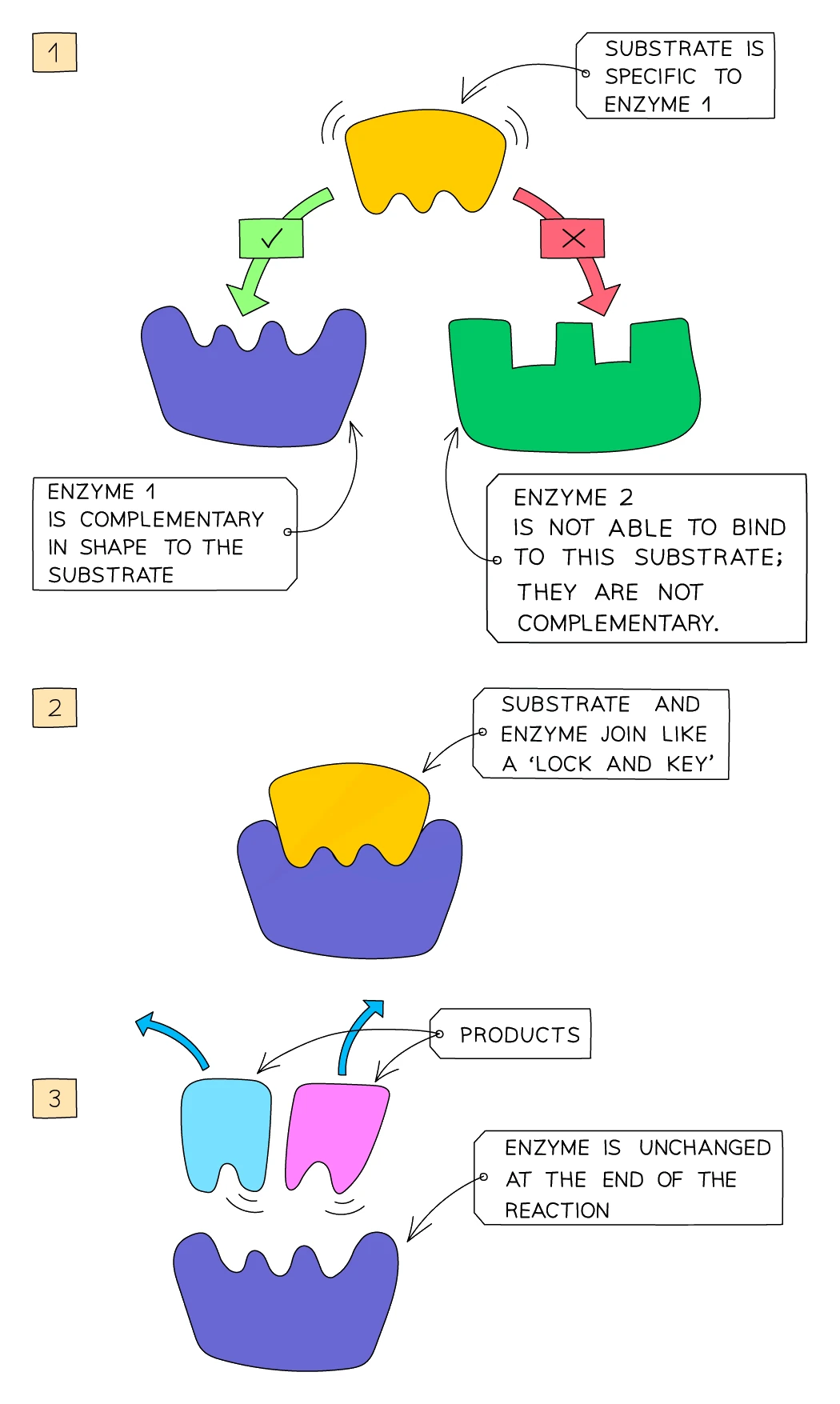
- Each enzyme has a specifically shaped pocket on its surface called the .
- The molecule the enzyme acts on is called the substrate.
- The substrate fits into the active site exactly (the way a key fits into a lock) because the two shapes are complementary.
- The three steps are:
- Substrate and collide randomly in solution
- The substrate enters the active site, forming an enzyme-substrate complex, and the reaction takes place
- The product leaves the active site, which is now free to bind another substrate
Each enzyme is specific to one substrate (or to one type of bond). Amylase only works on starch, for example, because no other molecule has the right shape to fit the amylase active site.
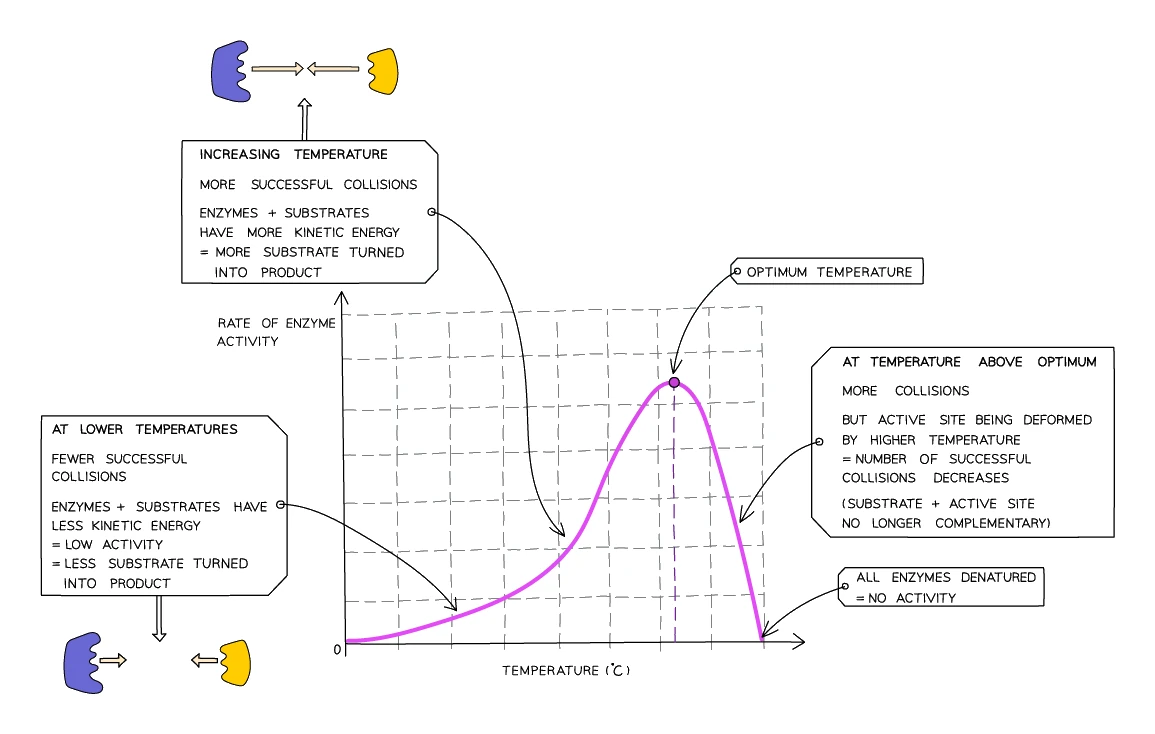
Effect of temperature on enzyme activity
- At low temperatures, enzymes work slowly: the particles have little kinetic energy, so collisions between enzyme and substrate are rare. The reaction is slow but the enzymes are not damaged.
- As temperature rises, collisions happen more often and with more energy. The rate of reaction climbs.
- At the optimum temperature, the enzyme is working as fast as it can. For most human enzymes the optimum is about 37 °C, conveniently the body's normal temperature.
- Above the optimum, the bonds that hold the enzyme's shape together start to break. The active site changes shape and the substrate no longer fits. The enzyme is .
- Denaturation is permanent: cooling the enzyme back down does not restore its shape or its activity.
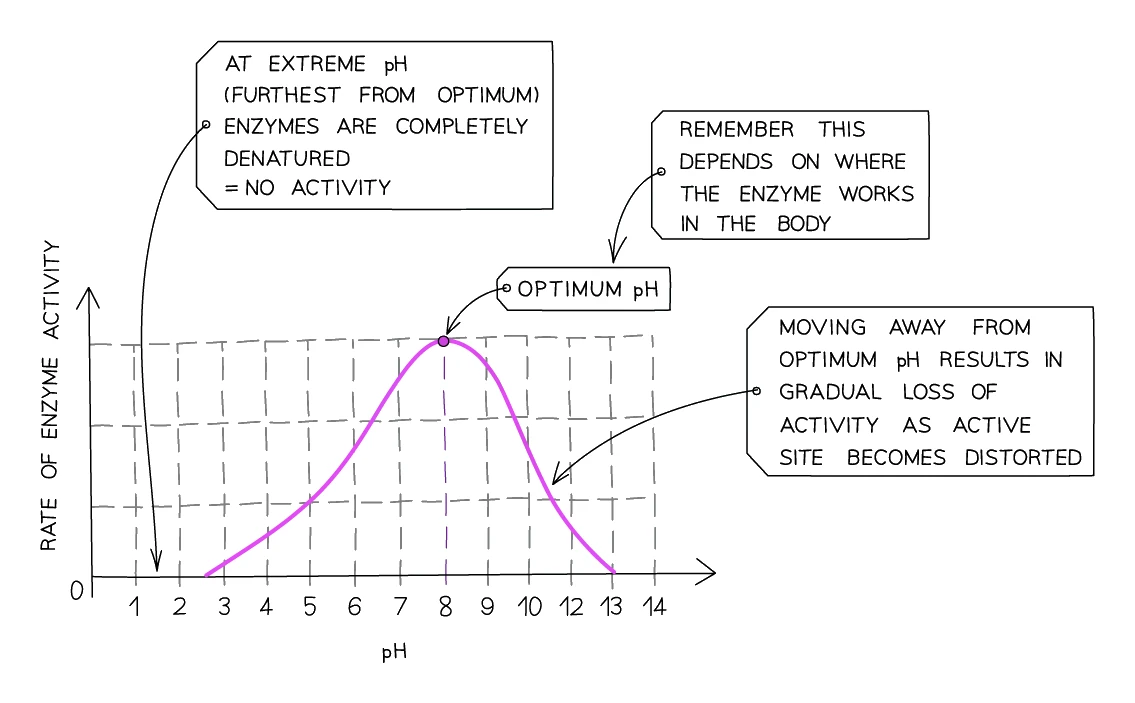
Effect of pH on enzyme activity
- Each enzyme has an optimum pH at which it works fastest.
- Most enzymes have an optimum near pH 7 (neutral).
- Some enzymes have evolved to work in unusual environments:
- Pepsin, the protease in the stomach, has an optimum of pH 2 (very acidic, matching the stomach's hydrochloric acid).
- Enzymes secreted into the small intestine (pancreatic and intestinal enzymes) have an optimum near pH 8 (slightly alkaline).
- Above or below the optimum, the bonds holding the enzyme together break and the active site changes shape: the enzyme denatures.
Core practical: temperature and enzyme activity
The effect of temperature on amylase (a starch-digesting enzyme) can be measured using iodine to test for starch:
- Add 5 cm³ of starch solution to a test tube
- Place a drop of iodine in each well of a spotting tile
- Place the starch tube in a water bath at the test temperature (e.g. 20 °C) for 10 minutes to let the solution reach the bath's temperature
- Add 2 cm³ of amylase to the starch and start the stopwatch
- Every minute, transfer a drop of the mixture to a fresh iodine well. The drop turns blue-black if starch is still present, yellow-brown once it has all been digested into maltose
- Record the time it takes for the iodine to stop turning blue-black
- Repeat at a range of temperatures (e.g. 10, 20, 30, 40, 50, 60 °C)
A short time means fast digestion (high enzyme activity). Plotting rate (1 ÷ time) against temperature gives the classic peaked curve, with the optimum around 37 °C for amylase.
Core practical: pH and enzyme activity
The same experiment can be repeated at fixed temperature (in a water bath at 37 °C), using buffer solutions at different pH values (e.g. pH 3, 5, 7, 9, 11) instead of varying temperature. Amylase's optimum pH is around 7.