Nutrition & Digestion
Structures and Functions in Living Organisms · 9 question types
What bile is and where it comes from
Bile is a green-yellow alkaline fluid produced by cells in the liver, stored in the gall bladder, and released into the duodenum when food arrives. Bile is not an enzyme (it does not break any chemical bonds), but it has two essential roles in digestion.
Role 1: Neutralising stomach acid
Food leaves the stomach very acidic (pH ~2). The digestive enzymes secreted into the small intestine have their optimum at pH 8 and would be denatured by stomach acid. Bile is alkaline and neutralises the stomach acid as it enters the duodenum, raising the pH to the right level for the small intestine's enzymes to work.
Role 2: Emulsifying lipids
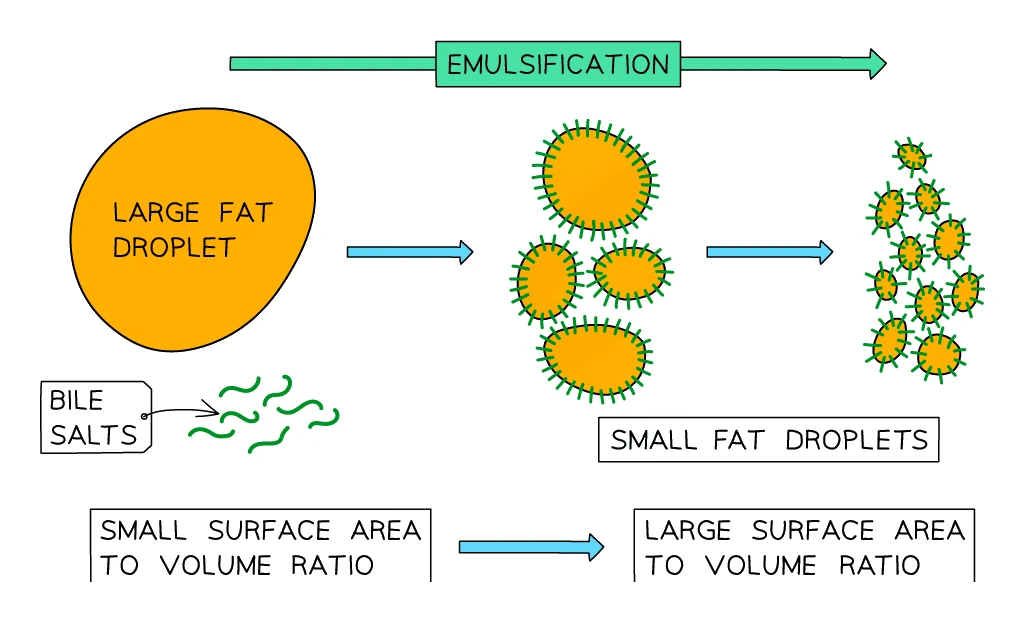
Lipase is a water-soluble enzyme, but lipids are oily and form large globules in the watery contents of the gut. Lipase can only attack a lipid at its surface, so a single big lipid globule is digested very slowly.
Bile salts in bile break each large lipid globule into many tiny droplets, called emulsification. The total surface area of all the small droplets is enormous compared to one big globule, so lipase has far more surface to attack, and lipid digestion speeds up dramatically.
Emulsification is mechanical digestion, not chemical digestion. The lipid molecules themselves are not broken; only the size of the droplets has changed.