Excretion
Structures and Functions in Living Organisms
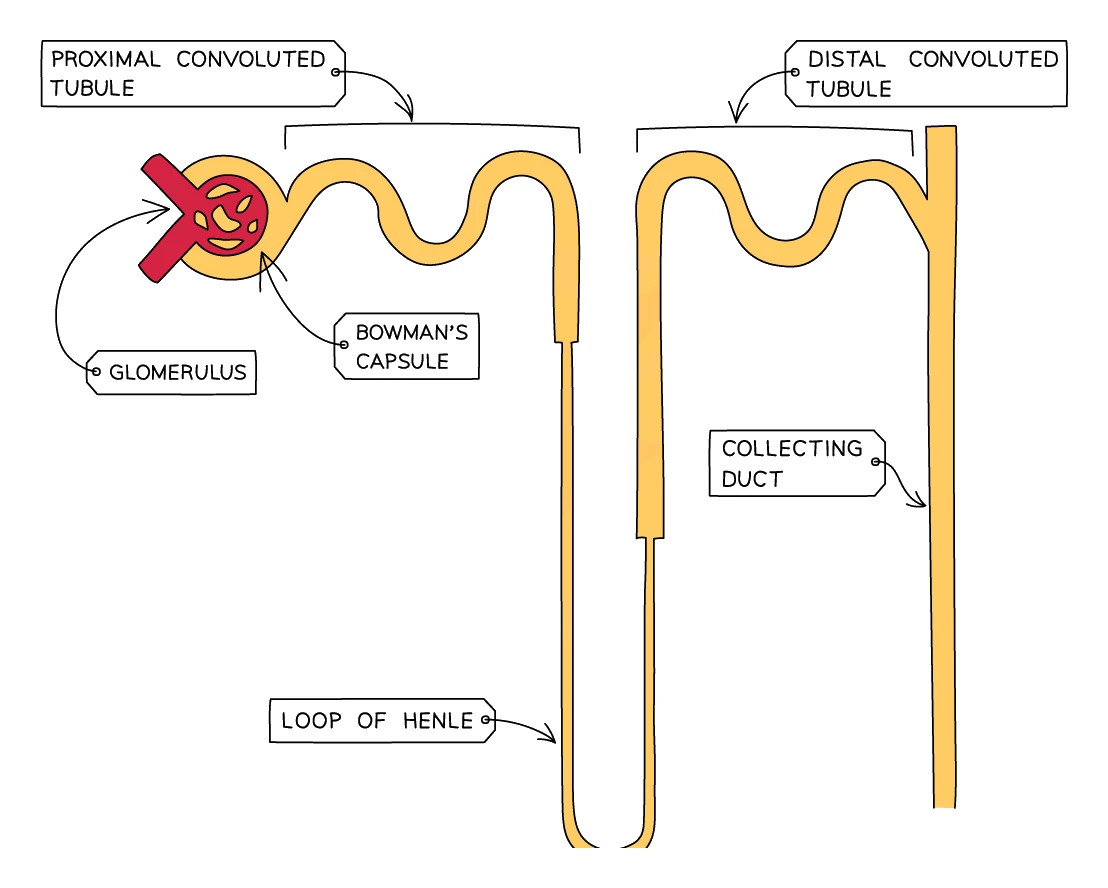
The nephron is the functional unit of the kidney: every step of urine formation happens along its length. A single nephron has these parts, in order along the route the filtrate takes:
- Bowman's capsule: a cup-shaped structure in the cortex that surrounds the glomerulus, a tight knot of capillaries. The Bowman's capsule is where blood is filtered (, section 6).
- Proximal convoluted tubule (PCT): a coiled tube also in the cortex. of glucose happens here.
- Loop of Henle: a long hairpin loop that dips deep down into the medulla and back up. Reabsorbs some water and salts.
- Distal convoluted tubule (DCT): a second coiled tube, back in the cortex. Fine-tunes the salt content of the filtrate.
- Collecting duct: runs back down through the medulla to the renal pelvis. The site of most water reabsorption, controlled by the hormone (section 7).
Around each nephron runs a dense network of capillaries that picks up the substances reabsorbed from the filtrate and returns them to the bloodstream.
Common exam question
Identifying structures on a kidney or nephron diagram
Question: Identify labelled structures on a diagram of the urinary system, a kidney section or a nephron, usually as one-mark multiple-choice items: the Bowman's capsule, loop of Henle or proximal convoluted tubule, where ultrafiltration happens, where glucose is reabsorbed, or which structure ADH affects (1 mark each).
Asked in 6 of the 23 papers. Know the nephron in filtrate order: the cup-shaped Bowman's capsule around the glomerulus (ultrafiltration); the first coiled tube, the proximal convoluted tubule (glucose reabsorbed); the hairpin loop of Henle in the medulla; the second coil, the distal convoluted tubule; then the collecting duct, which ADH acts on. On a whole-kidney section the renal artery and vein carry blood; only the ureter carries urine.
The ureter runs from kidney to bladder; the urethra leaves the bladder. One scheme rejects "urethra" for the ureter (a phonetic spelling that cannot be confused with it is allowed) and "gall bladder" for the bladder.