Excretion
Structures and Functions in Living Organisms · 6 question types
Three main processes turn blood into urine as the filtrate flows along the nephron:
- in the glomerulus / Bowman's capsule (filtration under pressure)
- in the PCT (taking useful molecules back)
- Water reabsorption in the collecting duct (controlled by ADH)
Ultrafiltration
The Bowman's capsule surrounds a small knot of capillaries called the glomerulus. Two clever design features set up high-pressure filtration here:
- The afferent arteriole (the vessel bringing blood in) is wider than the efferent arteriole (the vessel taking blood out). This produces a bottleneck that raises the blood pressure inside the glomerulus to several times the normal capillary pressure.
- The wall of the glomerular capillary and the wall of the Bowman's capsule together form an extremely thin, partially-permeable filter.
The high blood pressure forces the small components of plasma out of the capillaries and across the filter into the Bowman's capsule:
- Water
- Glucose
- Amino acids
- Urea
- Mineral ions (Na⁺, K⁺, Cl⁻, etc.)
Larger molecules and cells are too big to cross the filter and stay in the blood:
- Red blood cells
- White blood cells
- Platelets
- Plasma proteins (such as albumin)
The fluid that collects inside the Bowman's capsule is called the glomerular filtrate. It is blood plasma without the proteins and cells.
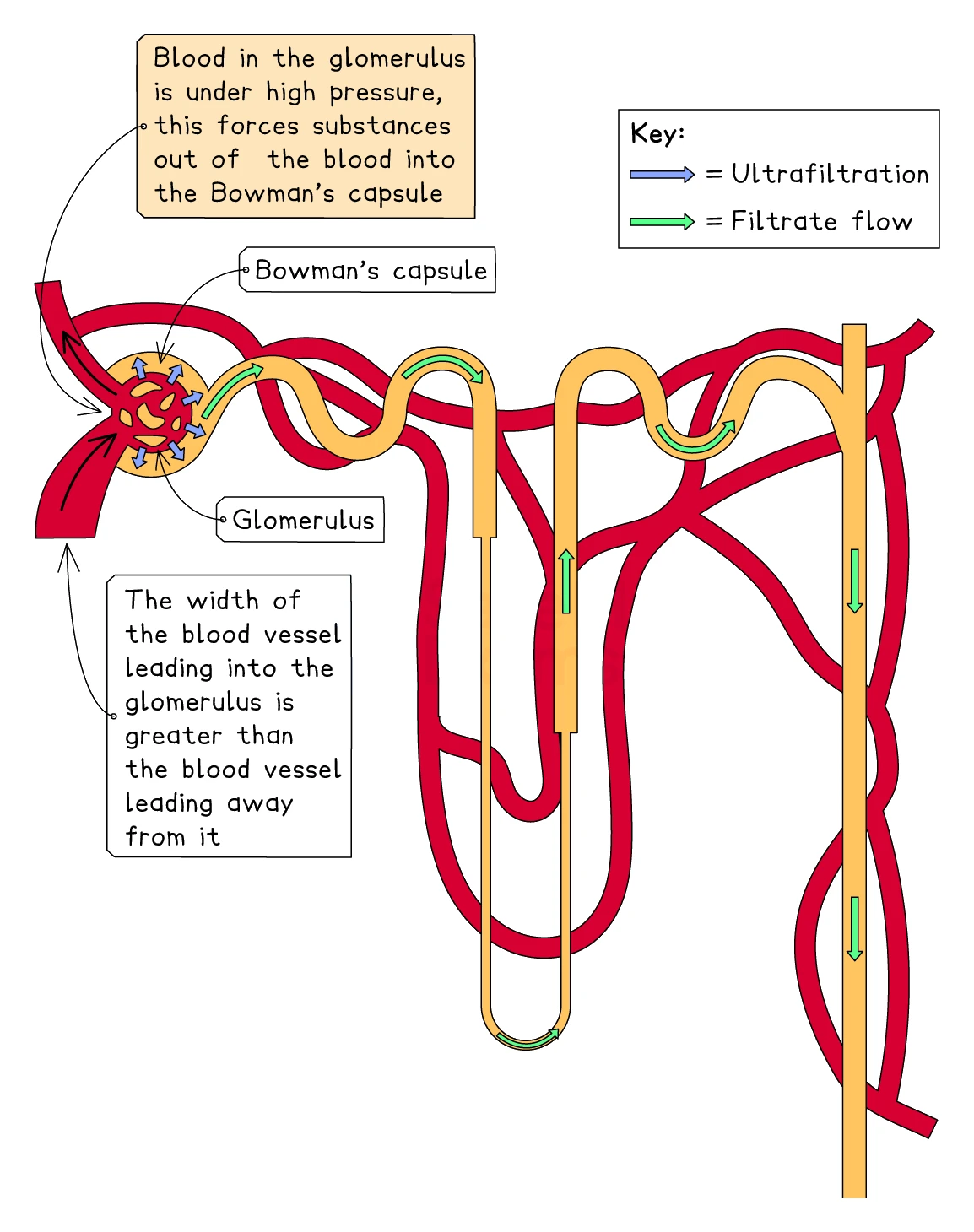
High blood pressure in the glomerulus can damage the filter, allowing proteins to get through. Finding protein in urine is therefore an early sign of high blood pressure or kidney disease.
Why the afferent arteriole is wider, and why protein is absent from normal filtrate
What comes up: explain why the afferent arteriole being wider than the efferent arteriole matters for kidney function (2 marks); or explain why protein is not normally found in urine (2 marks).
Write (two marks): (1) The size difference increases blood pressure inside the glomerulus. (2) This pressure forces small molecules (water, glucose, urea, ions) out of the blood into the Bowman's capsule — this is ultrafiltration. Protein molecules are too large to pass through the filter, so they stay in the blood. If high blood pressure forces protein through, it will appear in urine.
Watch out: the mark scheme credits "increases pressure" as one point and "small molecules / filtrate enter Bowman's capsule" as the second — you need both. Simply writing "ultrafiltration occurs" alone is not sufficient without saying what that achieves.
Testing a urine sample for protein
What comes up: describe how to test a urine sample for protein (2 marks).
Write (test): add biuret reagent; a positive result turns lilac/purple.
Watch out: the mark scheme also accepts ninhydrin (turns purple) and urine test strips (albustix/uristix). The biuret colour is lilac, purple or pink — blue is not credited. Finding protein in the urine points to a damaged glomerulus, since protein is normally too large to be filtered out of the blood.
Selective reabsorption in the PCT
The glomerular filtrate is full of valuable molecules that the body cannot afford to wash away. As the filtrate flows along the proximal convoluted tubule (PCT), these useful substances are pulled back into the bloodstream through the surrounding capillaries:
- All of the glucose is reabsorbed (by active transport, against its concentration gradient)
- All of the amino acids are reabsorbed
- Most of the mineral ions are reabsorbed
- A large amount of water is reabsorbed too, by osmosis (following the reabsorbed solutes)
It is selective because only some of the molecules are pulled back: useful ones move into the blood while waste substances (such as urea) are left behind in the filtrate.
Active transport of glucose against its gradient needs ATP, so the cells lining the PCT are packed with mitochondria. The wall of the PCT also has microvilli on its inner surface, dramatically increasing the surface area for reabsorption.
In a healthy person, all of the glucose in the filtrate is reabsorbed in the PCT, so there should be no glucose in the urine at all. If glucose is found in the urine, it usually means blood glucose has risen so high that the PCT cannot keep up. This is a classic sign of diabetes.
Explaining why blood plasma contains glucose but urine normally does not
What comes up: explain what happens to glucose in the kidney; or explain the difference in glucose concentration between the glomerular filtrate and the urine (3 marks).
Write (three marks): (1) Glucose passes from the glomerulus into the Bowman's capsule during ultrafiltration. (2) It is then reabsorbed back into the blood by active transport. (3) This reabsorption happens in the proximal convoluted tubule (PCT).
Watch out: the mark scheme specifies that reabsorption must be credited as active transport (or "uses energy/ATP") — writing "diffusion" loses the process mark. The location (PCT) is a separate mark point that is often dropped.
Water reabsorption in the loop of Henle and collecting duct
After the PCT, the filtrate flows down through the loop of Henle into the medulla and back up. The loop of Henle uses a clever counter-current arrangement (beyond this level in detail) to make the surrounding tissue of the medulla very salty. This means that when the filtrate later flows through the collecting duct back down through the same salty tissue, water moves out of the filtrate by osmosis into the blood.
The amount of water that is reabsorbed here depends on how much the body needs to keep, and that is controlled by the hormone (section 7).
| Process | Where | What happens | Key substances |
|---|---|---|---|
| Ultrafiltration | Glomerulus → Bowman's capsule | High blood pressure forces small molecules through a partially-permeable filter | Water, glucose, urea, ions filtered out; proteins and cells stay in blood |
| Selective reabsorption | Proximal convoluted tubule | Useful molecules are reabsorbed by active transport into the blood | All glucose, all amino acids, most ions, much water |
| Water reabsorption | Collecting duct | Water moves into the blood by osmosis; amount controlled by ADH | Water |
What is left in the collecting duct at the end of all of this becomes urine: water + urea + excess ions + a few other waste products. The urine flows into the renal pelvis, down the ureter, into the bladder, and eventually out through the urethra.