Excretion
Structures and Functions in Living Organisms
Osmoregulation is the control of the water content and salt concentration of the body fluids within narrow limits
Exam tip
Define osmoregulation with salt as well as water
When a question asks what osmoregulation means (2 marks), "controlling the water content of the body" is only half the definition and earns one mark. The second mark needs the dissolved substances too: osmoregulation maintains the water and salt (solute) concentration, or the water potential, of the blood and body fluids. Give both halves in one sentence.
Body cells only function properly within a small range of water content. Too little water in the blood and cells lose water by osmosis and shrink. Too much water and cells swell and may burst. The kidneys keep things in balance by adjusting how much water they leave in the urine.
The hormone that controls this adjustment is (antidiuretic hormone). The word "antidiuretic" means "against urine production", so high ADH makes the kidneys produce less urine.
How ADH works (negative feedback)
The body uses a negative feedback loop to keep blood water content steady. The loop has these stages:
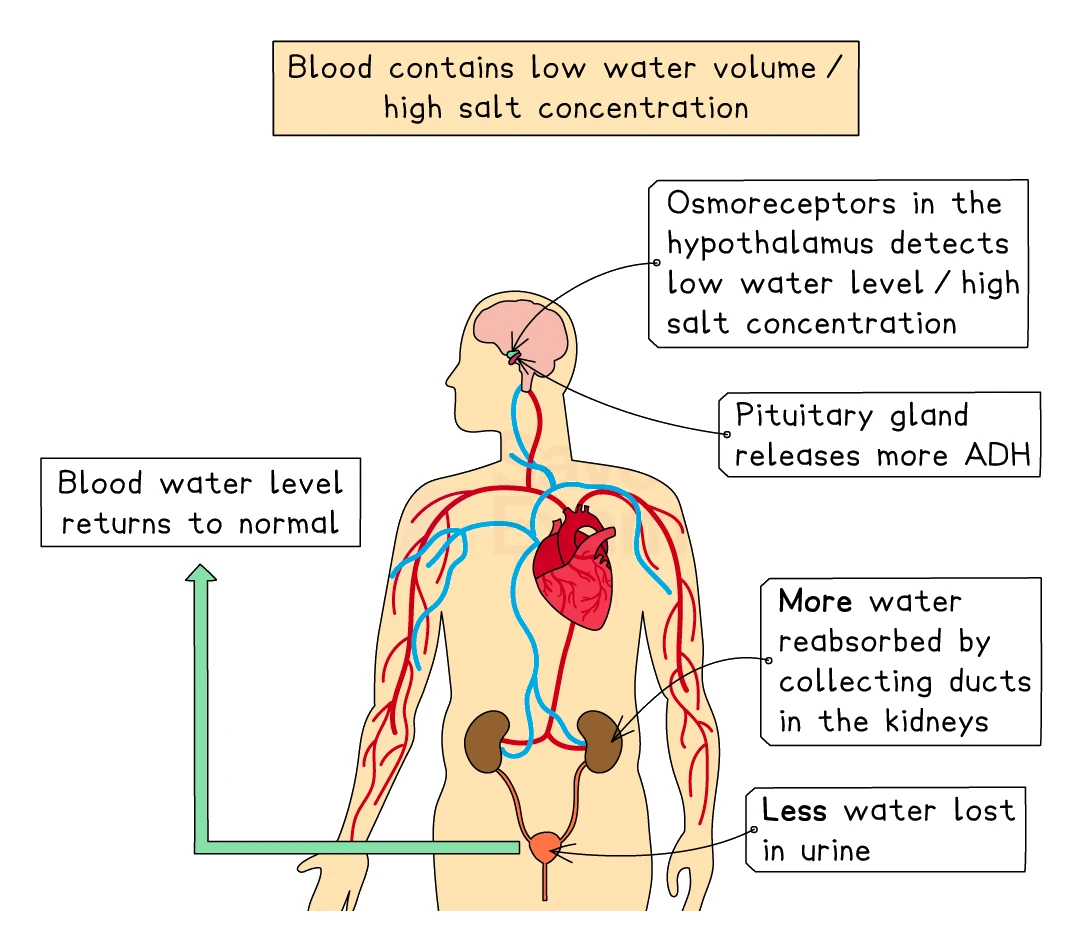
- Detection. Special cells called osmoreceptors in the hypothalamus of the brain monitor the water concentration of the blood as it flows past.
- Signalling. The hypothalamus tells the pituitary gland (just beneath it) to release more or less ADH into the blood.
- Effect on the kidney. ADH circulates to the kidneys, where it changes how permeable to water the walls of the collecting ducts are.
- Reabsorption. With more permeable walls, more water moves out of the filtrate back into the blood, leaving less in the urine. With less permeable walls, less water is reabsorbed and more ends up in the urine.
When blood water is too LOW (dehydrated)
For example, after exercise on a hot day, or after eating a salty meal:
- Osmoreceptors detect that the blood is too concentrated (low water).
- Hypothalamus signals the pituitary to release more ADH.
- ADH makes the collecting ducts more permeable to water.
- More water is reabsorbed from the filtrate back into the blood.
- The body produces a small volume of concentrated, dark yellow urine.
- Blood water rises back to normal. (You also feel thirsty and drink water, which adds more.)
When blood water is too HIGH (over-hydrated)
For example, after drinking a litre of water:
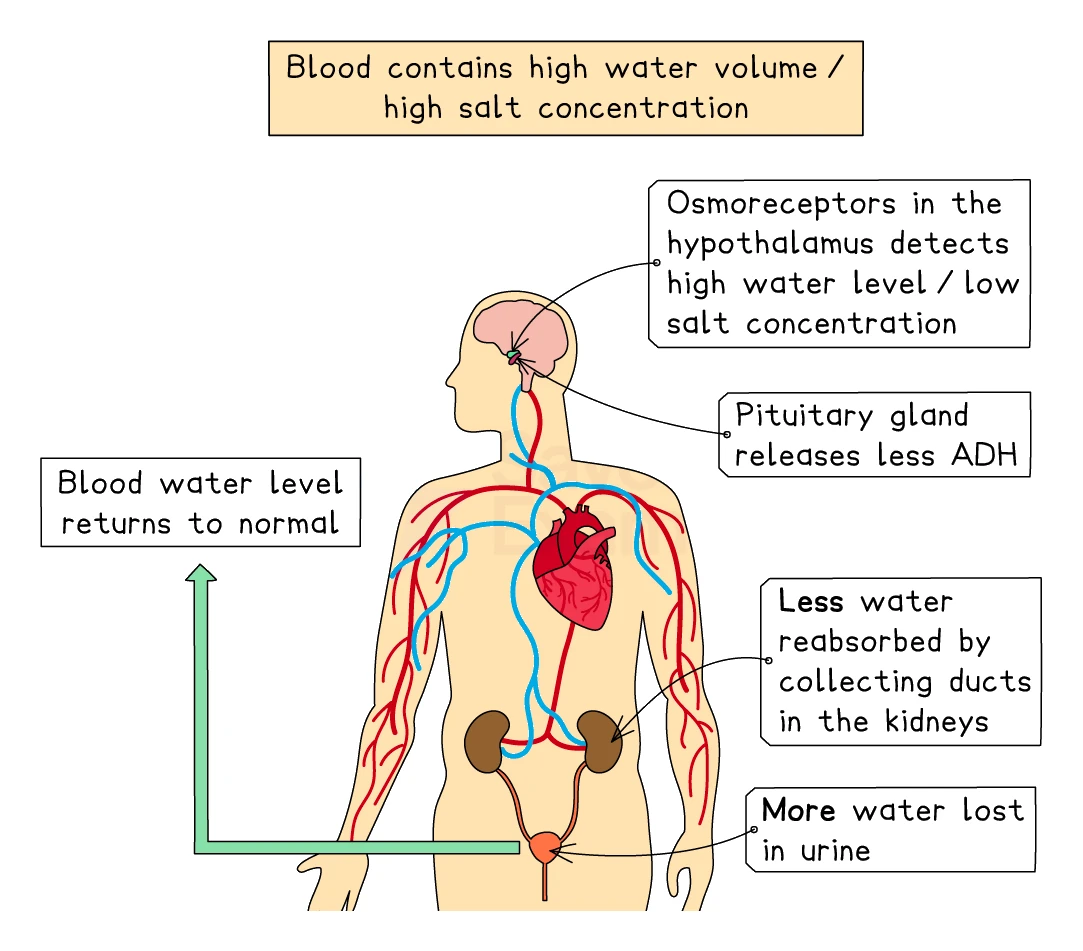
- Osmoreceptors detect that the blood is too dilute (high water).
- Hypothalamus signals the pituitary to release less ADH.
- ADH levels drop. Collecting ducts become less permeable to water.
- Less water is reabsorbed; more passes into the urine.
- The body produces a large volume of dilute, pale yellow urine.
- Blood water falls back to normal.
Key mark-scheme phrase: "ADH increases the permeability of the collecting duct to water." Exam mark schemes expect this exact wording.
Common exam question
Explaining the ADH response to dehydration
Question: Explain the changes in the body when a person is dehydrated (after exercise, a salty meal, or vomiting and diarrhoea) that lead to a small volume of concentrated urine (3–5 marks).
Asked in 6 of the 23 papers. The marks follow the chain, usually one per link: the water content of the blood falls; osmoreceptors in the hypothalamus detect this; the pituitary releases more ADH; ADH makes the collecting duct more permeable to water; so more water is reabsorbed into the blood and less, more concentrated urine is made. Name the collecting duct and say what changes about it: one scheme marks each separately.
If the question compares pure water with an isotonic drink, reverse the chain: blood more dilute, less ADH, less water reabsorbed, so more, paler urine; the isotonic drink's salt and sugar keep the blood at normal concentration. A two-mark describe version wants only the urine: less of it, and more concentrated or darker.