Coordination & Response
Structures and Functions in Living Organisms · 7 question types
Keeping the body's core temperature close to 37 °C is essential because the body's enzymes only work properly within a narrow temperature range. Even a 2 °C swing is potentially fatal. The skin plays a major role in adjusting heat loss to keep core temperature steady.
Temperature receptors in the skin and in the hypothalamus (a region at the base of the brain) detect changes in body temperature. The hypothalamus then coordinates the response, which is carried out by structures in the skin.
When the body is too hot
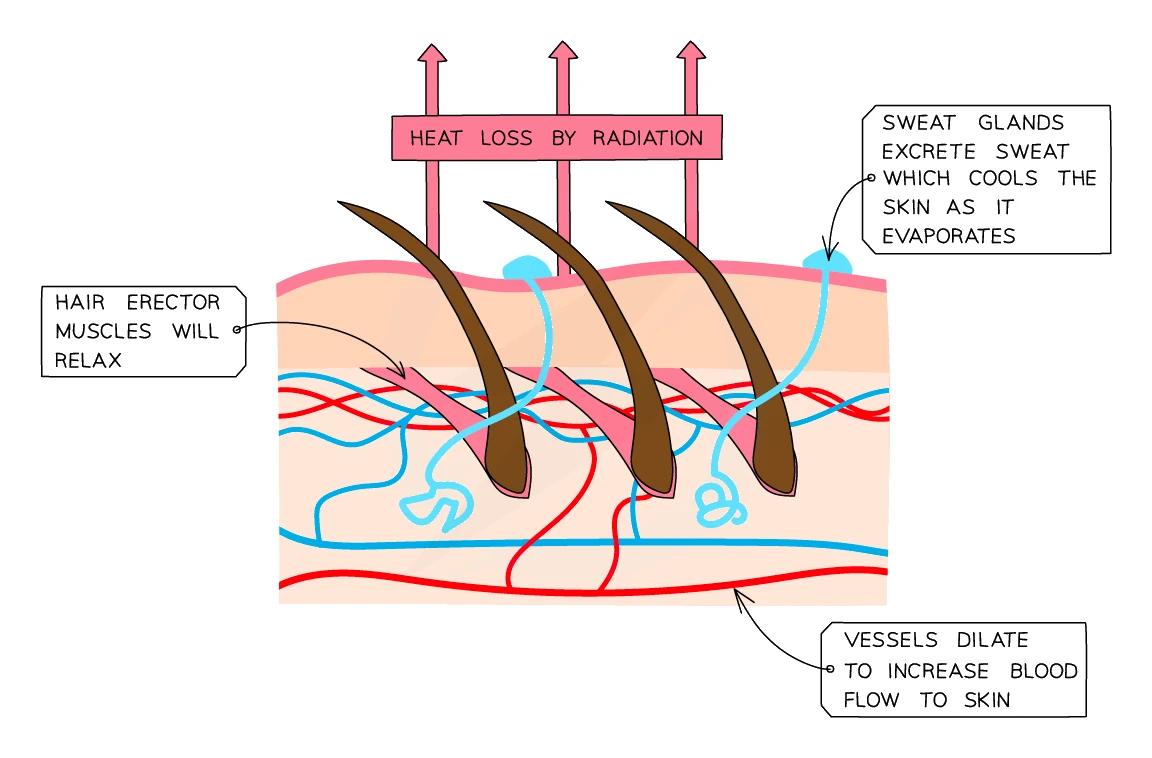
Three cooling mechanisms in the skin:
- of skin arterioles. The small arterioles that supply the surface capillaries widen (because the muscles in their walls relax). This sends more blood close to the skin's surface, where it loses heat to the surrounding air by radiation. The skin looks flushed red.
- Sweating. Sweat glands secrete more sweat onto the skin's surface. Water in the sweat evaporates, taking thermal energy from the body with it as latent heat. The skin cools as it evaporates.
- Hairs lie flat. Hair erector muscles relax, so the hairs lie flat against the skin. Less air is trapped close to the skin, so the insulating layer is thinner and heat can escape more easily.
When the body is too cold
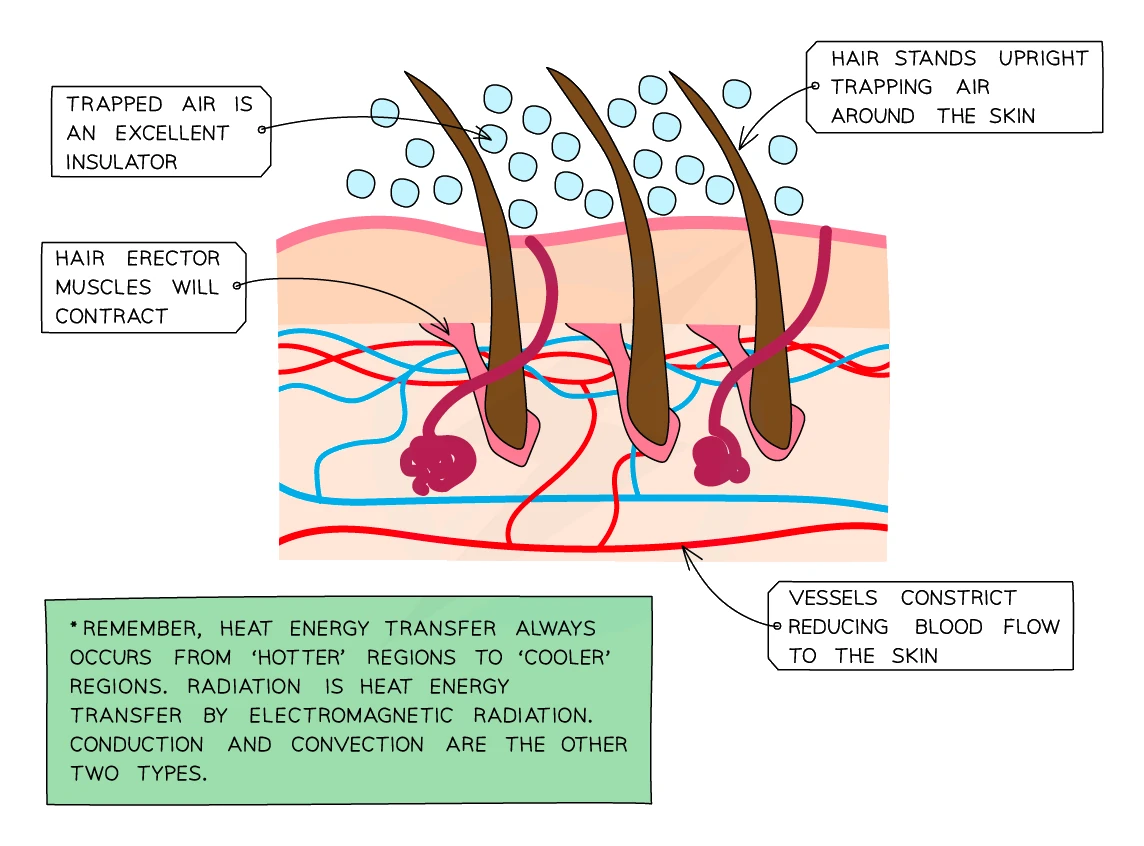
Three warming (or heat-conserving) mechanisms:
- of skin arterioles. The arterioles narrow (their muscles contract), sending less blood through the surface capillaries. Less heat is lost by radiation. The skin looks pale.
- Less sweating. Sweat glands secrete less sweat, so less heat is lost by evaporation.
- Shivering. Skeletal muscles contract and relax rapidly. The contractions need ATP, which is supplied by respiration; respiration releases heat as a by-product, warming the body.
- Hairs stand on end. Hair erector muscles contract, pulling the hairs upright. This traps a layer of air next to the skin. Air is a poor conductor of heat, so the trapped air acts as insulation, reducing heat loss. (We have less hair than most mammals, so this gives "goosebumps" but does not insulate much in humans.)
Note for exams: the Edexcel mark scheme expects students to mention sweating, vasodilation and vasoconstriction by name. Hair erection (goosebumps) is mentioned in the textbook but is not strictly required.
Explaining how the skin responds when body temperature rises
What comes up: "Explain how the skin capillaries regulate body temperature when body temperature increases" (3 marks), or describe the response to overheating.
Write (three marks): (1) Vasodilation occurs: the arterioles supplying the skin surface widen. (2) More blood flows close to the skin surface. (3) More heat is lost by radiation (and/or convection), lowering body temperature.
Watch out: Use the word vasodilation and refer specifically to arterioles widening — the mark scheme rejects "capillaries dilate" and "veins widen." Also include sweating as a separate credited mechanism: sweat evaporates from the skin surface, removing thermal energy from the body.